

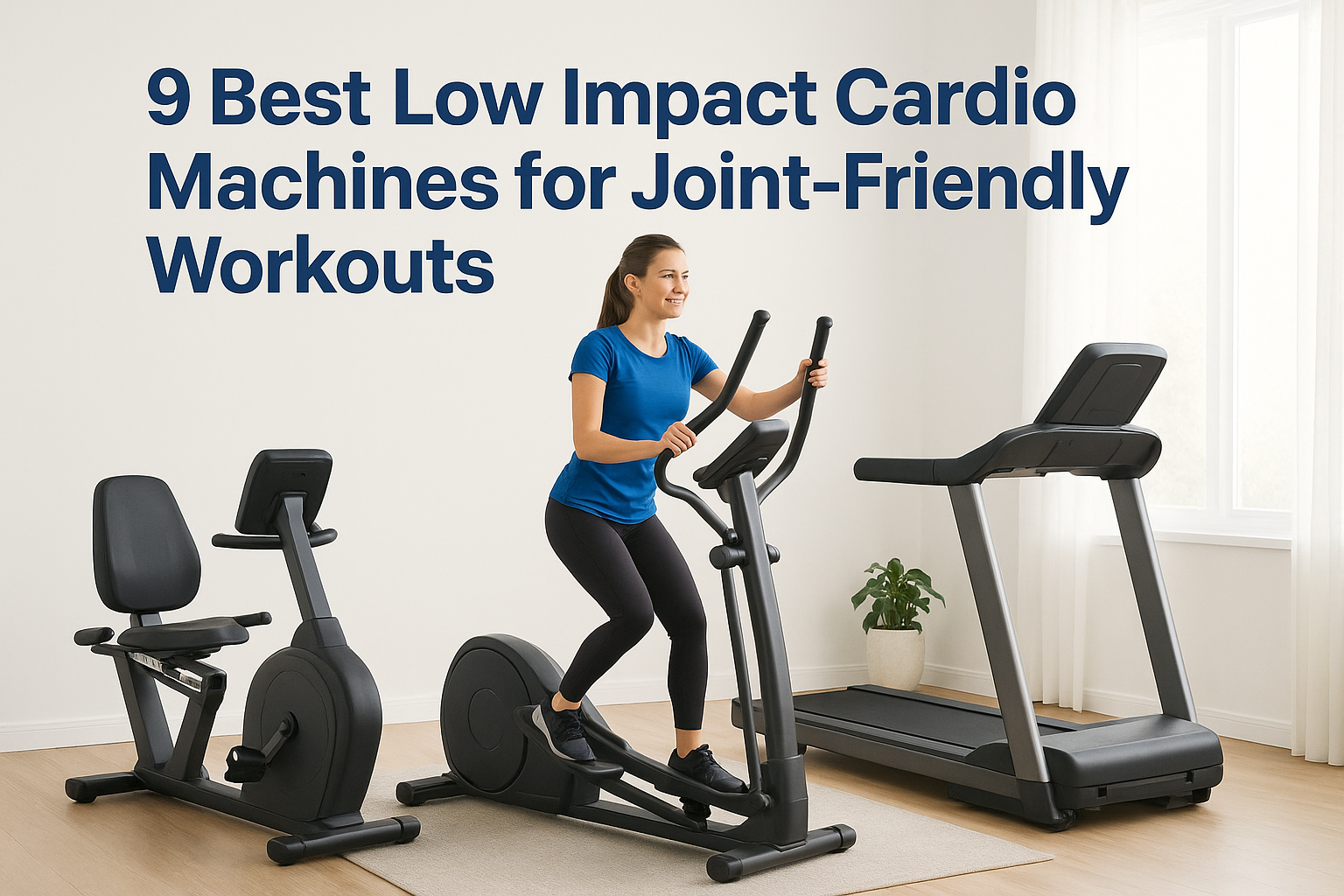
28 Jul 9 Best Low Impact Cardio Machines for Joint-Friendly Workouts
If your knees, hips, or lower back start complaining halfway through a workout, you already know that not every cardio machine treats your joints the same way. Finding the best low impact cardio machines matters more once you’ve dealt with an old injury, arthritis, or just years of wear from running on pavement. The good news is you don’t have to give up cardio, you just have to choose equipment built to move you without pounding your joints.
This guide answers a simple question: which machines let you get your heart rate up while keeping the impact low? We cover recumbent bikes, ellipticals, rowers, and stair steppers, comparing how each one loads your joints differently and who each type suits best, whether you’re recovering from surgery or just training smarter as you age.
We’ve spent years building and testing commercial-grade cardio equipment at 3G Cardio, so we know firsthand what separates a machine that actually protects your joints from one that just claims to. Below, you’ll find nine specific machines worth considering, what makes each one joint-friendly, and the features that matter most when you’re shopping, from stride adjustability to resistance smoothness to console usability.
1. What makes a cardio machine low impact?
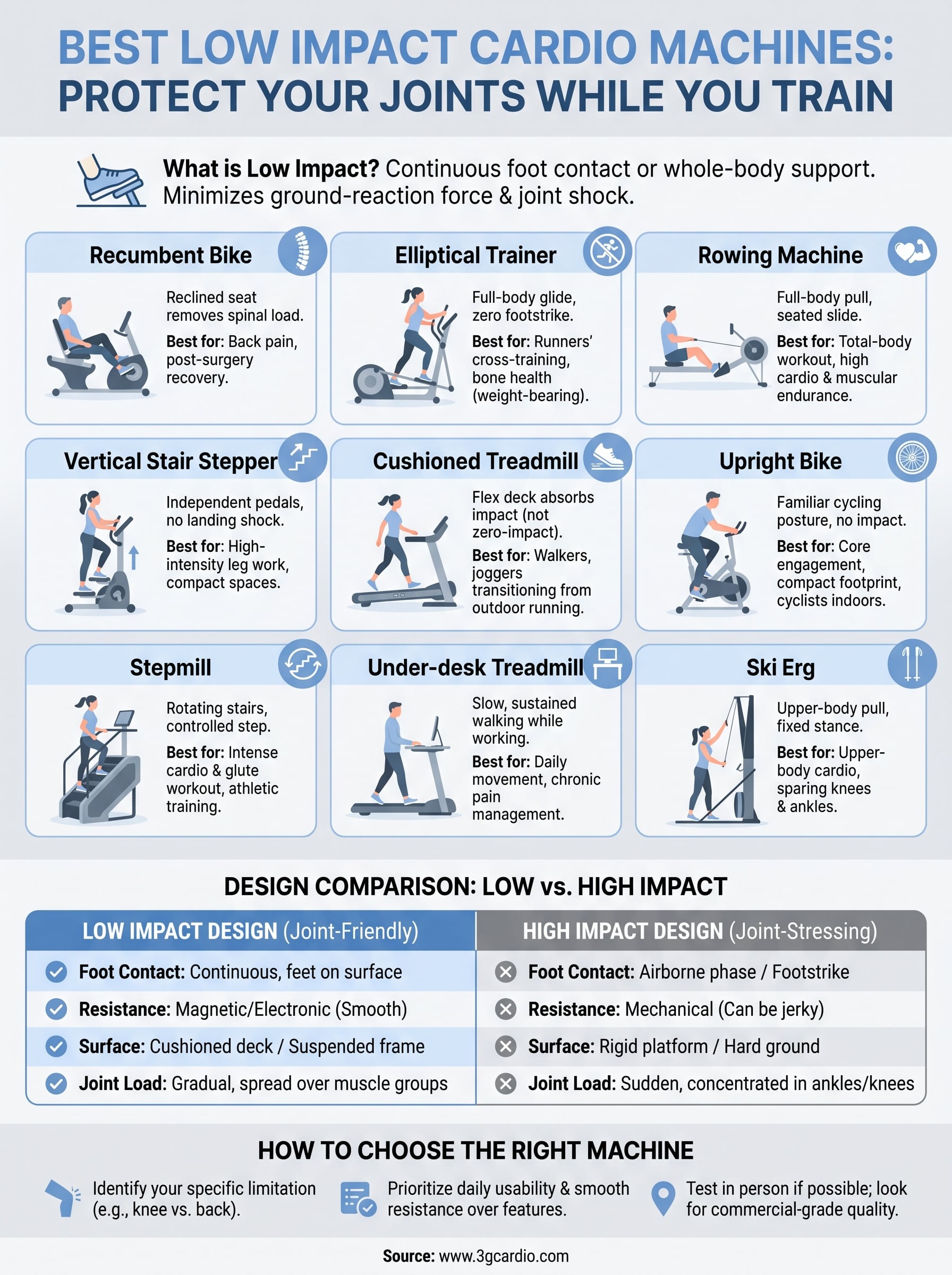
"Low impact" doesn’t mean low effort. It means your body absorbs less ground-reaction force with every rep. When you run outdoors or on a hard treadmill deck, your joints take a jolt equal to two to three times your body weight with every footstrike. A low impact machine either eliminates that jolt entirely, like a recumbent bike, or spreads it out so gradually that your knees, hips, and spine barely notice, like an elliptical or a rowing machine.
A machine is low impact when at least one foot, or your whole body, stays in continuous contact with a moving surface instead of striking a stationary one.
Three design factors determine whether a machine actually delivers on that promise. Fixed foot contact is the biggest one. Ellipticals, recumbent bikes, and stair steppers keep your feet planted on pedals or platforms that move with you, so there’s no airborne phase and no landing shock. Rowing machines go a step further by putting your full body weight on a sliding seat, removing weight-bearing stress from your legs almost entirely.
Resistance type matters just as much. Machines using magnetic or electronic resistance deliver smoother, more consistent load than mechanical friction brakes, which can create sudden jerks that stress your joints mid-stroke. Cushioned or shock-absorbing surfaces round out the list, think a treadmill deck with flex points built into the frame rather than a rigid platform bolted straight to the base.
Here’s a quick way to compare the mechanics side by side:
| Factor | Low impact design | High impact design |
|---|---|---|
| Foot contact | Continuous, feet stay on pedals or belt | Airborne phase between strides |
| Resistance | Magnetic or electronic, adjustable and smooth | Mechanical friction, can feel jerky |
| Surface | Cushioned deck or suspended frame | Rigid platform with no give |
| Joint load | Gradual, spread over larger muscle groups | Sudden, concentrated in ankles and knees |
Once you understand these three factors, you can look at any piece of equipment on a showroom floor or product page and judge for yourself whether the manufacturer’s "joint-friendly" claim actually holds up, rather than taking marketing copy at face value.
2. Recumbent exercise bikes
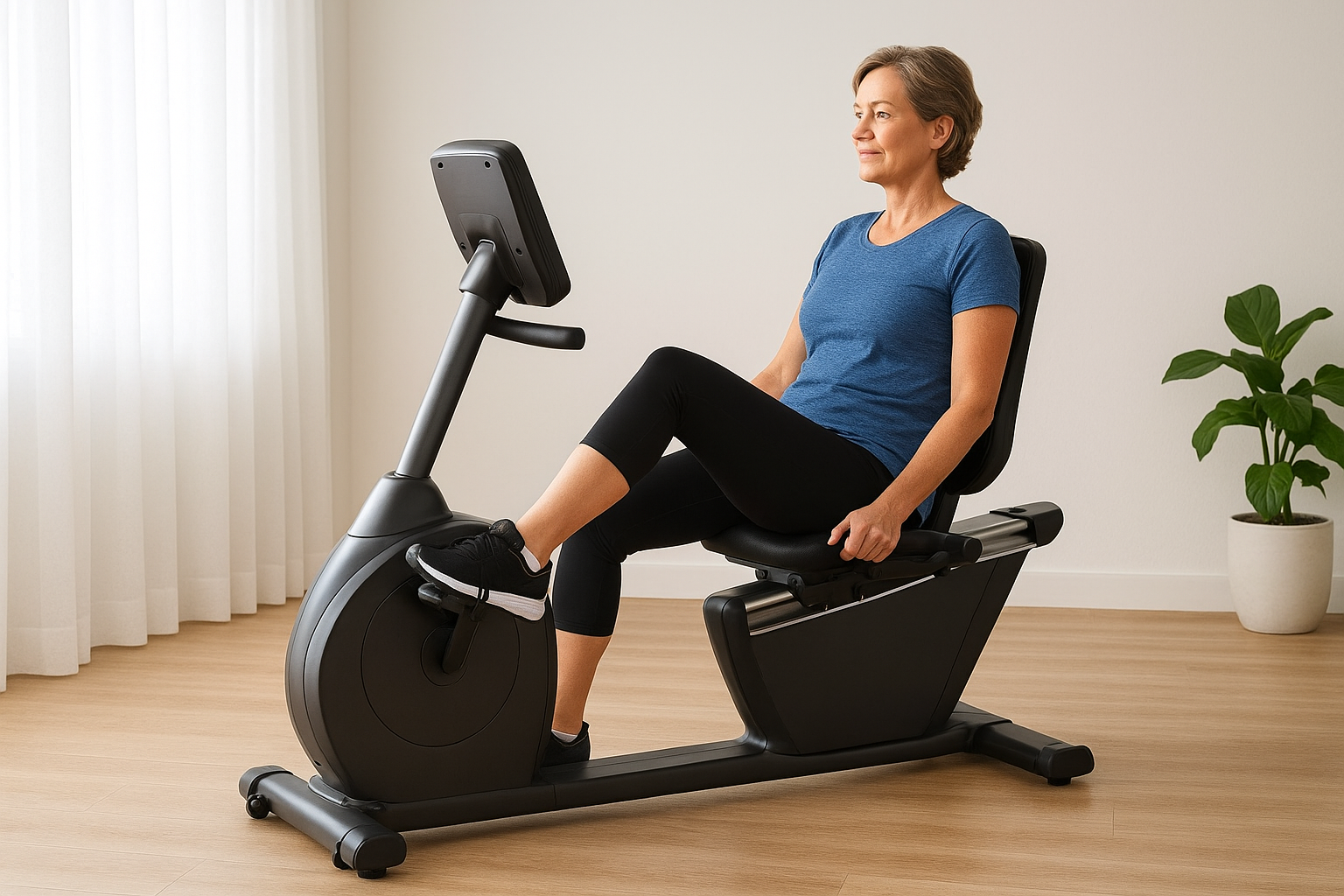
Recumbent bikes put you in a reclined, supported seated position with your legs extended forward instead of underneath you. That single design choice removes almost all compressive load from your spine and hips, making this category the gentlest entry point on our list of the best low impact cardio machines.
How it works
You sit in a bucket seat with back support, feet on pedals positioned in front of you rather than below. The reclined body position takes pressure off your lower back and lets your glutes and hamstrings do more of the work than a traditional upright bike. Resistance comes from a magnetic brake system, which adjusts smoothly without the jerky feel of old friction-belt bikes. Because your feet never leave the pedals and your joints move through a controlled, circular path, there’s zero impact and minimal shear force on your knees.
A recumbent bike is the closest you’ll get to zero-impact cardio while still working your heart and legs hard.
Who it’s for
Recumbent bikes suit people recovering from knee or hip surgery, older adults managing arthritis, and anyone with lower back issues that make upright positions uncomfortable. They’re also a smart choice if you’re deconditioned and need a machine that won’t punish a first attempt at consistent cardio. The back support matters here more than people expect, especially for longer sessions.
Price range
Quality residential recumbent bikes with magnetic resistance and Bluetooth console features typically run $1,999 to $2,999. Consumer Reports named 3G Cardio’s Elite RB X the best recumbent exercise bike of 2025, and models in that tier reflect commercial-grade construction built for daily home use, not entry-level big-box versions that wear out within a year.
3. Elliptical trainers
Elliptical trainers combine a standing posture with a smooth, gliding stride, giving you a full-body workout that mimics running without the footstrike. This machine sits near the top of any best low impact cardio machines list because it lets you stay upright and weight-bearing, which helps with bone density, while still eliminating the jolt of pavement or treadmill running.
How it works
Your feet stay locked onto two pedals connected to a fixed elliptical path, so your knees and ankles move in a fluid oval motion instead of striking a surface. Moving handlebars add an upper-body component, turning the machine into a full-body cardio tool rather than just a leg workout. Resistance and incline adjust electronically on most models, letting you shift the workout from a light glide to a steep, muscle-building climb.
An elliptical lets you train like a runner without ever leaving the ground.
Who it’s for
Ellipticals suit people who miss the feel of running but need to protect their knees, plus anyone wanting a standing workout for bone health that a seated bike can’t provide. They also work well for cross-training athletes managing shin splints or plantar fasciitis, since the fixed pedal path removes repetitive impact from the equation entirely.
Price range
Expect to pay $2,499 to $3,999 for a commercial-grade elliptical with adjustable stride length and electronic resistance. Cheaper models often lock you into one stride length, which limits how naturally the machine matches your body mechanics.
4. Treadmills with cushioned decks
Treadmills get a bad reputation in low impact circles, but that’s only true of rigid, budget models. A cushioned deck with built-in flex points changes the equation entirely, absorbing a meaningful chunk of the shock before it ever reaches your knees. This makes treadmills a viable pick for anyone who wants the familiarity of walking or jogging without the joint punishment of running on concrete.
How it works
Manufacturers build shock absorption into the deck itself, usually with elastomer cushions or a suspended frame that flexes slightly with each footstrike. Combined with a thicker running belt, this setup cuts peak impact force by a noticeable margin compared to outdoor pavement or a hard commercial deck. Adjustable incline lets you raise your heart rate through grade instead of speed, which keeps the workout hard without adding more pounding.
A cushioned deck won’t make running zero-impact, but it can turn a joint-jarring habit into a sustainable one.
Who it’s for
Cushioned treadmills suit walkers and joggers who still want the option to run occasionally, plus anyone managing mild joint sensitivity who isn’t ready to give up impact entirely. They’re a reasonable middle ground for people transitioning away from high impact running toward gentler cardio without abandoning the treadmill format they already know.
Price range
Residential treadmills with genuine cushioned decks and commercial-grade motors typically cost $2,299 to $4,699, depending on motor horsepower, deck size, and console features like Bluetooth connectivity and adjustable cushioning zones.
5. Vertical stair steppers
Vertical stair steppers replicate climbing stairs in place, giving you a demanding lower-body workout without the pounding of running or the outdoor stair pounding that wrecks knees over time. Among the best low impact cardio machines on this list, steppers stand out for burning serious calories in a small footprint while keeping both feet planted throughout the movement.
How it works
You stand on two independent pedals that move vertically, mimicking a climbing motion as you push down against adjustable resistance. Your feet never leave the pedal surface, so there’s no airborne phase and no landing force traveling up through your ankles and knees. Most models use hydraulic or magnetic resistance, letting you control intensity by adjusting how hard you push rather than how fast you move. That distinction matters because it keeps the joint load steady instead of spiking with speed changes.
Vertical stair steppers deliver a leg-burning workout with none of the joint pounding of actual stairs.
Who it’s for
Steppers suit people who want a high-intensity option without impact, including runners cross-training around an injury and anyone targeting glutes, quads, and calves specifically. They also fit smaller spaces well, since the footprint is usually compact compared to a treadmill or elliptical, making them practical for apartments or home gyms with limited room.
Price range
Residential vertical stair steppers with commercial-grade hydraulics and Bluetooth consoles typically run $1,999 to $2,999, putting them among the more affordable entries on this list while still delivering durable, daily-use construction.
6. Rowing machines
Rowing machines put your whole body to work while your seat glides on a track, so your legs, back, and arms share the load instead of your knees taking it alone. Among the best low impact cardio machines, rowers stand out because they build serious cardiovascular and muscular endurance in one motion, without a single footstrike involved.
How it works
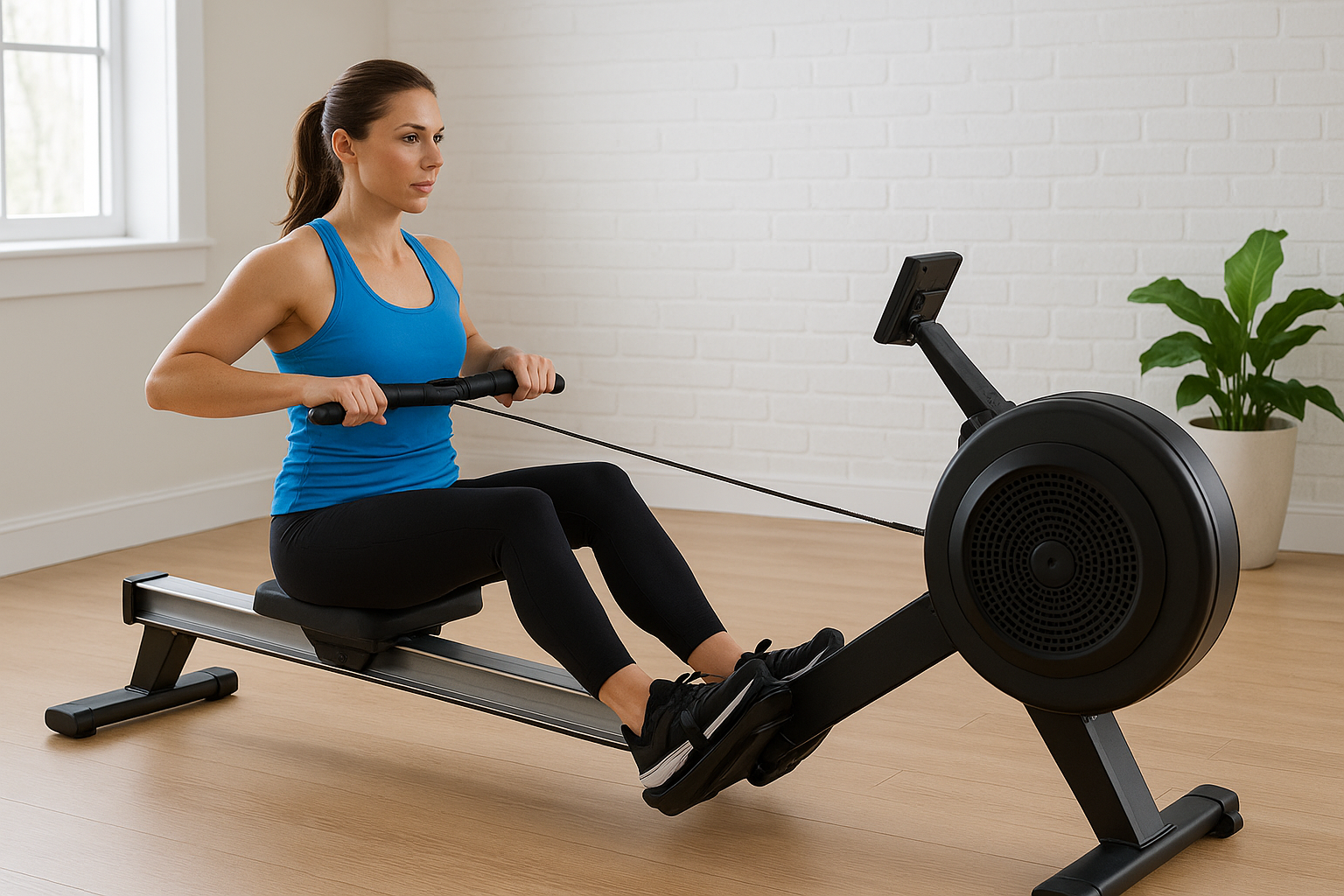
You sit on a sliding seat and drive with your legs first, then pull the handle back with your arms and back in a coordinated stroke. Your feet stay strapped to fixed footplates the entire time, so there’s no impact phase at any point in the movement. Resistance comes from air, magnetic, or water flywheels, and magnetic models tend to feel smoothest for anyone with sensitive joints since the load builds gradually instead of catching abruptly.
Rowing spreads the workload across nearly every major muscle group, which is why it burns calories fast without ever pounding your joints.
Who it’s for
Rowers suit people who want a full-body workout in less time than separate cardio and strength sessions would take. They also work well for anyone with knee or hip limitations who still wants to train hard, since the seated, sliding motion keeps compressive forces to a minimum while still challenging your cardiovascular system significantly.
Price range
Quality rowing machines with smooth magnetic resistance and durable frames generally run from $900 to $2,500, depending on flywheel type, console features, and build quality. Budget models under $500 often use noisy air resistance and flimsy seat rails that wear out faster than sturdier magnetic designs.
7. Upright exercise bikes
Upright exercise bikes look and feel closest to a regular bicycle, with a vertical seated posture and pedals directly beneath you. They sit a step above recumbent bikes on the impact scale because your core and lower back handle more stabilizing work, but they still belong on any list of the best low impact cardio machines since your feet never leave the pedals.
How it works
You pedal in a fixed circular motion while seated upright, gripping handlebars for balance and stability. Magnetic resistance systems adjust the load smoothly, letting you dial intensity up or down without sudden jolts through your knees. Because the pedal stroke stays consistent and controlled, there’s no impact phase at all, just continuous, joint-friendly rotation that still challenges your cardiovascular system.
An upright bike gives you a more athletic posture than a recumbent model while keeping the same zero-impact pedal stroke.
Who it’s for
Upright bikes suit people who want a compact footprint and a more engaged core workout than a recumbent bike offers, without stepping up to full standing impact. They also work well for cyclists maintaining fitness indoors, since the posture mimics road cycling more closely. Anyone with wrist or shoulder sensitivity should check handlebar positioning first, since leaning forward slightly can strain the upper body over long sessions.
Price range
Commercial-grade upright bikes with magnetic resistance and Bluetooth-enabled consoles typically cost $999 to $1,999, making this one of the more budget-friendly categories on this list without sacrificing durability or smooth resistance.
8. Stair climbers and stepmills
Stepmills use a rotating staircase, like a permanently moving escalator, instead of the two independent pedals you get with a vertical stair stepper. That difference puts this machine slightly higher on the impact scale than category five, but it still keeps both feet planted on solid steps, which makes it far gentler than running stairs outdoors or pounding pavement.
How it works
A motorized chain of steps rotates continuously, and you climb at whatever pace matches the belt speed you set. Your foot lands on a stationary stair tread rather than absorbing a footstrike from a jump or stride, so the load stays controlled and predictable. Handrails let you offload some body weight if your knees need it, though leaning too much reduces the calorie burn you’re working for. Because the steps keep moving under you, the cardiovascular demand climbs fast, often faster than a treadmill at a similar perceived effort.
A stepmill trades a bit of the impact stair steppers avoid for a noticeably tougher cardio and glute workout.
Who it’s for
Stepmills suit people who’ve built a base of fitness and want high-intensity training without switching to running or jumping. Firefighters, athletes, and anyone training for hiking or mountaineering often gravitate toward this machine specifically because it mimics sustained climbing.
Price range
Residential stepmills are less common than other categories here, and pricing typically runs from $2,500 to $4,000 for models with a durable motorized chain and a console built for daily use rather than occasional gym visits.
9. Under-desk walking treadmills
Under-desk walking treadmills trade speed and incline for a compact, low-profile deck built for slow, sustained movement while you work. They round out the best low impact cardio machines on this list because they solve a different problem than the rest: not how to work out harder, but how to move more throughout a day that would otherwise be spent sitting.
How it works
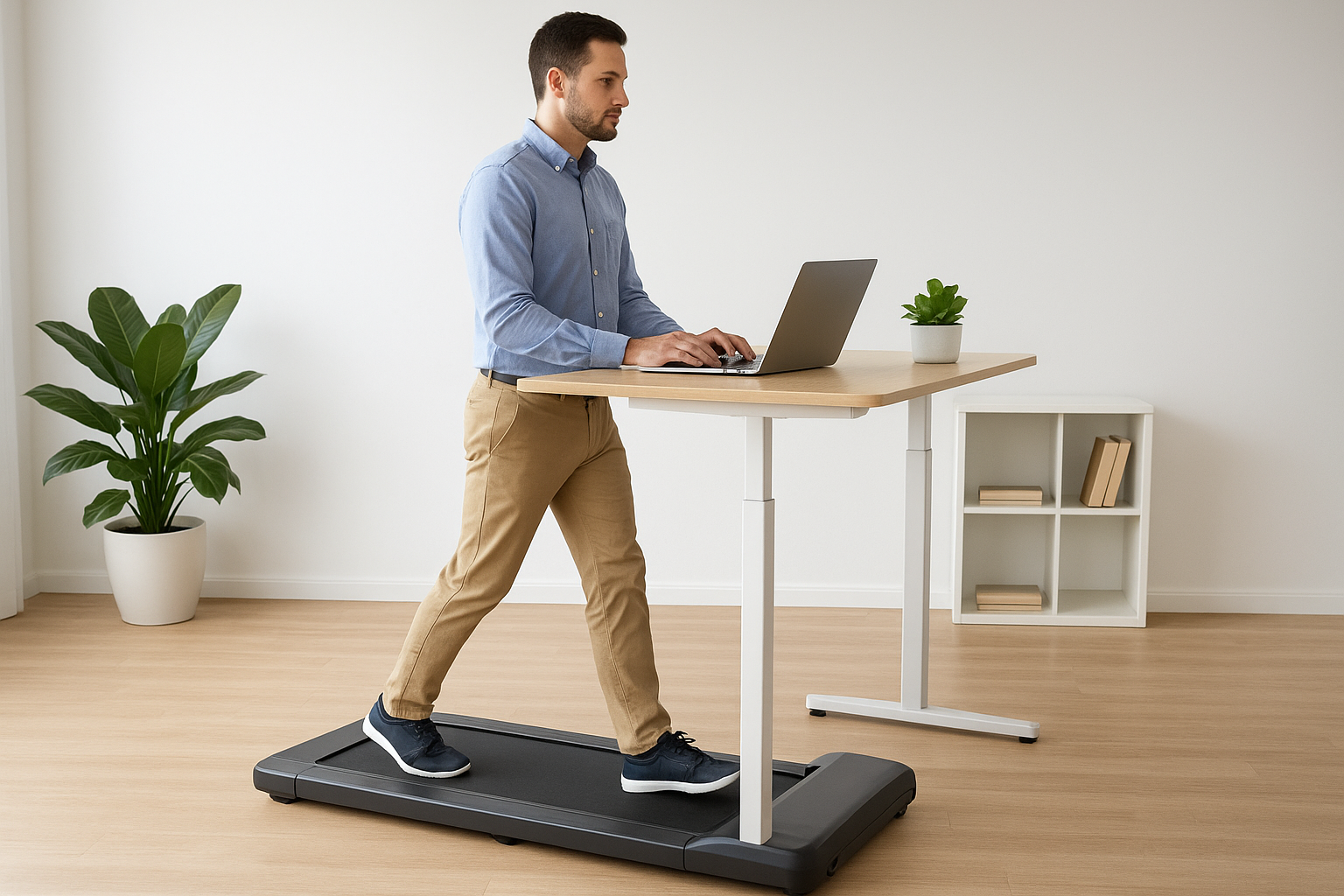
A short, low-clearance deck sits flush to the floor, usually no more than a few inches high, so it slides under a standing desk without forcing you to adjust your setup. Speeds typically top out around 2 to 4 miles per hour, which keeps your stride short and controlled with no bounce or airborne phase. Because you’re walking rather than running, ground-reaction force stays minimal, closer to normal walking than anything resembling a jog. Most consoles are stripped down, often just a speed dial and a display, since the machine is designed to run quietly in the background of your workday.
An under-desk treadmill won’t replace a real cardio session, but it can add hours of gentle movement to a day of sitting.
Who it’s for
This machine suits people managing chronic joint pain who still want daily movement, remote workers looking to counter long sitting hours, and anyone easing back into activity after injury or surgery. It’s not built for anyone chasing a hard cardio workout.
Price range
Under-desk walking treadmills generally cost $300 to $900, well below the other categories here, reflecting their simpler motors and stripped-down consoles built for slow, steady walking rather than demanding daily training.
10. Ski erg machines
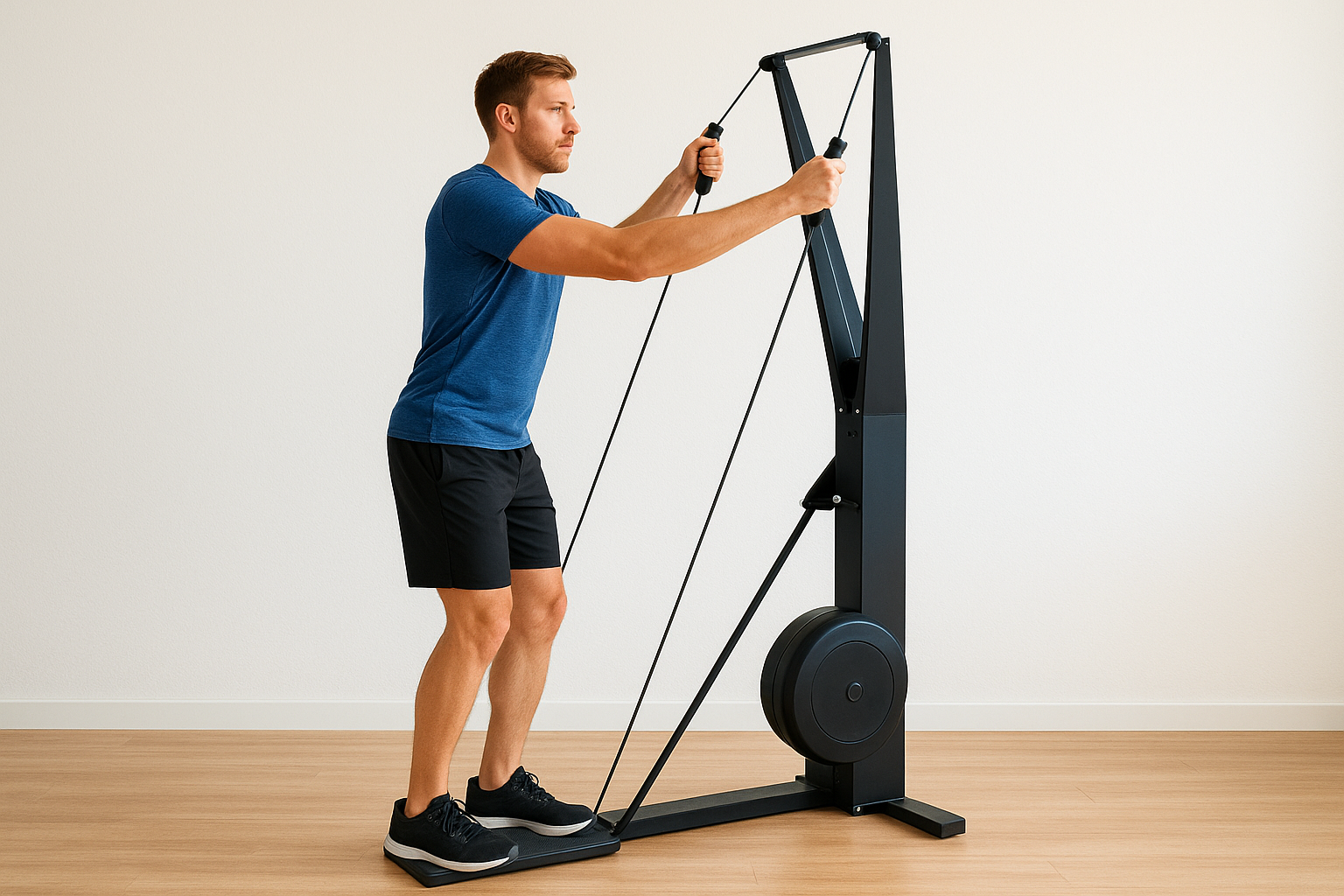
Ski erg machines mimic the double-pole motion of cross-country skiing, standing upright while you pull two independent handles down against resistance. This machine rounds out our best low impact cardio machines list because it hits your back, shoulders, and core hard while keeping your feet planted the entire time, no running, no jumping, no footstrike at all.
How it works
You stand on a small platform with fixed foot placement, gripping two cables attached to a flywheel above your head. Pulling down engages your lats, triceps, and core in a coordinated motion, similar to a rowing stroke but performed vertically instead of seated. Most models use magnetic or air resistance, and the movement pattern means your knees and hips absorb almost no load, since your body weight stays centered over your feet rather than shifting with each stride.
A ski erg turns your upper body into the primary engine, sparing your knees while still spiking your heart rate fast.
Who it’s for
Ski ergs suit people with knee or ankle limitations who still want an intense, sweat-inducing workout, plus cross-country skiers training off-season. They also work well as a complement to lower-body machines like recumbent bikes, giving your legs a rest day while you still train your cardiovascular system hard through your upper body and core.
Price range
Ski erg machines typically cost $700 to $1,500 for residential models with smooth magnetic resistance, making this one of the more affordable specialty options if you’re building a home gym around joint-friendly variety rather than a single all-purpose machine.
11. Low impact vs. high impact cardio: which is right for you
Neither category beats the other outright, but your joints, goals, and training history should decide which one gets more of your weekly schedule. High impact cardio, think running, jump rope, or plyometrics, builds bone density faster because the repeated ground-reaction force signals your skeleton to strengthen itself. It also tends to burn calories quickly and trains your body to handle the jarring movements common in sports like basketball or soccer. That said, high impact training accumulates wear over years, and if you already deal with arthritis, a prior joint injury, or excess body weight, that wear shows up sooner rather than later.
Low impact machines let you rack up training volume without the recovery cost. You can row, cycle, or climb stairs daily without the joint inflammation that comes from running the same mileage on pavement. This matters most for anyone searching for the best low impact cardio machines specifically because they’re managing pain, not just preference.
The best cardio program usually blends both: high impact for bone health when your joints allow it, low impact for volume and recovery days.
Age, injury history, and current pain levels should drive the split. A 30-year-old with healthy knees might run twice weekly and row the rest. A 55-year-old managing knee arthritis might skip running entirely and rotate between a recumbent bike, elliptical, and stair stepper instead.
12. How to choose the right machine for your fitness goals
Start by naming your actual limitation before you shop. If your knees are the issue, a recumbent bike or ski erg removes almost all knee-specific load. If it’s your lower back, the reclined seat on a recumbent bike beats an upright bike or rower, since neither of those keeps your spine as supported. Matching the machine to your specific joint matters more than picking whatever looks impressive in a showroom.
Buy for the joint that hurts, not for the machine that looks the most advanced.
Next, think about how you’ll actually use it week to week. A machine that bores you in three weeks is a bad investment regardless of price, so weigh daily usability against features you’ll rarely touch. Someone managing chronic pain and just trying to move more benefits more from an under-desk treadmill than a stepmill built for athletes.
Run through this checklist before you commit:
- Which joint or condition needs the most protection?
- How much floor space do you actually have?
- Do you want a standing workout for bone density, or a seated one for comfort?
- Does the resistance feel smooth, or does it catch and jerk mid-movement?
- Can the console connect to apps you already use, or does it lock you into a subscription?
- What’s included in the warranty, and does it cover parts and labor separately?
Finally, test the resistance and seat or platform in person if you can. Magnetic resistance systems consistently outperform mechanical friction brakes for comfort, and that difference is easy to feel within thirty seconds on the machine.
13. Frequently asked questions about low impact cardio machines
Can low impact cardio still help you lose weight?
Yes, and the difference comes down to intensity and duration, not impact level. A hard 30-minute session on a rowing machine or elliptical burns calories comparable to jogging, since your heart rate and muscle recruitment matter more than whether your feet leave the ground. Pair consistent sessions with a calorie deficit and weight loss follows the same math it always has.
Is walking on a treadmill considered low impact?
Generally yes, especially compared to running. Walking keeps one foot in contact with the belt at all times, so there’s no airborne phase and minimal ground-reaction force. A cushioned deck reduces the load even further, which is why walking treadmills show up repeatedly on joint-friendly recommendations from physical therapists.
Walking is low impact by nature; running on the same treadmill is not.
How many days a week should you do low impact cardio?
Most people tolerate low impact machines five to six days weekly without extra recovery time, since there’s little inflammatory load compared to running. The American Heart Association recommends at least 150 minutes of moderate cardio weekly, and low impact equipment makes that target easier to hit without joint soreness stacking up.
Do low impact machines still build muscle?
Somewhat, though they’re primarily cardiovascular tools. Rowers and ski ergs add real upper-body and back strength alongside the cardio benefit, while recumbent bikes and steppers lean more toward endurance than hypertrophy.
Finding the right fit for your joints
Your joints don’t need you to quit cardio, they need you to quit the machines that hammer them. Whether that means a recumbent bike for a bad back, an elliptical for cross-training around shin splints, or a stepper for burning calories without knee strain, the right pick comes down to matching the machine to the joint that’s giving you trouble. Skip the equipment that promises everything and delivers wear and tear instead, and build your routine around commercial-grade construction that holds up to daily use without breaking down in a year.
We build our machines around that exact idea: real joint protection, smooth magnetic resistance, and no forced subscriptions to use the features you already paid for. If a recumbent bike sounds like the low impact fit your knees and back have been waiting for, take a look at the Elite RB X recumbent bike and see why it earned Consumer Reports’ top spot in 2025.




No Comments