

24 Jul Cardio Workout Routine for Beginners: A Simple Weekly Plan
Starting a cardio workout routine for beginners feels overwhelming when every article throws out conflicting advice about intervals, heart rate zones, and equipment you don’t own yet. You just want to know what to do, for how long, and how often, without needing a exercise science degree to figure it out. That confusion is exactly why so many people quit before week two.
Here’s the direct answer: beginners need a simple weekly plan built around 3 to 5 sessions of low-impact cardio, starting at 15 to 20 minutes and building gradually as your body adapts. You don’t need to sprint or grind through punishing workouts. Consistency at a moderate pace beats intensity you can’t sustain, and steady progress matters more than any single hard session.
Below, you’ll find a week-by-week breakdown with specific exercises, durations, and rest days built in, plus guidance on picking equipment that actually supports beginner-friendly training. We’ve built machines like the Elite RB X recumbent bike and Elite Runner X treadmill with this exact stage of fitness in mind, so the plan translates directly to real equipment you can use at home.
1. Treadmill walking workouts
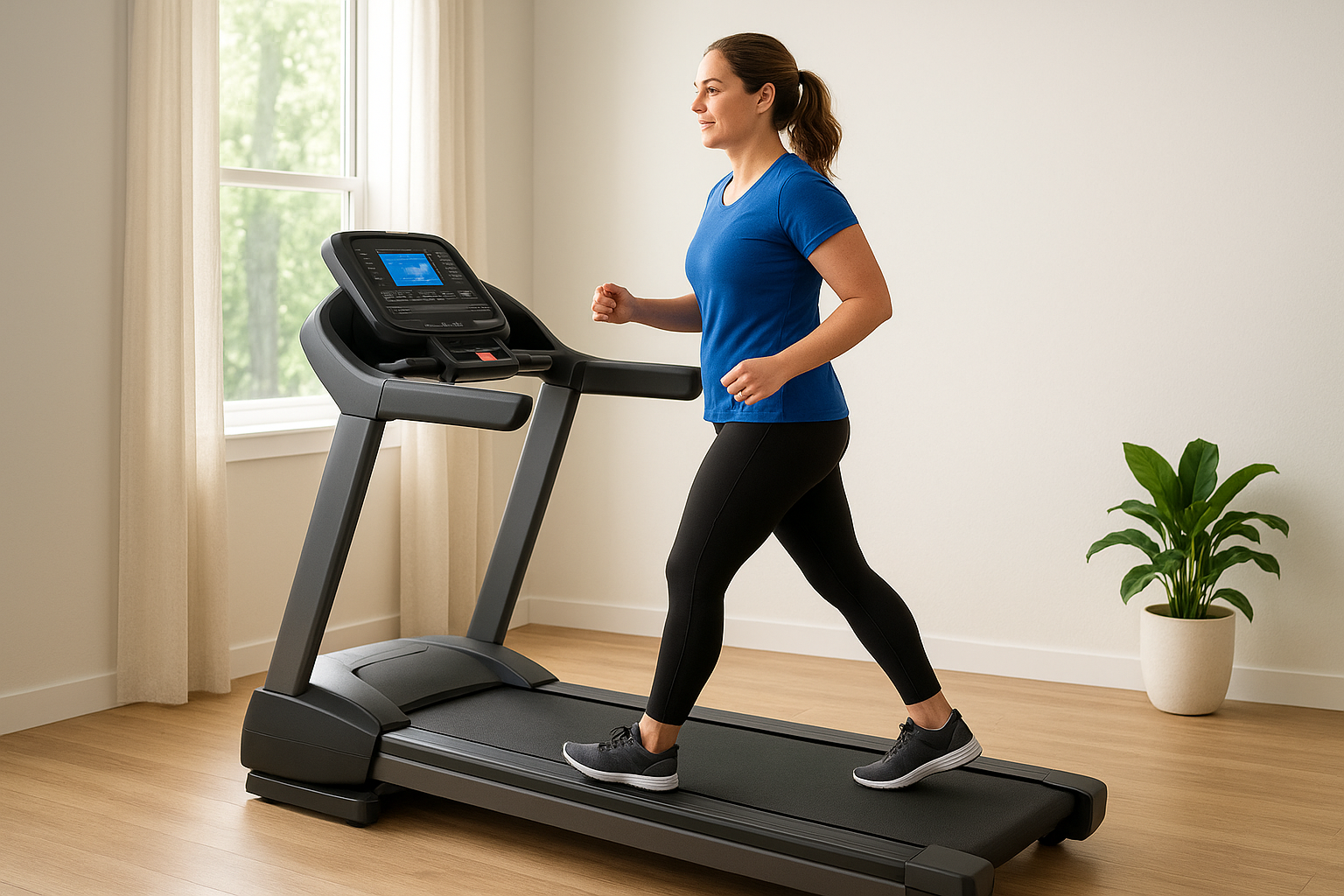
Walking on a treadmill is the most forgiving way to start a cardio workout routine for beginners, and it’s where most people should begin. You control the speed, the incline, and the environment, which means no weather, no traffic, and no guessing about pace. A treadmill also gives you instant feedback through the console, so you can track time, distance, and heart rate without doing math in your head.
How it works
Treadmill walking is low-impact because one foot stays in contact with the belt at all times, unlike running where both feet leave the ground. This keeps stress off your knees and hips while still elevating your heart rate enough to build real cardiovascular fitness. Adding a slight incline, even just 2 to 3 percent, activates your glutes and hamstrings more and burns extra calories without requiring faster speeds. Most beginner-friendly consoles, including the one on our Elite Runner X, let you adjust incline and speed in small increments so you’re never forced into a jump that feels too aggressive.
Who it’s for
This workout suits almost every beginner, especially those who are returning to exercise after a long break, carrying extra weight, or dealing with joint sensitivity. It also works well if you’re the type who wants privacy while you build confidence, since you can do it at home instead of a gym floor. People recovering from a sedentary lifestyle often find treadmill walking the easiest entry point because there’s no coordination curve like there is with dance cardio or swimming.
Treadmill walking removes every excuse, no weather, no traffic, no learning curve, just consistent steps that build real fitness.
Beginner routine & tips
Start at a pace where you can hold a conversation but feel your breathing pick up. That’s usually somewhere between 2.5 and 3.5 mph for most new exercisers. Build from there over four weeks:
- Week 1: 15 minutes, flat incline, 3 sessions
- Week 2: 20 minutes, 1 percent incline, 3 sessions
- Week 3: 25 minutes, 2 percent incline, 4 sessions
- Week 4: 30 minutes, 2 to 3 percent incline, 4 to 5 sessions
Keep your posture upright and avoid gripping the handrails, since leaning on them reduces the calorie burn and throws off your natural gait. Wireless heart rate straps, like the ones included with our treadmills, help you stay in a moderate zone, generally 50 to 70 percent of your max heart rate, without constantly checking a phone. If you want variety without adding impact, try alternating one minute at your base pace with one minute slightly faster for the last 10 minutes of a session once you hit week three. This introduces mild interval work without tipping into the kind of intensity that leads to burnout or injury. Pair your sessions with a fitness app through Bluetooth connectivity if you like structured guidance or want to track progress over time, since seeing weeks of consistent data is often what keeps beginners motivated past the point where most people quit.
2. Recumbent bike cycling
A recumbent bike swaps the upright cycling position for a reclined seat with back support, which takes pressure off your lower back and joints while you pedal. It’s one of the easiest pieces of equipment to slot into a cardio workout routine for beginners because you sit down, buckle in mentally, and start moving without balance concerns or coordination hurdles.
How it works
Because your body weight rests in the seat rather than on your feet or hands, recumbent cycling removes nearly all impact from the joints while still working your quads, hamstrings, and glutes. Resistance levels control the intensity instead of speed, so you can dial in a challenge without worrying about falling or losing form. Our Elite RB X uses magnetic resistance with smooth, incremental adjustments, which means you can find a setting that raises your heart rate without feeling like you’re grinding against a wall. Consumer Reports named the Elite RB X the best recumbent exercise bike of 2025, largely because that resistance curve stays consistent even at low beginner settings.
Who it’s for
Recumbent bikes suit people with knee, hip, or lower back issues who still want a real cardiovascular challenge. Older adults, people carrying extra weight, and anyone recovering from injury tend to gravitate toward this format because the seated position feels stable and forgiving. It also works well for beginners who get bored easily, since the back support and armrests make it comfortable to read, watch something, or use a tablet shelf during longer sessions.
A recumbent bike lets you build real cardio fitness while sitting in a position your joints will actually thank you for.
Beginner routine & tips
Start with resistance level 1 or 2 and pedal at a pace where your legs feel worked but not strained by the end of the session.
- Week 1: 15 minutes, low resistance, 3 sessions
- Week 2: 20 minutes, low to moderate resistance, 3 sessions
- Week 3: 25 minutes, moderate resistance, 4 sessions
- Week 4: 30 minutes, moderate resistance, 4 to 5 sessions
Keep your back flat against the seat and avoid locking your knees at the top of each pedal stroke. Pair the included heart rate strap with Bluetooth connectivity to a fitness app if you want structured coaching without leaving your living room.
3. Elliptical training sessions
An elliptical trainer combines the leg motion of walking with the arm motion of cross-country skiing, all without your feet ever leaving the pedals. That gliding pattern makes it one of the smoothest options for a cardio workout routine for beginners who want a full-body element without the joint pounding of running. You get a wider range of muscle engagement than a treadmill offers, since the moving handlebars pull your shoulders, back, and arms into the work too.
How it works
Ellipticals use a fixed elliptical path for your feet, which mimics the natural motion of walking or running while eliminating the impact phase where your foot strikes the ground. Resistance and incline settings adjust the intensity, similar to a treadmill, but the zero-impact glide means your knees and ankles absorb almost no shock. Our Elite EM X offers adjustable stride lengths, so shorter users and taller users both get a natural, comfortable range of motion instead of being forced into a stride that feels awkward. That stride adjustability matters more than people expect, since a mismatched stride is the top reason beginners feel unstable on an elliptical during their first few sessions.
Who it’s for
Elliptical training suits beginners who want a higher calorie burn than walking provides but still need to protect sensitive knees, hips, or ankles. It also fits people who get bored with repetitive leg-only movement, since engaging your arms through the handlebars breaks up the monotony. If you’ve tried running before and it aggravated an old injury, the elliptical often becomes the bridge that lets you keep working toward that intensity without the setback.
An elliptical gives you a full-body cardio session without a single jarring step.
Beginner routine & tips
Start with light resistance and a stride length that feels natural, not stretched.
- Week 1: 15 minutes, low resistance, 3 sessions
- Week 2: 20 minutes, low to moderate resistance, 3 sessions
- Week 3: 25 minutes, moderate resistance, 4 sessions
- Week 4: 30 minutes, moderate resistance, 4 to 5 sessions
Push and pull the handlebars actively instead of letting them drag your arms along, since that engagement is what separates an elliptical workout from simple leg pedaling. Alternate forward and reverse motion every few minutes once you reach week three to work slightly different muscle groups and keep the session from feeling repetitive.
4. Vertical stair stepper workouts
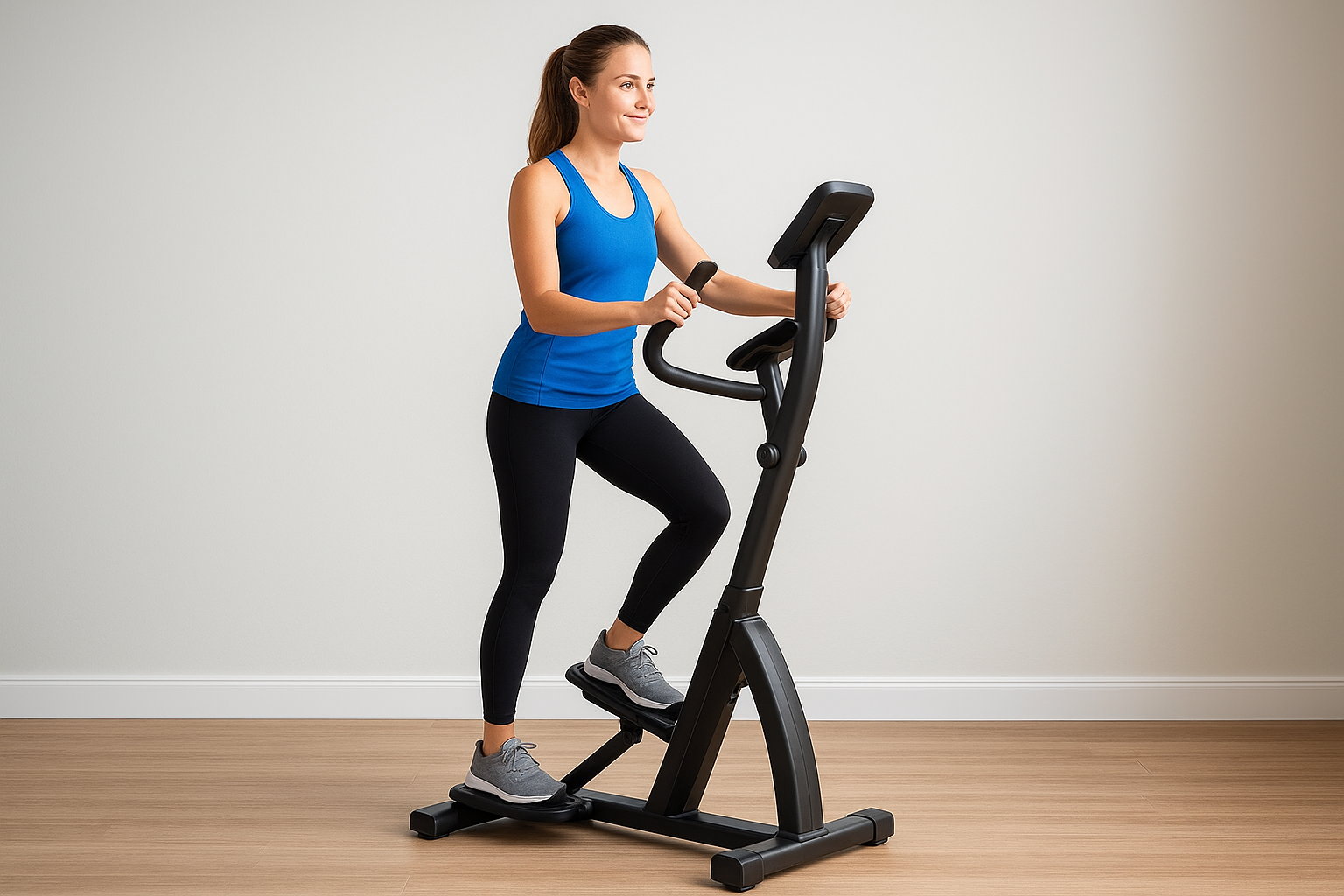
A vertical stair stepper simulates climbing an endless staircase, giving you one of the highest calorie burns available in a cardio workout routine for beginners without any running impact. Unlike a mini stepper that barely moves your legs, a full vertical stepper uses independent pedals that travel a real stepping distance, so your glutes, quads, and calves all work through a genuine range of motion. It’s a tougher entry point than walking or biking, but the payoff in fitness gains comes quickly once your legs adapt.
How it works
Each pedal on a vertical stepper moves independently, so you’re pushing your body weight upward with every step rather than pedaling in a circle or gliding on a fixed path. That vertical resistance recruits more muscle mass per minute than most other cardio machines, which is why sessions feel harder even at shorter durations. Our Elite VS X uses adjustable step resistance, letting you start with a shorter, lighter step and lengthen it as your legs and lungs catch up. Holding the front rails lightly for balance is normal at first, but the goal over time is to rely less on your arms and more on your legs to control the pace.
Who it’s for
Stair steppers suit beginners who already have decent joint health and want to build lower-body strength alongside cardiovascular fitness. It’s a strong fit if you climb actual stairs regularly at home or work and want your training to carry over directly. This machine isn’t the best starting point if you have knee or hip pain, since the stepping motion demands more control than a recumbent bike or elliptical.
A vertical stepper turns ordinary stair climbing into a structured workout that builds both stamina and leg strength fast.
Beginner routine & tips
Start with short, light steps and a slower pace than feels natural, since the machine’s resistance compounds quickly.
- Week 1: 10 minutes, light resistance, 3 sessions
- Week 2: 15 minutes, light to moderate resistance, 3 sessions
- Week 3: 18 minutes, moderate resistance, 3 to 4 sessions
- Week 4: 20 minutes, moderate resistance, 4 sessions
Keep your torso upright instead of leaning on the rails, and focus on pressing through your heels for better glute engagement.
5. Outdoor walking
Outdoor walking costs nothing and requires no equipment, which makes it one of the most accessible entry points into a cardio workout routine for beginners. Fresh air, changing scenery, and natural sunlight give it a mental edge over indoor machines, and for many people, that variety is what keeps a habit alive past the first few weeks. If you already have a treadmill at home, outdoor walking works well as a complementary session for days when you want a change of pace or don’t feel like being indoors.
How it works
Unlike a treadmill, outdoor walking exposes you to natural terrain, which means your stabilizer muscles work harder to handle small changes in ground surface, slope, and camber. That extra demand builds functional strength alongside cardiovascular fitness, something a flat, motorized belt can’t replicate. Weather and route also introduce variables that keep your body guessing, since walking uphill one day and on flat pavement the next changes the intensity without you needing to touch a single setting.
Who it’s for
This format suits beginners who prefer training outside a gym or living room, and it works especially well if you’re motivated by scenery, fresh air, or walking with a friend. Anyone without reliable access to a treadmill can lean on outdoor walking as a free alternative that still builds real fitness. It’s less ideal if you live somewhere with extreme heat, ice, or unreliable sidewalks, since safety and consistency both suffer in those conditions.
Outdoor walking proves that you don’t need a machine to start building real cardiovascular fitness, just a safe route and a willingness to show up.
Beginner routine & tips
Treat outdoor walking with the same structure you’d apply indoors, since progression still matters more than the setting.
- Week 1: 15 minutes, flat route, 3 sessions
- Week 2: 20 minutes, gentle hills, 3 sessions
- Week 3: 25 minutes, mixed terrain, 4 sessions
- Week 4: 30 minutes, mixed terrain, 4 to 5 sessions
Wear supportive shoes, check weather before heading out, and consider a fitness tracker or phone app to log distance and pace so your progress stays visible week to week.
6. Bodyweight cardio circuits
Bodyweight cardio circuits mix moves like jumping jacks, high knees, squats, and mountain climbers into short rounds you can do anywhere, no machine required. This format fits a cardio workout routine for beginners who travel often, work out at odd hours, or simply want a no-equipment option for days when the gym or garage setup feels inconvenient. You get a full-body challenge that raises your heart rate quickly, often faster than walking or cycling, because multiple muscle groups fire at once.
How it works
Circuits work by alternating short bursts of movement with brief rest, so your heart rate climbs during the active portion and recovers slightly before the next round starts. This on-off pattern is what makes bodyweight training so time-efficient, since 15 minutes of circuits can produce a cardiovascular effect similar to a longer steady-state session. Beginners should stick to low-impact variations at first, like marching in place instead of jumping jacks, to keep joint stress manageable while the body adapts to the new demand.
Who it’s for
This workout suits people who like variety and get bored doing the same repetitive motion on a machine. It also works well for anyone without space or budget for equipment, since a bedroom floor or hotel room is enough. Beginners with joint pain should modify carefully, since some circuit moves carry more impact than a treadmill or recumbent bike.
Bodyweight circuits prove that a real cardio workout can happen anywhere, with nothing more than a few feet of floor space.
Beginner routine & tips
Start with 30 seconds of work followed by 30 seconds of rest, repeated through four exercises.
- Week 1: 2 rounds of 4 exercises, 3 sessions
- Week 2: 3 rounds of 4 exercises, 3 sessions
- Week 3: 3 rounds, 40 seconds work, 4 sessions
- Week 4: 4 rounds, 40 seconds work, 4 sessions
Vary your exercises so the same joints don’t take repeated stress every session, and always warm up for a few minutes before starting your first round.
7. Dance cardio
Dance cardio turns choreographed movement set to music into a workout, and it’s one of the few formats where beginners forget they’re exercising because they’re focused on following the steps. This approach fits a cardio workout routine for beginners who find treadmills or bikes tedious and need rhythm and music to stay engaged. You don’t need dance experience, just a willingness to move and laugh at your own missteps while your heart rate climbs.
How it works
Moving through choreographed steps, arm patterns, and directional changes keeps your heart rate elevated through constant motion rather than steady, repetitive strides. Unlike a treadmill, dance cardio recruits your core and coordination muscles alongside your legs, since you’re constantly shifting weight and changing direction. Following along with a video or class also removes the mental load of programming your own workout, since someone else dictates the pace and structure while you focus purely on movement.
Who it’s for
This format suits beginners who respond better to music and group energy than solo machine sessions, and it works especially well if you’ve enjoyed dance, aerobics, or group fitness classes in the past. Anyone who struggles to stay motivated doing repetitive cardio alone often finds dance cardio easier to stick with because the variety keeps boredom away. It’s less suited to beginners with significant balance issues or joint pain, since some routines involve quick directional changes that demand stable footing.
Dance cardio works because it hides the workout inside something fun enough that you forget to watch the clock.
Beginner routine & tips
Start with beginner-level videos labeled low-impact, since many popular routines assume a fitness base you may not have yet.
- Week 1: 15 minutes, low-impact routine, 3 sessions
- Week 2: 20 minutes, low-impact routine, 3 sessions
- Week 3: 25 minutes, mixed intensity, 4 sessions
- Week 4: 30 minutes, mixed intensity, 4 to 5 sessions
Skip the jumps and hops in early sessions by stepping side to side instead, and keep a water bottle nearby since dance cardio tends to feel less like exercise until you notice how much you’re sweating.
8. Swimming laps
Swimming laps gives you a full-body cardio workout with zero impact on your joints, since water supports your body weight the entire time you’re moving. This makes it one of the most complete options for a cardio workout routine for beginners who want to build endurance without pounding their knees, hips, or lower back. Few other formats work your arms, legs, and core simultaneously while keeping your heart rate elevated at the same time.

How it works
Water resistance works against every stroke, so your muscles engage constantly instead of only during specific phases like pushing off a treadmill belt. Buoyancy removes the compressive force gravity normally places on your joints, which is why swimmers rarely develop the overuse injuries common in running. Breathing patterns also train your cardiovascular system differently, since controlled breath timing during strokes builds lung efficiency alongside heart strength.
Who it’s for
Swimming suits beginners with arthritis, joint replacements, or chronic pain who need an option with virtually no impact. It also fits people who overheat easily during land-based cardio, since water keeps your body temperature manageable even during longer sessions. This format works less well if you don’t have consistent pool access or if you’re uncomfortable in water, since building basic stroke technique takes some upfront learning before the cardio benefits kick in.
Swimming lets you build serious cardiovascular fitness without your joints absorbing a single pound of impact.
Beginner routine & tips
Start with a mix of swimming and resting at the wall, since lap swimming demands more coordination than most land cardio.
- Week 1: 10 minutes total pool time, short laps with rest, 2 to 3 sessions
- Week 2: 15 minutes, longer laps, 3 sessions
- Week 3: 20 minutes, fewer rest breaks, 3 sessions
- Week 4: 25 to 30 minutes, continuous laps, 3 to 4 sessions
Focus on freestyle or backstroke first, since both are easier to sustain than breaststroke for new swimmers, and consider a few lessons if your technique feels exhausting rather than smooth.
9. Low-impact interval training
Low-impact interval training alternates short bursts of higher effort with longer recovery periods, all while keeping both feet in contact with the ground or a machine pedal. It’s the most structured entry into a cardio workout routine for beginners who’ve built a base with steady-state walking or cycling and want to add variety without adding joint stress. Think faster treadmill walking mixed with easier recovery paces, rather than sprinting or jumping, which keeps the format accessible even in week one of real training.
How it works
Intervals work by pushing your heart rate up during the work segment, then letting it drop during recovery, which trains your body to clear fatigue faster over time. This on-off pattern builds cardiovascular efficiency quicker than steady pacing alone, since your heart and lungs adapt to handling repeated surges in demand. On a treadmill or recumbent bike, you can create intervals by raising speed or resistance for 30 to 60 seconds, then dropping back down for a minute or two, all without ever leaving a low-impact position.
Intervals let you train harder without training rougher, since the impact stays low even as your effort climbs.
Who it’s for
This format suits beginners who’ve completed a few weeks of steady walking or cycling and feel ready for more challenge. It also fits people short on time, since 20 minutes of intervals can match the cardiovascular benefit of 35 minutes at a steady pace. Skip this approach in your very first week of exercise, since your body needs a baseline of steady effort before intervals make sense.
Beginner routine & tips
Start with a 1:2 work-to-rest ratio and build from there:
- Week 1: 30 seconds faster pace, 90 seconds easy, 6 rounds
- Week 2: 30 seconds faster pace, 60 seconds easy, 8 rounds
- Week 3: 45 seconds faster pace, 60 seconds easy, 8 rounds
- Week 4: 60 seconds faster pace, 60 seconds easy, 8 rounds
Always warm up for five minutes before your first interval, and never chase speed at the expense of form.
Making cardio a habit that lasts
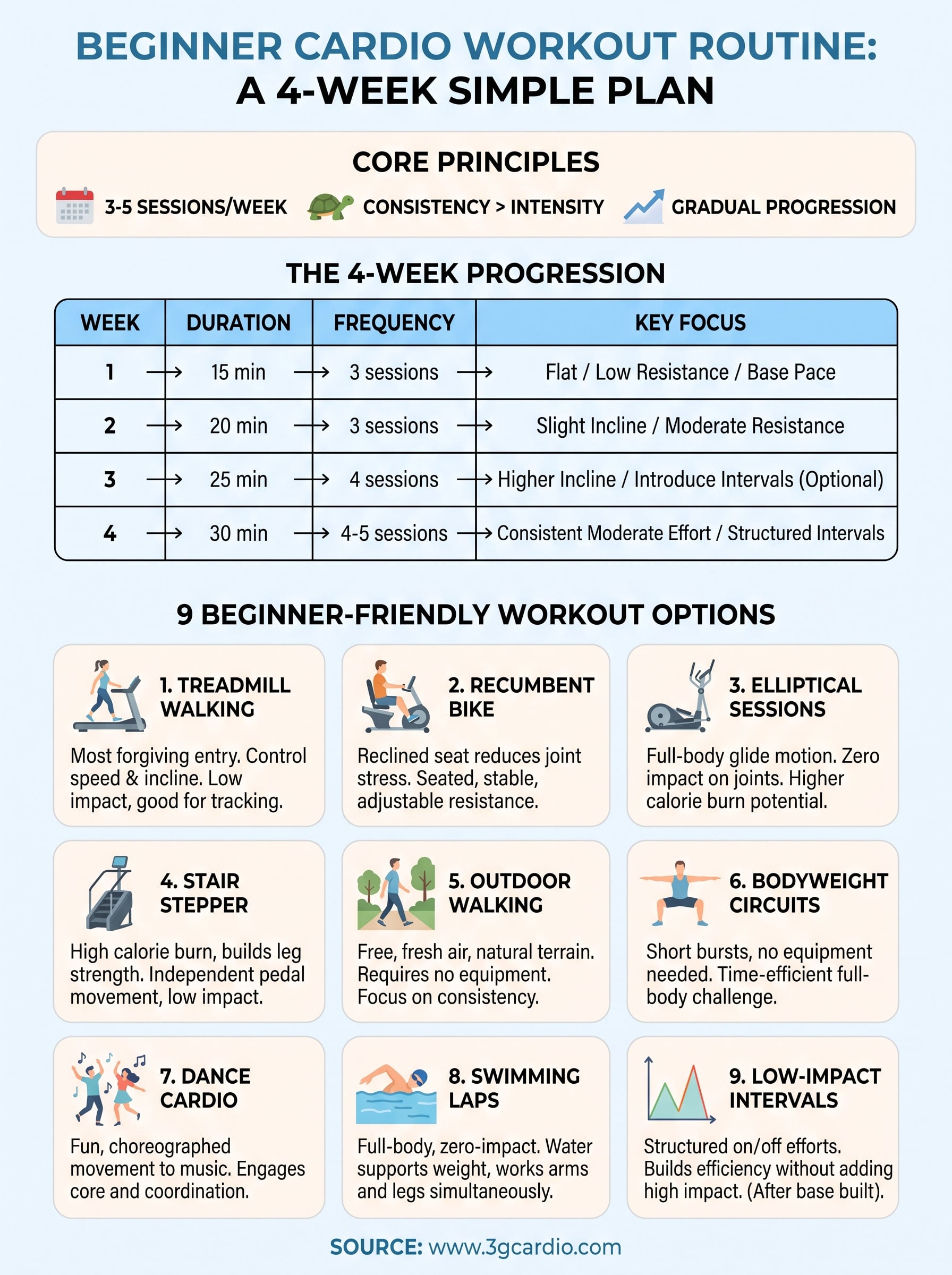
Nine formats, one lesson: the best cardio workout routine for beginners is the one you’ll actually repeat next week. Pick whichever option matches your joints, your schedule, and your patience level, then follow the same four-week progression pattern you’ve seen throughout this guide, starting light, adding minutes gradually, and layering in intervals only once a base exists. Stacking two or three formats, like treadmill walking on weekdays and swimming on weekends, keeps boredom away without complicating your plan.
Don’t chase perfection in week one. Missed sessions happen, weather changes plans, and some days your legs just feel heavier. What matters is showing up again the next day instead of abandoning the whole routine over one skipped workout.
If you’re ready to build that routine on equipment designed for exactly this stage of fitness, browse our recumbent bikes, treadmills, and ellipticals with FreeSync Bluetooth connectivity and find the machine that fits your home and your goals.




No Comments