

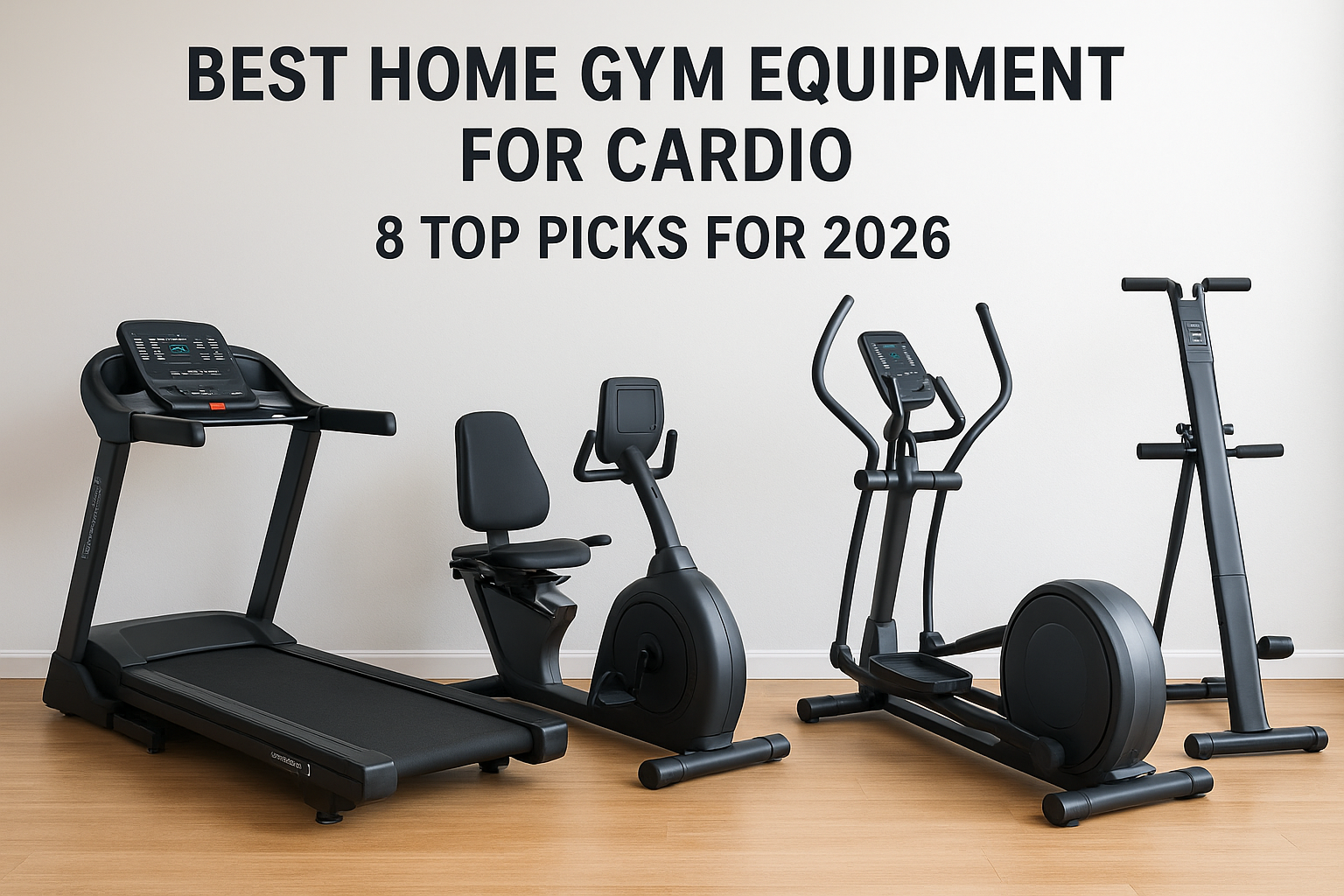
20 Jul Best Home Gym Equipment for Cardio: 8 Top Picks for 2026
Picking the best home gym equipment for cardio gets confusing fast once you start comparing treadmills, bikes, ellipticals, and steppers side by side. Every brand claims commercial quality, every console promises app connectivity, and prices swing from a few hundred dollars to well over four thousand. If you’ve spent an evening with ten browser tabs open trying to figure out which machine actually holds up to daily use, you’re not alone.
This guide cuts through that noise with eight specific picks for 2026, chosen based on build quality, warranty coverage, and how well each machine performs for real home workouts rather than showroom demos. We looked at motor strength, frame construction, stride and resistance range, and whether the equipment connects to apps like Kinomap without locking you into a subscription.
You’ll get a breakdown of treadmills, recumbent bikes, ellipticals, and vertical steppers, with notes on who each machine suits best, from casual walkers to serious interval trainers. We built this list from firsthand knowledge of what separates a machine that lasts fifteen years from one that rattles apart in two, so you can shop with confidence rather than guesswork.
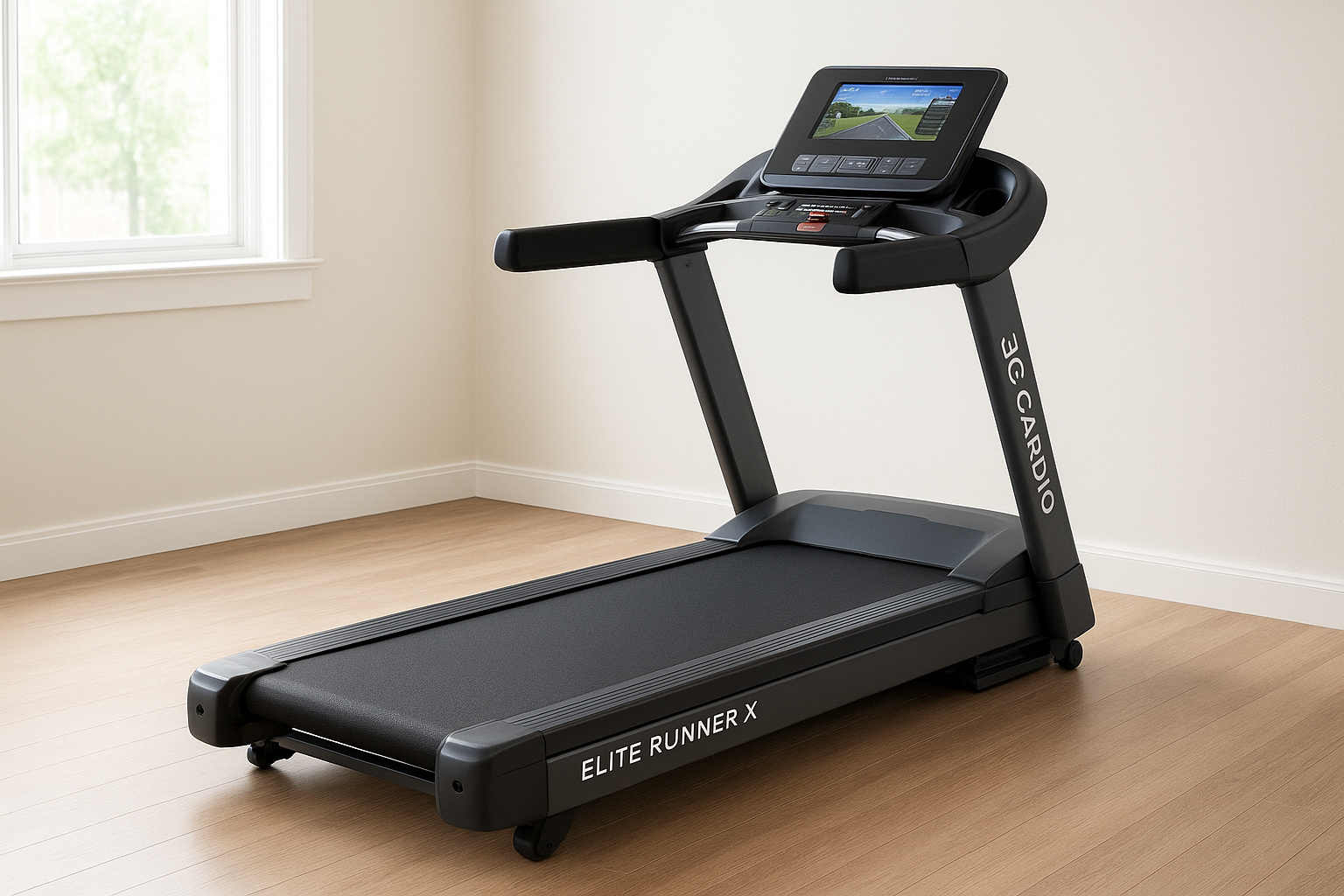
1. 3G Cardio Elite Runner X treadmill
Treadmills sit at the top of most cardio wish lists because they mimic the most natural human movement: walking and running. The 3G Cardio Elite Runner X earns the first spot on this list because it pairs a commercial-grade motor with a suspension system built for daily pounding, not occasional jogs. It’s the machine we point to most often when someone asks what the best home gym equipment for cardio actually looks like once you strip away marketing fluff.
How it works
The Elite Runner X runs on a 4.0 continuous-horsepower motor driving a 22-inch by 62-inch running surface, which gives you enough room to stride out without clipping the edges of the belt. Six shock absorbers under the deck cushion every footstrike, so your knees and hips take less impact than they would on pavement or a thinner budget deck. Incline adjusts up to 15 percent through a quiet, motorized system, letting you simulate hill repeats or steady-state climbs without touching a single button mid-stride.
Speed ranges from 0.5 to 12 miles per hour, which covers everything from a rehab-pace walk to genuine sprint intervals. Bluetooth FreeSync™ FTMS connectivity links the console to apps like Kinomap, Zwift, and other FTMS-compatible platforms, so the treadmill adjusts speed and incline automatically based on the virtual terrain you’re running. That’s a meaningful upgrade over treadmills that only display your stats without ever talking back to the software.
A treadmill only earns its price tag if the motor and deck can handle years of daily miles without slowing down.
Who it’s for
This treadmill suits people who run or walk most days of the week and want a deck that won’t wear out after eighteen months. Runners training for 5Ks, half marathons, or just maintaining base mileage through winter will notice the difference in cushioning compared to lighter home models. It also works well for households with more than one user, since the frame handles a 400-pound weight capacity and doesn’t develop the wobble you get with lower-end machines once multiple people put miles on it.
Walkers recovering from injury or managing joint issues benefit from the low starting speed and adjustable incline, which let a physical therapist or trainer build a progressive program without needing a separate machine for slow-paced work. If your home fitness plan revolves around consistency rather than occasional use, this is the treadmill built for that kind of wear.
Key features to look for
When you’re comparing this treadmill against other home models, focus on the specs that actually predict longevity and usability rather than console graphics:
- Motor size: 4.0 CHP handles daily running better than the 2.5-3.0 CHP motors common in budget treadmills
- Deck cushioning: Six-point shock absorption reduces joint stress over thousands of miles
- Running surface: 22" x 62" gives taller users and runners room to stride naturally
- Connectivity: FreeSync™ FTMS Bluetooth links to third-party apps without a mandatory subscription
- Warranty: Lifetime frame, 7-year parts, and 1-year labor coverage on residential use
- Weight capacity: 400 pounds supports multiple users and heavier training loads
These details matter more than screen size or touch-panel design, since motor and deck quality determine whether the machine still runs smoothly in year seven.
Price range
The Elite Runner X typically sells for around $3,499 to $3,999, depending on current promotions and delivery options. That price includes free curbside delivery, and White Glove delivery with installation is available for an added fee if you’d rather skip the assembly. Financing through PayPal Credit offers 6 months at 0% interest, which makes the upfront cost easier to manage without paying interest on the purchase. Given the commercial-grade components inside, that price sits well below what you’d pay for comparable motor and deck specs from big-box treadmill brands carrying similar warranties.
2. 3G Cardio Elite RB X recumbent bike
Recumbent bikes solve a problem a lot of home gym shoppers don’t think about until their knees or lower back start complaining: upright bikes and treadmills put pressure on joints that recumbent seating simply removes. The 3G Cardio Elite RB X made headlines when Consumer Reports named it the best recumbent exercise bike of 2025, and after putting it through daily use, that ranking holds up. It’s a strong answer for anyone searching for the best home gym equipment for cardio who wants a lower-impact option that doesn’t feel like a compromise.
How it works
The Elite RB X uses a self-powered generator drive system, meaning it doesn’t need to be plugged into a wall outlet to run the console or resistance magnets. Twenty resistance levels give you a wide enough range to move from a light recovery ride to a genuinely tough interval session without upgrading equipment later. The seat adjusts to fit riders from roughly 4’10" up to 6’8", and the recumbent frame puts your hips lower than your knees, which takes strain off the lower back compared to upright cycling.
A wireless heart rate strap comes included, feeding data straight to the console so you can train in a specific heart rate zone instead of guessing. FreeSync™ FTMS Bluetooth connects the bike to Kinomap and other compatible apps, letting resistance adjust automatically as you ride virtual routes.
A recumbent bike earns its keep when the seat, drive system, and resistance range work together to make long rides comfortable, not just tolerable.
Who it’s for
This bike suits riders dealing with knee, hip, or back issues who still want a demanding cardio option. It also works well for older adults or anyone returning to exercise after a layoff, since the seated position removes the balance concerns that come with upright bikes or treadmills. Households with multiple riders of different heights benefit from the wide seat adjustment range, and the step-through frame design makes getting on and off easier than it is on most upright models.
Key features to look for
Here’s what actually separates a durable recumbent bike from one that feels flimsy after a year:
- Drive system: Self-powered generator drive means no outlet dependency and quieter operation
- Resistance levels: 20 levels give enough range for both recovery rides and hard intervals
- Seat adjustability: Wide range accommodates riders from under 5 feet to over 6.5 feet
- Heart rate monitoring: Included wireless chest strap beats grip sensors for accuracy
- Connectivity: FreeSync™ FTMS Bluetooth without forced subscription fees
- Warranty: Lifetime frame with 7-year parts and 1-year labor on residential units
Price range
The Elite RB X generally runs between $1,999 and $2,499, making it one of the more accessible entries on this list. Free curbside delivery is standard, with White Glove delivery and installation available for those who’d rather not assemble it themselves. Financing through PayPal Credit at 0% for six months applies here too, and the price matching guarantee within six months of purchase protects you if the cost drops shortly after you buy.
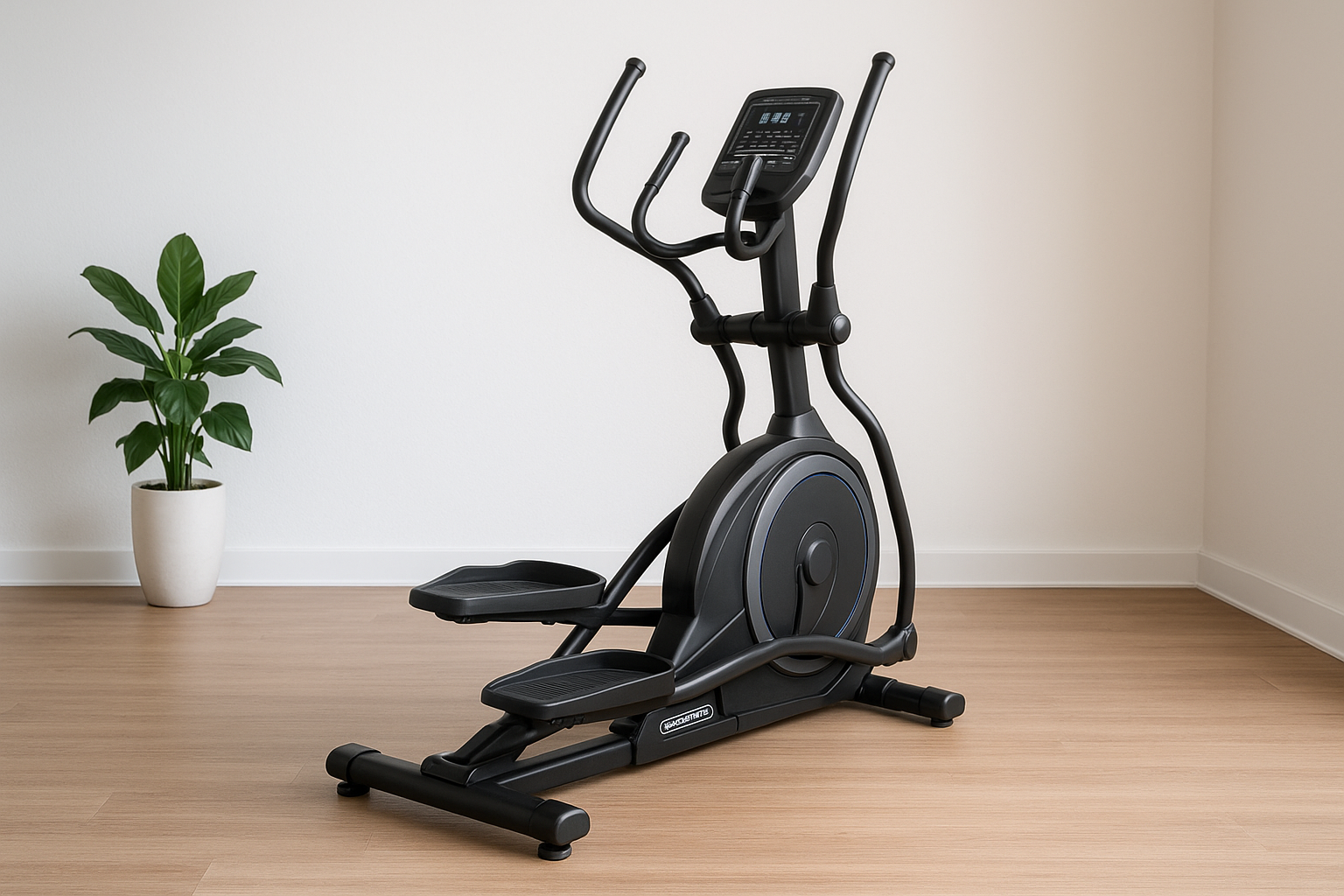
3. 3G Cardio Elite EM X elliptical trainer
Ellipticals fill the gap between treadmills and recumbent bikes, giving you a full-body, low-impact motion that still torches calories the way running does. The 3G Cardio Elite EM X stands out because it doesn’t skimp on stride length or resistance the way a lot of home ellipticals do once you get past the display screen. For readers weighing the best home gym equipment for cardio against joint concerns, this machine deserves a serious look.
How it works
The Elite EM X uses a 20-inch adjustable stride length, which lets taller users get a natural, full extension instead of the cramped, choppy motion common on shorter home ellipticals. A heavy flywheel drives the resistance, and 20 magnetic resistance levels let you dial in anything from an easy recovery session to a climb steep enough to spike your heart rate fast. Moving handlebars engage your arms and shoulders along with your legs, so you’re working more muscle groups per minute than you would on a bike or treadmill alone.
A built-in wireless heart rate strap ships with the machine, syncing to the console so you can train by zone rather than feel. FreeSync™ FTMS Bluetooth connects the Elite EM X to Kinomap and other compatible apps, letting resistance shift automatically as the terrain on screen changes.
An elliptical only delivers on its low-impact promise when the stride length actually fits your body instead of forcing a shortened, awkward gait.
Who it’s for
This elliptical suits people who want a demanding cardio workout without the joint pounding that comes from running. Taller users especially benefit here, since a lot of budget ellipticals cap stride length around 18 inches, which feels cramped for anyone over 5’10". It also works well for households mixing fitness levels, since the wide resistance range lets a beginner and a trained athlete both get a real workout on the same machine without adjustments beyond the console.
Key features to look for
Compare these specs before buying any elliptical, since screen features rarely predict how the machine holds up:
- Stride length: 20 inches accommodates taller users better than shorter, budget strides
- Resistance levels: 20 magnetic levels cover recovery days through serious interval work
- Flywheel weight: Heavier flywheels produce smoother, more consistent motion
- Heart rate monitoring: Included wireless strap beats built-in handlebar sensors
- Connectivity: FreeSync™ FTMS Bluetooth without mandatory subscription costs
- Warranty: Lifetime frame, 7-year parts, 1-year labor on residential use
Price range
The Elite EM X typically sells between $2,499 and $2,999, depending on promotions running at the time. Free curbside delivery comes standard, and White Glove delivery with full installation is available if you’d rather not assemble a machine this size yourself. The same 0% financing through PayPal Credit for six months applies, and the price matching guarantee covers you if you spot a lower price within six months of your purchase date.
4. 3G Cardio Elite VS X vertical stair stepper
Stair climbing burns more calories per minute than almost any other cardio motion, and the 3G Cardio Elite VS X brings that intensity into a home gym without the bulk of a full staircase machine. Gym-goers who used to hit the StairMaster before every leg day often struggle to replicate that burn at home, and this vertical stepper closes that gap. If you’re comparing the best home gym equipment for cardio for pure calorie burn per square foot, this machine belongs on your shortlist.
How it works
The Elite VS X uses independent pedals that move vertically rather than in a circular or elliptical path, so your legs perform a genuine climbing motion instead of a gliding one. Twenty resistance levels adjust hydraulic cylinders under each pedal, letting you control how much force each step demands, from a light warm-up pace to a leg-burning climb that gets your heart rate up in under two minutes. Handlebars stay stationary in front of you for balance, which keeps the focus on your legs and glutes rather than turning it into an upper-body workout.
The console tracks steps, floors climbed, calories, and time, and it pairs with a wireless heart rate strap included in the box. FreeSync™ FTMS Bluetooth connectivity lets the stepper sync with Kinomap and other compatible apps, though the simplicity of the movement means most users rely on the console readouts more than a screen.
A vertical stepper works because it forces your legs to fight gravity directly, not glide around it.
Who it’s for
This machine suits people short on space who still want serious intensity, since the footprint is smaller than a treadmill or elliptical. It’s a strong fit for anyone training for hiking, skiing, or sports that demand glute and quad endurance, and for home gym owners who already have a bike or treadmill and want a second machine that hits different muscles. It’s less suited to anyone with knee or hip issues that make deep, repeated flexion uncomfortable, since the climbing motion is more demanding than recumbent cycling.
Key features to look for
Look past the console and check these specs before buying any vertical stepper:
- Pedal resistance system: Hydraulic cylinders with 20 levels give you real range from warm-up to max effort
- Step height and range: Deeper pedal travel builds more glute and quad engagement per step
- Footprint: Compact base fits apartments and smaller home gyms
- Heart rate monitoring: Included wireless strap for accurate zone training
- Warranty: Lifetime frame, 7-year parts, 1-year labor on residential units
Price range
The Elite VS X typically runs between $2,499 and $2,999, with free curbside delivery standard and White Glove installation available for an added fee. The same six-month 0% financing through PayPal Credit applies, and the price matching guarantee covers you if a lower price shows up within six months of purchase.
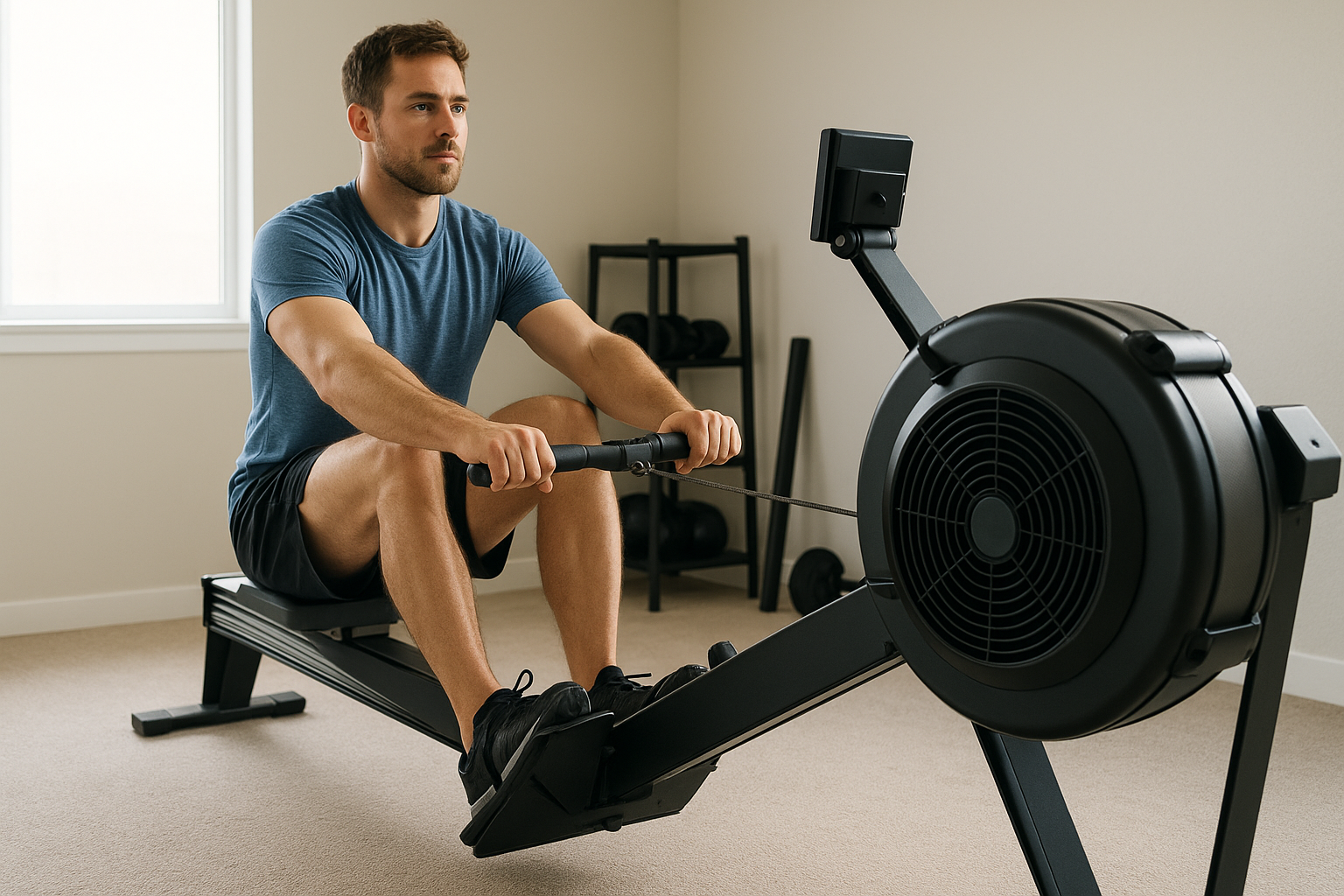
5. Rowing machines
Rowing machines earn their spot on this list because no other cardio machine works your back, legs, and arms in a single stroke. A rower turns cardio into a full-body strength endurance session, which is why physical therapists and CrossFit coaches both reach for the same equipment. If you’re building out a home gym for cardio and want something that trains more than your legs, a rowing machine deserves serious consideration alongside dedicated treadmills and bikes.
How it works
Every stroke breaks down into a leg drive, a lean back through the core, and a pull with the arms, then a controlled return to the catch position. Resistance comes from one of four systems: air, magnetic, water, or hydraulic pistons, and each produces a different feel. Air rowers get harder the faster you pull, which rewards power output. Magnetic rowers stay quiet and consistent regardless of stroke rate, making them a better fit for apartments or shared walls. Most consoles track stroke rate, split time, distance, and calories, and higher-end models add Bluetooth connectivity so you can log workouts through a fitness app instead of writing numbers down by hand.
A rowing machine only delivers real value when your form stays clean, since sloppy strokes turn a great full-body workout into a lower-back injury waiting to happen.
Who it’s for
Rowers suit people who want efficient, joint-friendly cardio that also builds pulling strength in the back and shoulders. Athletes cross-training for running, cycling, or swimming often add a rower because it strengthens the posterior chain without the impact of running. It’s a poor fit for anyone with acute lower-back issues who hasn’t cleared rowing form with a physical therapist first, since the hip hinge under load can aggravate an existing injury if the motion isn’t taught properly.
Key features to look for
Compare resistance type and build quality before buying, since these two factors decide how the machine feels years down the road.
| Resistance Type | Feel | Noise Level | Best For |
|---|---|---|---|
| Air | Power-based, harder with effort | Moderate to loud | Athletes wanting max intensity |
| Magnetic | Smooth, consistent | Very quiet | Apartments, shared walls |
| Water | Natural, fluid resistance | Moderate | Rowers wanting a realistic feel |
| Hydraulic | Compact, adjustable | Quiet | Small spaces, budget buyers |
Also check the rail length for taller users, the seat and slide quality for smooth gliding, and whether the frame folds for storage if floor space is tight.
Price range
Rowing machines span a wide range depending on resistance type and build quality. Budget hydraulic models start around $200 to $400, but the sliding rail and seat wear out fast under regular use. Mid-range magnetic and water rowers typically run $700 to $1,500, and that’s where most home gym owners find the best balance of durability and price. Commercial-grade air rowers with rugged frames can climb toward $1,800 to $2,500, closer to what you’d pay for a quality treadmill or recumbent bike on this list.
6. Indoor cycling bikes
Indoor cycling bikes, often called spin bikes, replicate the feel of a road bike more closely than a recumbent model does, and that closeness is exactly why they’ve stayed popular through every fitness trend of the last decade. A home gym for cardio built around a spin bike gives you a machine that’s compact, fast to warm up on, and capable of genuinely brutal interval sessions once you know how to load the resistance. If your goal leans toward high-intensity training rather than joint-friendly recovery rides, this category deserves a spot on your shortlist.
How it works
A weighted flywheel, usually somewhere between 30 and 50 pounds, drives the pedaling motion and creates momentum that mimics outdoor riding far better than a lightweight upright bike does. Resistance comes from either a felt pad pressing against the flywheel or a magnetic brake system, and you adjust it with a dial or lever mid-ride to simulate hills or sprints. The riding position puts you forward over the pedals with drop or flat handlebars, which engages your core and upper body more than a recumbent seat ever will. Higher-end consoles add Bluetooth connectivity so the bike can sync with cycling apps, letting resistance shift automatically during a virtual ride.
A spin bike rewards riders who actually adjust resistance throughout a workout instead of coasting at the same setting for thirty minutes straight.
Who it’s for
Indoor cycling bikes suit riders who want an intense, sweat-heavy workout in a small footprint and don’t mind the more aggressive, forward-leaning posture. They work well for anyone training for outdoor cycling events, since the pedal stroke and body position translate directly to road riding. Households that already use group fitness apps for spin classes get the most value here, since the format matches what they’re used to from studio workouts. This category isn’t the best fit for anyone with wrist, neck, or lower-back sensitivity, since the forward lean puts more strain on those areas than a recumbent bike does.
Key features to look for
Before buying a spin bike, weigh these specs against how you plan to ride:
- Flywheel weight: 30-40 pounds gives smooth, realistic momentum; anything under 20 pounds feels jerky
- Resistance type: Magnetic brakes stay quiet and need less maintenance than felt-pad friction systems
- Frame stability: Steel frames with a wide stance resist wobble during standing sprints
- Adjustability: Seat and handlebar fore-aft adjustment matters as much as height for proper fit
- Connectivity: Bluetooth sync to cycling apps adds structure without requiring a subscription
Price range
Entry-level spin bikes start around $300 to $600, though flywheel quality and frame stability drop off fast at that price point. Mid-range bikes with magnetic resistance and sturdier frames run $700 to $1,200, which covers most home riders comfortably. Premium models built for daily, hard interval training climb toward $1,500 to $2,000, putting them in similar territory to a quality recumbent bike or rowing machine on this list.
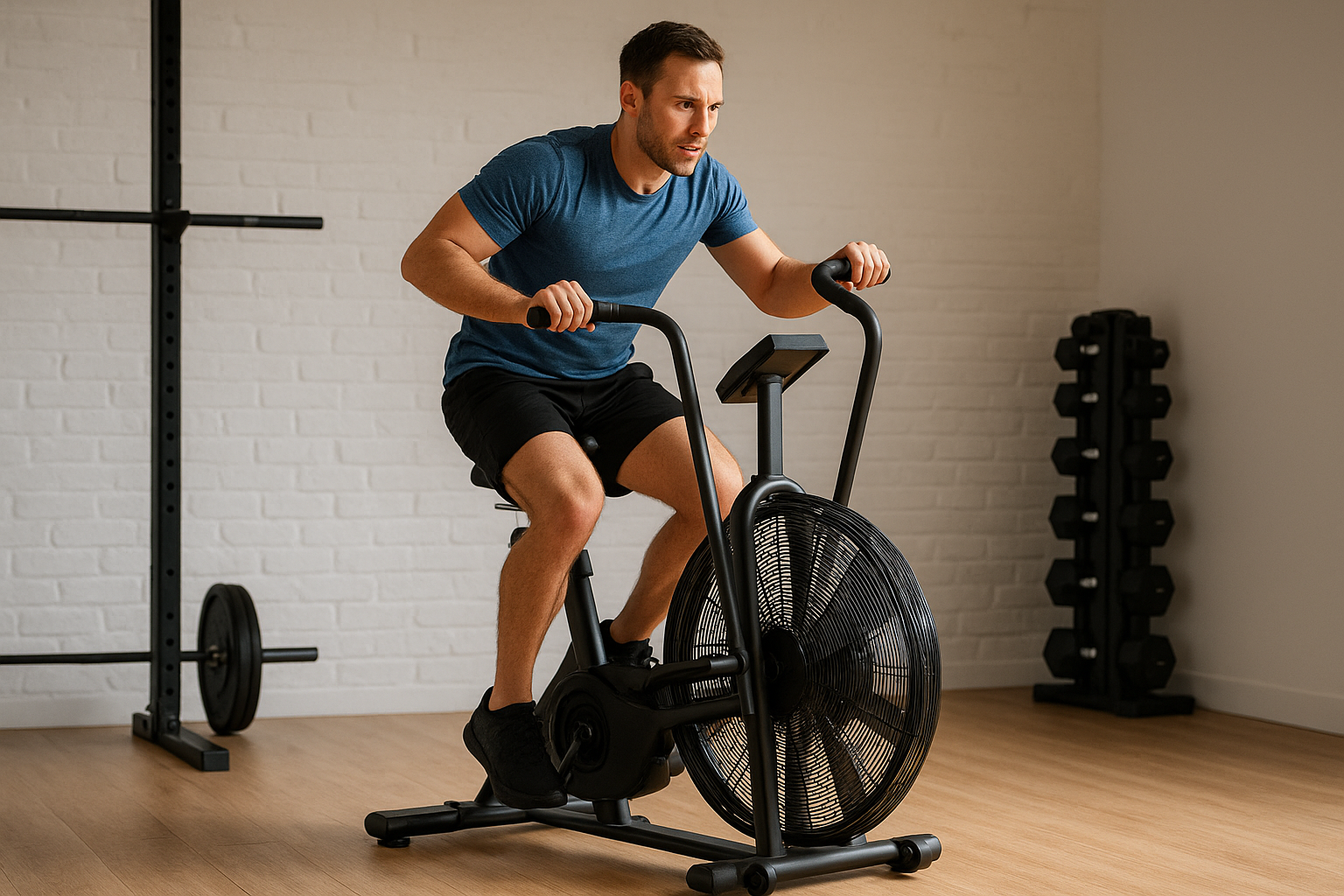
7. Air bikes
Air bikes strip cardio down to its most punishing form, and that’s exactly why CrossFit gyms lean on them so heavily. A fan-based flywheel means the resistance scales with your own effort, so there’s no dial to set and no excuse to coast. For anyone chasing the best home gym equipment for cardio with a focus on short, brutal intervals rather than long steady rides, an air bike belongs on the shortlist.
How it works
Every air bike uses a large fan flywheel connected to pedals and, on most models, moving handlebars that add an upper-body component to the workout. Push harder and the fan spins faster, creating more air resistance instantly, which means the machine never plateaus the way a magnetic bike can. This self-regulating resistance makes it nearly impossible to cheat a sprint, since your own output sets the ceiling. Consoles typically track calories per hour, distance, and time, and higher-end models add heart rate compatibility and Bluetooth so you can log intervals through a fitness app instead of a notepad.
An air bike punishes half-effort pedaling and rewards full-effort pedaling in equal measure, which is exactly why it works so well for interval training.
Who it’s for
Air bikes suit people who thrive on short, intense efforts rather than long, steady cardio sessions. Athletes doing HIIT, CrossFit-style circuits, or sport-specific conditioning get the most value here, since a 20-second all-out push on an air bike produces a heart rate spike that rivals sprinting outdoors. Households with limited time for exercise benefit too, since a 10-minute air bike session can deliver more cardiovascular stress than 30 minutes on a recumbent bike. This category isn’t ideal for anyone wanting low-impact, joint-friendly cardio or long recovery rides, since the upright position and full-body pumping motion demand more from your shoulders and lower back than a recumbent seat does.
Key features to look for
Before buying an air bike, check these specs against how hard you actually plan to push it:
- Fan size and blade design: Larger fans generate resistance faster at high effort levels
- Frame stability: Wide steel bases resist rocking during max-effort sprints
- Seat adjustability: Fore-aft and height adjustment matters since posture shifts constantly during intervals
- Handlebar type: Dual-action arms add upper-body work; stationary handles keep the focus on legs
- Console accuracy: Calorie and watt readouts vary widely between brands, so check reviews before trusting the numbers
Price range
Budget air bikes start around $400 to $600, and they get the job done for casual interval work, though fan noise and frame flex show up fast under heavy use. Mid-range models with sturdier frames and smoother fan bearings run $700 to $1,000, which covers most serious home users. Commercial-grade air bikes built for daily CrossFit-style abuse climb toward $1,200 to $1,600, landing in similar territory to a quality rowing machine or spin bike on this list.
8. Under-desk treadmills
Under-desk treadmills solve a different problem than every other machine on this list. They’re not built for hard intervals or marathon training. They’re built to get you moving during the hours you’d otherwise spend sitting at a desk. For anyone whose biggest cardio obstacle is an eight-hour workday, this compact category rounds out a home gym for cardio by covering the gaps a treadmill or bike can’t fill during work hours.
How it works
A low-profile deck sits just a few inches off the floor, powered by a smaller motor, usually in the 1.5 to 2.5 continuous-horsepower range, tuned for walking speeds rather than running. Top speeds typically cap around 4 miles per hour, since the goal is a steady, quiet walk you can sustain while typing or sitting in on a video call, not a sprint session. Most models skip a handlebar console entirely and pair with a phone app or small LED display on the deck itself, tracking steps, distance, and time. Some fold flat or slide under a couch for storage, which matters more here than on any other machine on this list since these units often live in a home office rather than a dedicated gym room.
An under-desk treadmill only earns its space if it’s quiet enough to use on a work call and low enough to slide under furniture when you’re done.
Who it’s for
This category suits people who sit most of the day and want to counter that with low-intensity movement rather than a single dedicated workout block. Remote workers and anyone with a standing desk setup get the most use out of these, since walking at 1 to 2.5 miles per hour while working doesn’t spike your heart rate enough to interfere with typing, talking, or focus. It’s a poor substitute for anyone chasing real cardiovascular training, since the low top speed and lighter motor can’t deliver the intensity a dedicated treadmill, bike, or rower provides. Think of it as a daily movement tool, not a replacement for the machines earlier on this list.
Key features to look for
Compare these specs before buying, since noise and height matter more here than raw performance:
- Deck height: Lower decks fit under more desks and slide away more easily for storage
- Noise level: Quiet motors matter most if you’re using it during calls or in shared living spaces
- Weight capacity: Confirm it matches your body weight, since some budget models cap lower than standard treadmills
- Remote or app control: Speed adjustment without bending down keeps you from breaking your work flow
- Belt size: Slightly wider, longer decks reduce the risk of stepping off during a long walking session
Price range
Budget under-desk treadmills start around $150 to $300, and at that price, expect a smaller motor and a shorter warranty. Mid-range models with sturdier frames and quieter motors run $350 to $600, which covers most home office buyers comfortably. Premium versions with better motors and app integration climb toward $700 to $900, still well below every other machine on this list, since the simplified build keeps manufacturing costs down.
Picking the right cardio machine for you
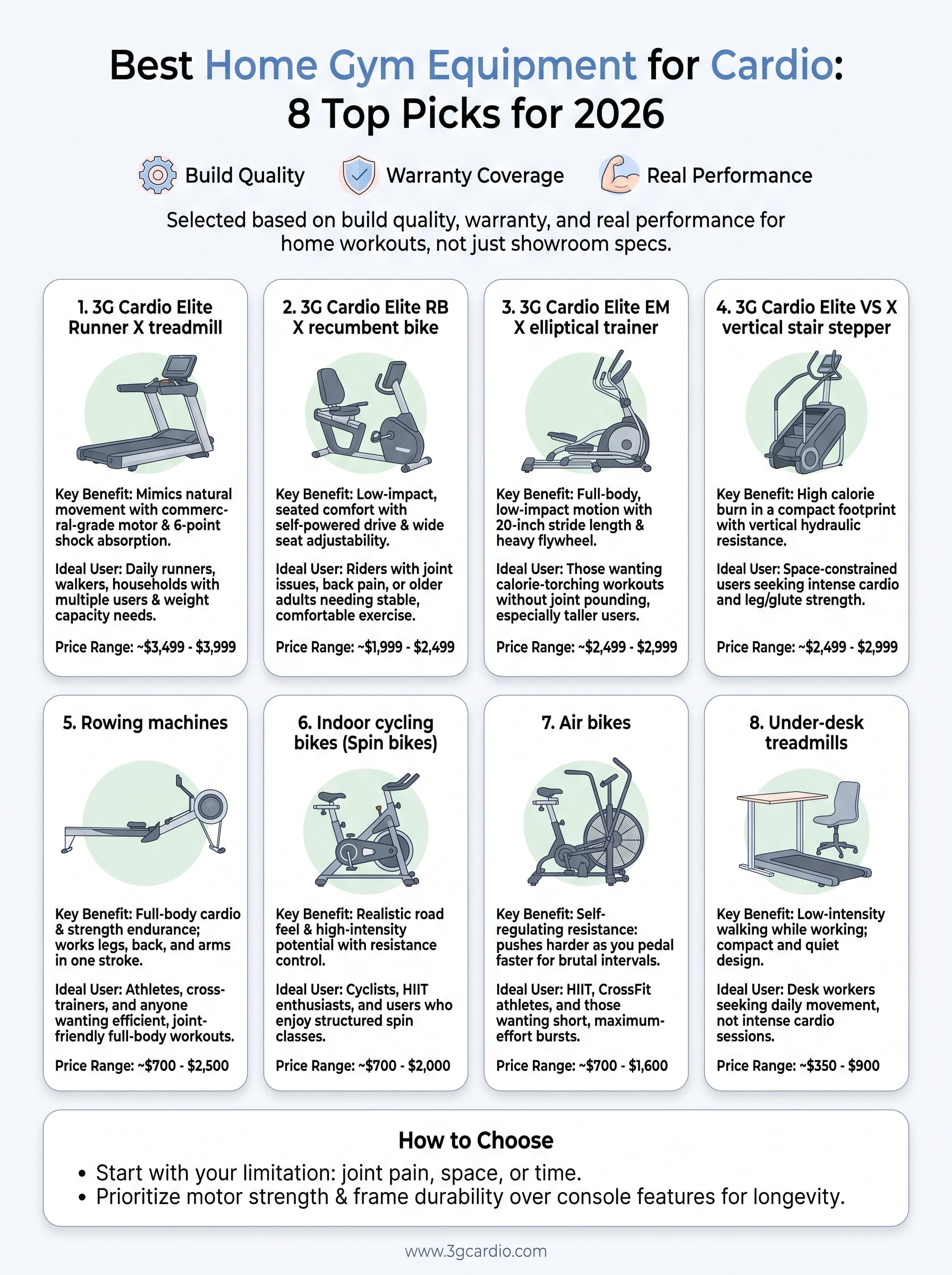
Every machine on this list solves a different problem. Treadmills and under-desk models cover walking and running, recumbent bikes and rowers protect your joints, and air bikes or vertical steppers deliver short, brutal intensity when you’re short on time. The best home gym equipment for cardio isn’t one universal answer, it’s whatever machine matches your body, your space, and how often you’ll actually use it.
Start with your biggest limitation, whether that’s joint pain, floor space, or time, then narrow your list from there. Prioritize motor strength and frame durability over console flash, since those are the parts that determine whether a machine still runs smoothly in year five.
If a commercial-grade treadmill, recumbent bike, elliptical, or vertical stepper sounds like the right fit, browse the full lineup at 3G Cardio and talk to a real person about which model fits your home and your goals.




Sorry, the comment form is closed at this time.