

26 Jul Treadmill Workout Plan for Weight Loss: A 4-Week Guide
You bought a treadmill, or you’re about to, and now you’re standing on it wondering what to actually do. Walking at the same 3.0 mph pace for 30 minutes a day gets boring fast, and worse, it stops working after a few weeks. If you’re searching for a treadmill workout plan for weight loss, you already know that random cardio sessions don’t cut it. You need structure: specific speeds, inclines, and intervals that push your body to keep adapting.
This guide gives you exactly that. Below you’ll find a 4-week progressive plan with day-by-day workouts, real numbers for speed and incline, and interval timings that ramp up as your fitness improves. No guesswork, no vague advice to "just walk more." Each week builds on the last so your body doesn’t plateau, and your fat-burning stays consistent instead of stalling out by week two.
We’ll also cover how to track progress, when to increase intensity, and how to pair your workouts with equipment that can actually handle daily interval training without falling apart. Whether you’re using a budget treadmill at the gym or a commercial-grade machine at home, this plan works. Let’s get into the weekly breakdown.
1. Pick the right treadmill for a weight-loss plan
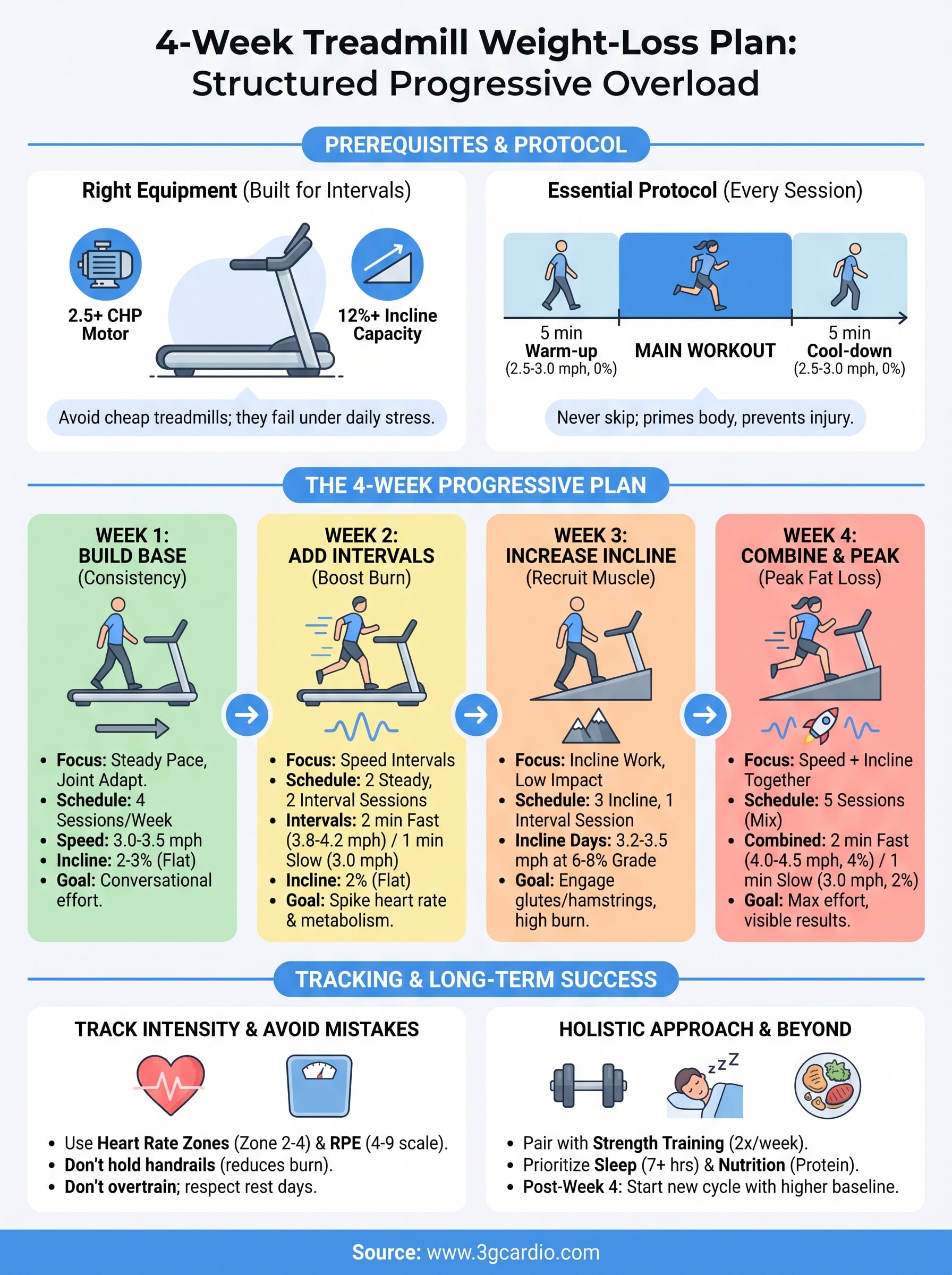
Before you touch the speed button, look at the machine underneath you. A weight-loss treadmill plan depends on intervals, meaning you’ll be changing speed and incline constantly for four weeks straight. Cheap treadmills with weak motors and 10% max incline can’t keep up with that kind of demand, and they tend to fail exactly when you need them most, right around week three when the workouts get harder.
Start with the motor. You want at least a 2.5 continuous horsepower (CHP) motor if you plan to run any part of this program, or 2.0 CHP if you’re sticking to brisk walking and incline work. Motors rated in "peak" horsepower instead of continuous horsepower are a red flag; that number is inflated and doesn’t reflect real performance under load. Incline range matters just as much. Week 3 and Week 4 of this plan push incline to 10-12%, so a treadmill capped at 10% limits how far you can progress.
A treadmill that can’t hit at least 12% incline and 10 mph will eventually cap your progress, not your effort.
Here’s what to check before you buy or before you commit your current machine to this plan:
- Continuous motor rating: 2.5 CHP or higher for running intervals
- Incline range: up to 12% or more for Week 3-4 workouts
- Speed range: at least 10-12 mph for interval sprints
- Deck cushioning: reduces joint stress during repeated speed changes
- Bluetooth or app connectivity: lets you follow interval timing without staring at the console
Comparing treadmill tiers
| Feature | Budget treadmill ($500-$1,000) | Mid-range treadmill ($1,500-$2,500) | Commercial-grade home treadmill ($2,500-$4,500) |
|---|---|---|---|
| Motor | 1.5-2.0 CHP | 2.5-3.0 CHP | 3.0-4.0 CHP |
| Max incline | 10% | 12-15% | 15%+ |
| Max speed | 8-10 mph | 10-12 mph | 12+ mph |
| Deck warranty | 1-3 years | 5-10 years | Lifetime |
| Built for daily intervals | Not reliably | Yes | Yes |
Owners transitioning from a gym membership to home training often underestimate how much daily interval work wears down a low-end machine. This is where commercial-grade construction at a residential price point earns its keep. 3G Cardio built the Elite Runner X and Pro Runner X treadmills specifically for this kind of repeated stress, with continuous-duty motors, incline up to 15%, and FreeSync FTMS Bluetooth so you can run interval apps like Kinomap directly from your own tablet instead of paying for a proprietary subscription screen.
Whoever ends up using the machine, the rule stays the same: match the treadmill to the plan, not the other way around. If your current equipment tops out at 10% incline and 8 mph, you can still complete Weeks 1 and 2 without issue, but you’ll want an upgrade path before Week 3 asks for more than the machine can give.
2. Warm up and cool down properly every session
Skipping the warm-up is the fastest way to turn a good treadmill workout plan for weight loss into a shin splint or pulled hamstring. Your muscles and joints need a gradual ramp-up before you hit interval speeds, and your heart needs time to shift from resting rate to working rate without spiking your blood pressure. Five minutes of easy walking at 2.5-3.0 mph with 0% incline is enough to raise your core temperature and get blood flowing to the muscles you’re about to load. Don’t treat this as optional filler; it’s part of the workout, not a delay before it starts.
Gradually increasing your effort during those five minutes also primes your nervous system for the faster speed changes coming later in the session. The American Heart Association notes that a proper warm-up reduces cardiovascular strain and lowers injury risk, especially for anyone returning to exercise after time off. Think of it as insurance against the exact kind of setback that derails a four-week plan in week one.
Five minutes on each end of your workout is the cheapest injury insurance you’ll ever buy.
Cooling down matters just as much, even though it’s the part everyone rushes. Ending an interval session abruptly, stepping off the belt while your heart rate is still elevated, can cause blood to pool in your legs and leave you lightheaded. Instead, drop your speed back to that same 2.5-3.0 mph range for five minutes after your last interval, letting your heart rate fall gradually before you step off.
Every workout in this guide, from Week 1 through Week 4, assumes a five-minute warm-up and five-minute cool-down bookending the main session. Those ten minutes aren’t included in the calorie estimates or interval charts ahead, so budget for them separately when you’re planning how much time each workout actually takes.
3. Week 1: build your walking base and confidence
Week 1 isn’t about burning maximum calories. It’s about teaching your joints, tendons, and cardiovascular system to handle regular treadmill sessions without breaking down. Think of this treadmill workout plan for weight loss as a foundation-building phase where consistency matters more than intensity.
Weekly workout schedule
Aim for four sessions this week, spaced with rest days in between so your body adapts without overuse injuries:
- Monday: 30-minute steady walk
- Wednesday: 30-minute steady walk
- Friday: 35-minute steady walk
- Saturday: 30-minute steady walk
Rest or light stretching on the off days keeps recovery on track.
Speed, incline, and interval targets
Keep speed between 3.0-3.5 mph and incline at 2-3% for every session this week. No intervals yet. Your goal is simply to complete each walk at a conversational pace, meaning you could hold a light conversation without gasping. If 3.5 mph feels too easy by Friday, bump it to 3.8 mph rather than adding incline, which stresses joints more than most beginners expect.
Week 1 succeeds when you finish every scheduled session, not when you finish it fast.
Estimated calories burned
For a 180-pound person walking at 3.2 mph with 2-3% incline, expect roughly 220-260 calories per 30-minute session. Lighter individuals will burn somewhat less, heavier individuals somewhat more. Across four sessions, that’s approximately 900-1,050 calories for the week, a modest but real start toward your deficit.
Tips to stay on track
Schedule your walks like appointments you can’t cancel. Missing Week 1 sessions makes Week 2’s intervals feel harder than they should. Hydrate before you start, since dehydration makes moderate pace feel unnecessarily difficult. Lastly, resist the urge to check your phone every thirty seconds; watching the clock makes 30 minutes feel like 60.
4. Week 2: add intervals to boost your calorie burn
Now that your body handles steady walking without complaint, it’s time to introduce interval training, the single biggest lever in any treadmill workout plan for weight loss. Alternating between higher and lower effort forces your cardiovascular system to work harder in short bursts, which burns more calories per minute than steady walking and keeps your metabolism elevated after you step off the belt.
Weekly workout schedule
Stick with four sessions again this week, but two of them now include intervals instead of steady pacing:
- Monday: 30-minute steady walk (same as Week 1)
- Wednesday: 25-minute interval session
- Friday: 30-minute steady walk
- Saturday: 30-minute interval session
Keeping two steady days lets your joints continue adapting while your body learns the interval pattern.
Speed, incline, and interval targets
On interval days, alternate 2 minutes at 3.8-4.2 mph with 1 minute at 3.0 mph, repeating that cycle for the full session at a flat 2% incline. Steady days stay at Week 1’s 3.5-3.8 mph pace with 2-3% incline. This 2:1 work-to-recovery ratio is enough to spike your heart rate without overwhelming a body only two weeks into training.
Intervals work because the recovery period, not just the push, is what teaches your heart to burn fat more efficiently.
Estimated calories burned
A 180-pound person completing a 25-minute interval session burns roughly 240-280 calories, noticeably more per minute than the steady walks from Week 1. Combined with the two steady sessions, weekly totals climb to approximately 1,000-1,150 calories, a solid jump without a drastic increase in time spent.
Tips to stay on track
Don’t rush the recovery minute; it exists so you can hit your work-interval speed cleanly, not just survive it. Watch your breathing during the 1-minute recovery, if you’re still gasping when the interval restarts, drop your work speed by 0.2 mph rather than skipping the interval entirely.
5. Week 3: increase incline for a bigger afterburn
This week shifts the emphasis from speed to incline work, which recruits more muscle in your glutes, calves, and hamstrings while keeping joint impact low. Higher incline also raises your heart rate at a slower pace than sprinting would, giving you a strong calorie burn without the pounding that comes from running. This stage of the treadmill workout plan for weight loss is where many people notice their pants fitting looser, even before the scale moves much.
Weekly workout schedule
Four sessions again this week, but now three of them include incline work instead of just flat intervals:
- Monday: 30-minute incline walk
- Wednesday: 25-minute interval session (from Week 2)
- Friday: 30-minute incline walk
- Saturday: 35-minute incline walk
Keeping one flat interval day preserves the speed adaptation you built in Week 2 while your body adjusts to steeper grades.
Speed, incline, and interval targets
On incline days, walk at 3.2-3.5 mph while raising incline to 6-8%, holding that grade for the full session. Your Wednesday interval session stays at Week 2’s speeds but drops incline to 1%, since combining high incline with speed intervals too soon overloads recovering joints.
Incline burns calories the way speed can’t: without the joint stress that eventually sidelines beginners.
Estimated calories burned
A 180-pound person walking 30 minutes at 3.3 mph with 7% incline burns roughly 290-330 calories, a meaningful jump from Week 1’s flat walks. Weekly totals now land around 1,150-1,300 calories, driven mostly by the added incline rather than added time.
Tips to stay on track
Lean slightly forward from your hips, not your waist, to avoid gripping the handrails, which reduces the calorie benefit of incline work. Shorten your stride as incline increases; a stride built for flat walking feels unnatural and tiring once the belt tilts upward. If your calves feel unusually tight after Monday’s session, drop Wednesday’s incline back to flat until the soreness fades.
6. Week 4: combine speed and incline for peak fat loss
Week 4 asks your body to do what it’s spent three weeks preparing for: hold speed and incline at the same time. This is the peak week of the treadmill workout plan for weight loss, where the cardiovascular base from Week 1, the interval pattern from Week 2, and the incline strength from Week 3 all come together in a single session. Expect this week to feel genuinely hard, that’s the point.
Weekly workout schedule
Five sessions this week, including one combined speed-and-incline day that anchors the whole program:
- Monday: 30-minute incline walk (from Week 3)
- Tuesday: 25-minute interval session (from Week 2)
- Thursday: 30-minute combined session
- Friday: 30-minute incline walk
- Saturday: 35-minute combined session
Five sessions works now because your joints and lungs have adapted over three weeks; jumping straight here in Week 1 would have been a mistake.
Speed, incline, and interval targets
On combined days, alternate 2 minutes at 4.0-4.5 mph with 4% incline against 1 minute at 3.0 mph with 2% incline, repeating for the full session. Keep Monday and Friday’s incline walks at Week 3’s 6-8% grade, and Tuesday’s interval session at Week 2’s flat speeds.
The combined session is where consistent effort finally shows up as visible fat loss, not just fitness gains.
Estimated calories burned
A 180-pound person completing a 30-minute combined session burns roughly 350-400 calories, the highest single-session burn in the whole plan. Weekly totals now reach approximately 1,400-1,550 calories, nearly double where Week 1 started.
Tips to stay on track
Don’t chase higher numbers than listed here just because you feel strong; overshooting speed and incline together spikes injury risk fast. Keep a water bottle within reach, since combined sessions push sweat rate noticeably higher than flat walking. If Thursday’s session leaves you unusually sore, drop Saturday’s incline by 2% rather than skipping the workout entirely.
7. Track your intensity with heart rate and RPE
Numbers on a console only tell part of the story. Two people walking at the same 3.5 mph and 5% incline can have wildly different heart rates depending on fitness level, age, and sleep the night before. That’s why any serious treadmill workout plan for weight loss needs a second layer of tracking beyond speed and incline: your actual physiological response to the work.
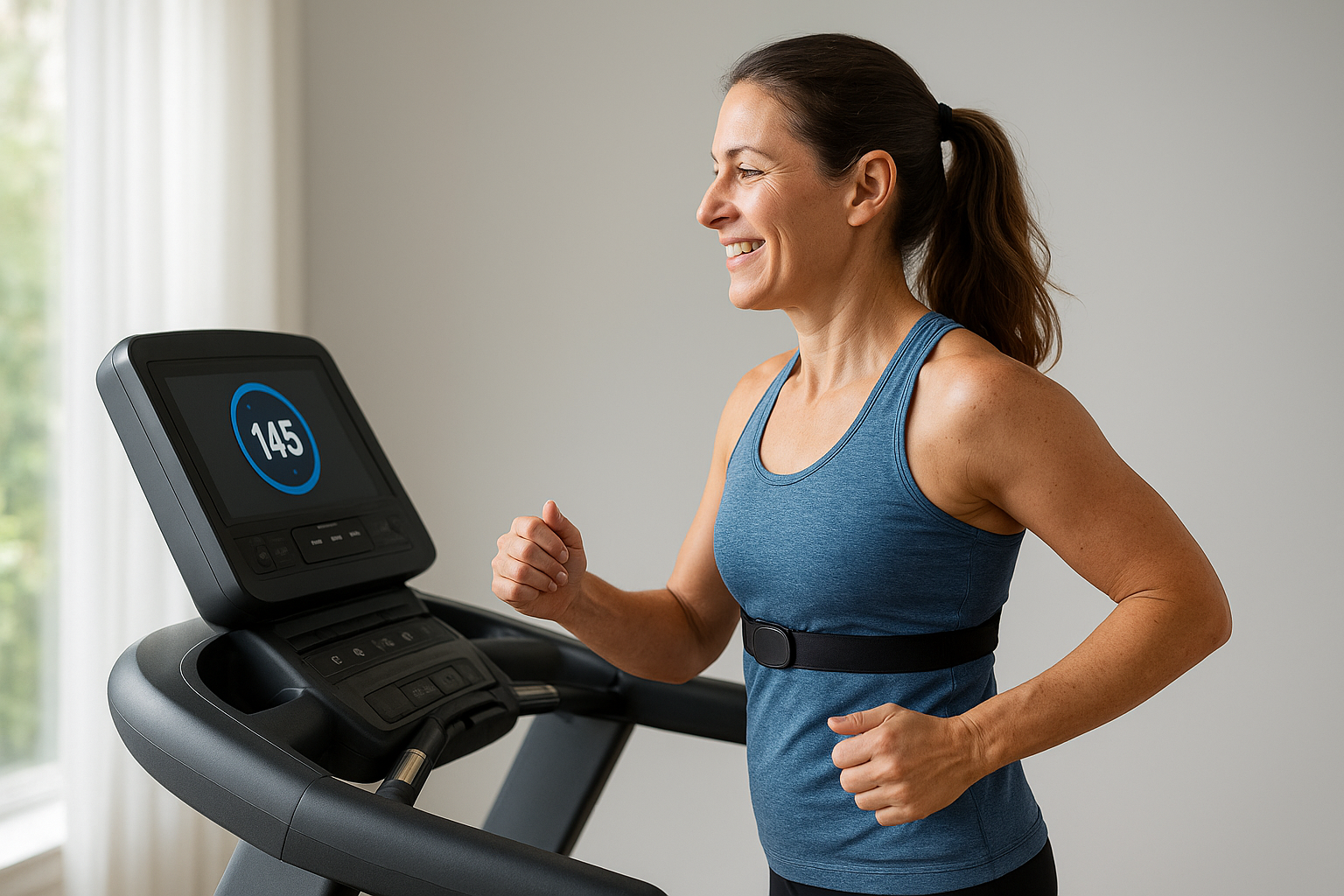
Heart rate zones give you an objective target. Most fat-burning work in this plan should land in Zone 2 (60-70% of max heart rate) during steady sessions, climbing into Zone 3-4 (70-85%) during intervals and combined workouts. A simple estimate of max heart rate is 220 minus your age, though it’s a rough guide rather than gospel. 3G Cardio’s Elite Runner X and Pro Runner X consoles pair with wireless heart rate straps included at purchase, so you get real numbers instead of guessing from how you feel.
| Zone | % of max heart rate | Best used for |
|---|---|---|
| Zone 1 | 50-60% | Warm-up, cool-down |
| Zone 2 | 60-70% | Steady walks (Weeks 1-3) |
| Zone 3 | 70-80% | Intervals (Weeks 2-4) |
| Zone 4 | 80-85% | Combined sessions (Week 4) |
Rating of Perceived Exertion (RPE) works as a backup when you don’t have a strap handy. On a 1-10 scale, steady walks should feel like a 4-5, intervals like a 7-8 during the work phase, and combined sessions can push to 8-9 at their peak. If your RPE feels higher than your heart rate zone suggests, that’s often a sign of poor sleep, dehydration, or accumulated fatigue.
Your heart rate doesn’t lie, even when your motivation does.
Combine both tools rather than picking one. Heart rate catches overtraining before you feel it, while RPE catches days when stress or illness makes an easy zone feel unexpectedly hard. Together, they keep you training in the right zone instead of guessing based on speed alone.
8. Avoid these treadmill mistakes that stall your progress
Even a well-built treadmill workout plan for weight loss falls apart if you repeat a few common habits. Most plateaus don’t come from a flawed program, they come from small errors that quietly cancel out the work you’re putting in. Catching these early saves you weeks of frustration wondering why the scale won’t budge.
Gripping the handrails is the biggest offender. Leaning on the rails shifts your body weight off your legs and onto your arms, which can cut calorie burn by 20% or more during incline work, especially in Weeks 3 and 4. If you need the rails for balance, that’s a sign your incline or speed is set too aggressively for where you actually are.
Overtraining ranks close behind. Adding extra sessions beyond what each week calls for, or skipping rest days because you feel motivated, breaks down recovery faster than it builds fitness. Your body loses fat during rest, not during the workout itself, so cramming in more treadmill time usually backfires.
The treadmill mistakes that stall progress are almost never about effort, they’re about ignoring recovery and shortcuts that quietly reduce intensity.
A few other habits worth watching:
- Same pace every day: repeating identical speed and incline week after week removes the progressive overload this plan depends on
- Ignoring soreness signals: pushing through sharp joint pain instead of dropping intensity, as noted in earlier weeks, turns manageable fatigue into an injury
- Skipping the warm-up on "easy" days: steady walks still need five minutes of ramp-up, even when the session feels light
- Eating back all the calories burned: a 300-calorie combined session doesn’t justify a 500-calorie reward afterward
Monitoring your console readouts honestly, rather than rounding speed or incline up in your head, keeps the plan’s calorie estimates accurate. Small dishonesties with yourself add up fast over four weeks.
9. Pair your treadmill plan with strength training and rest
Cardio alone can’t finish the job. A treadmill workout plan for weight loss burns calories while you’re on the belt, but muscle is what keeps your metabolism elevated on the days you’re not. Skipping resistance work means you lose lean tissue along with fat, which slows your resting burn rate exactly when you need it working hardest.
Two strength sessions per week, on your treadmill rest days, cover the gap without overloading your schedule. Focus on compound movements that recruit multiple muscle groups at once, squats, lunges, push-ups, rows, since these burn more energy per session than isolated exercises and reinforce the same legs and core you’re taxing on incline days.
- Monday/Wednesday treadmill weeks: strength train Tuesday and Thursday
- Four-day treadmill weeks: strength train on two of your non-treadmill days
- Keep sessions to 30-40 minutes, full-body, moderate weight
Recovery matters just as much as the work itself. Overlapping hard treadmill days with hard lifting days invites the overtraining problem covered earlier, where fatigue masks itself as motivation until an injury forces a break. Building at least one full rest day into every week, with no structured exercise at all, lets your nervous system reset alongside your muscles.
Fat loss happens during recovery, not during the workout that triggers it.
Sleep deserves a mention too, since it’s the recovery tool most people ignore. Fewer than seven hours consistently raises cortisol and hunger hormones, which works directly against the calorie deficit you’re building on the treadmill. Nutrition rounds out the picture: a moderate protein intake, roughly 0.7-1 gram per pound of bodyweight, supports the muscle repair that strength days demand and keeps you from undoing the calorie math with poor food choices. None of this replaces your treadmill sessions, but ignoring it quietly caps how much fat you actually lose.
10. Keep the results going after week four
Finishing week four doesn’t mean the plan is over, it means you’ve built a fitness base most people never reach. The mistake here is stopping cold or repeating week four’s exact numbers forever, expecting the same results. Your body adapted to that combined speed-and-incline work, so holding steady there for another month will slow your fat loss even though the sessions still feel hard.
The fix is a second progression cycle, not a return to week one. Take your week four numbers as the new baseline and build another four weeks on top of them, the same way you built week two on week one. Add 0.2-0.3 mph to your interval speeds, push incline work toward 9-10%, or extend your combined sessions from 30 minutes to 35-40. Progressive overload doesn’t stop at week four, it just needs a new starting point.
The plan that got you here won’t keep you moving forward if you never adjust it again.
A few ways to structure your next cycle:
- Repeat weeks 1-4 at higher intensity: same structure, higher speed and incline targets throughout
- Add a fifth interval day: once your joints handle five treadmill sessions without soreness
- Introduce hill-simulation programs: if your console supports pre-set incline variation, this adds variety without you manually adjusting every two minutes
- Reassess heart rate zones monthly: as fitness improves, your resting heart rate drops and your zones shift with it
Watch your weight and measurements every two weeks rather than daily, since daily fluctuations from water and sodium hide the real trend. If the scale plateaus for more than three weeks despite following an updated plan, look at your calorie intake first, not just your treadmill numbers. Weight loss stalls far more often from creeping portion sizes than from a workout plan losing effectiveness. Keep adjusting one variable at a time, whether that’s speed, incline, or session length, and the results from week four become the floor for what comes next, not the ceiling.
Turning this plan into a lasting habit
Four weeks of structured treadmill work does more than burn calories, it teaches your body what progressive effort feels like. You started with a 3.0 mph walk and finished holding speed and incline together for 35 minutes straight. That gap is the whole point of a treadmill workout plan for weight loss: consistent, measured overload beats random effort every time. The numbers in this guide are a starting framework, not a ceiling. Adjust speed, incline, and session length as your fitness improves, and keep tracking heart rate so you know you’re training in the right zone rather than guessing.
None of this works, though, if your equipment can’t handle daily intervals. A weak motor or a 10% incline cap will undercut Week 3 and Week 4 no matter how disciplined you are. If you’re shopping for a machine built to survive this exact program, take a look at the Elite Runner X treadmill and start week one on equipment that won’t quit before you do.




No Comments