

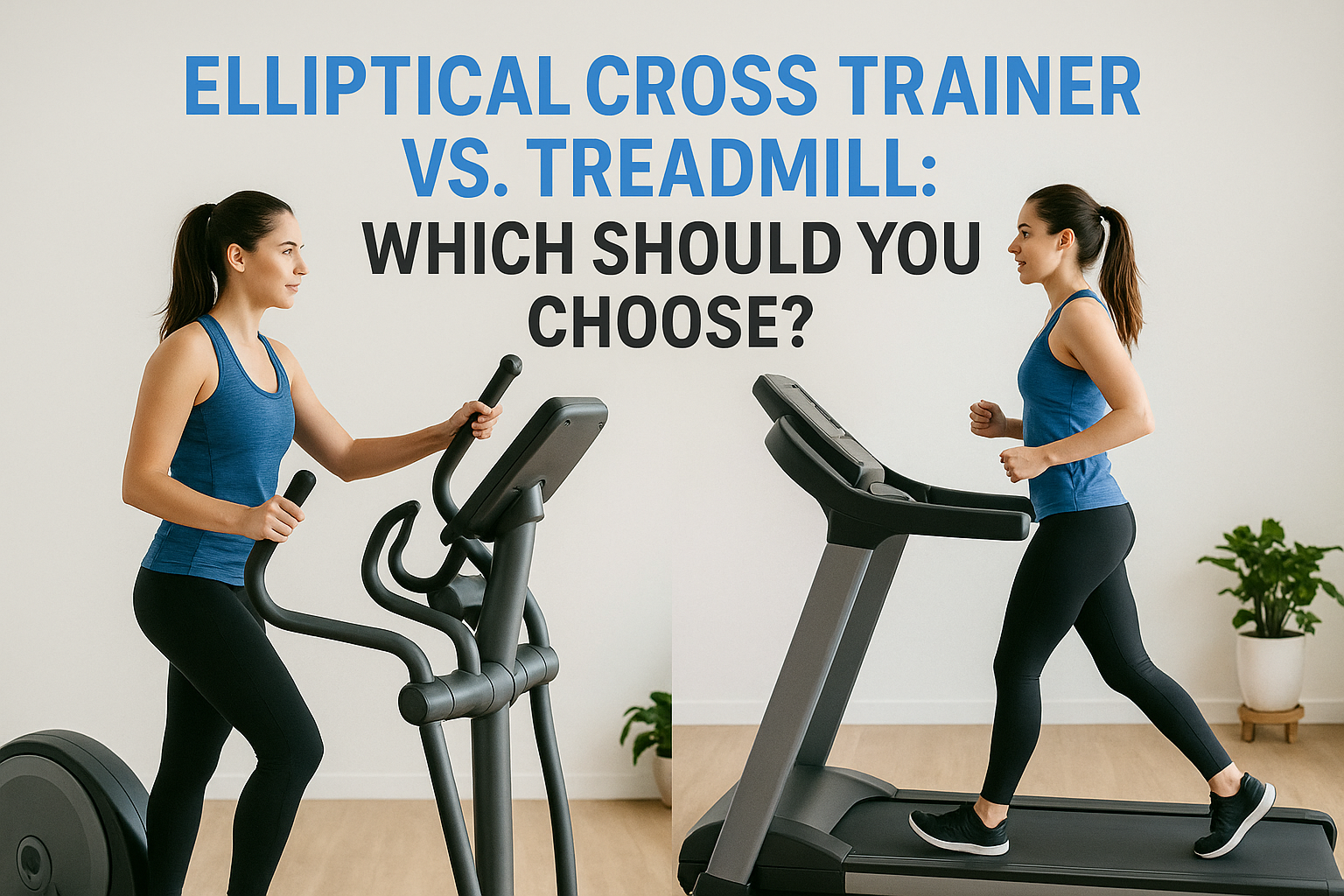
23 Jul Elliptical Cross Trainer vs Treadmill: Which Should You Choose?
Standing between an elliptical cross trainer vs treadmill at the store, or scrolling through both on a website, most people freeze. Both machines promise a solid cardio workout, but they load your joints, engage your muscles, and burn calories in very different ways. Pick the wrong one and you either aggravate an old knee injury or get bored enough to quit within a month.
Here’s the short answer: treadmills deliver a more natural running motion and higher calorie burn per minute for most users, while ellipticals protect your joints with zero-impact movement and work your upper body through the handles. The right choice depends on your joint health, your goals, and honestly, what you’ll actually use three times a week instead of once.
This article breaks down the real differences in muscle activation, impact forces, calorie expenditure, and long-term durability between these two machines. We’ll also cover who should lean toward each option based on injury history and fitness goals, so you can make a decision backed by facts rather than whatever’s on sale this weekend.
Why the elliptical vs treadmill choice matters for your goals
Your joints do the deciding for many people before goals even enter the conversation. If you’ve dealt with knee pain, shin splints, or a cranky lower back, the difference in ground reaction force between these two machines isn’t a footnote, it’s the whole story. A treadmill still asks your foot to strike a moving belt with every stride, and that repetitive pounding adds up fast over a 30-minute run. An elliptical keeps your feet locked to the pedals in a fixed, gliding path, so that jarring contact essentially disappears. This one mechanical difference shapes almost everything else in the elliptical cross trainer vs treadmill debate, from how long you can train pain-free to how quickly you bounce back between sessions.
Joint impact and injury risk
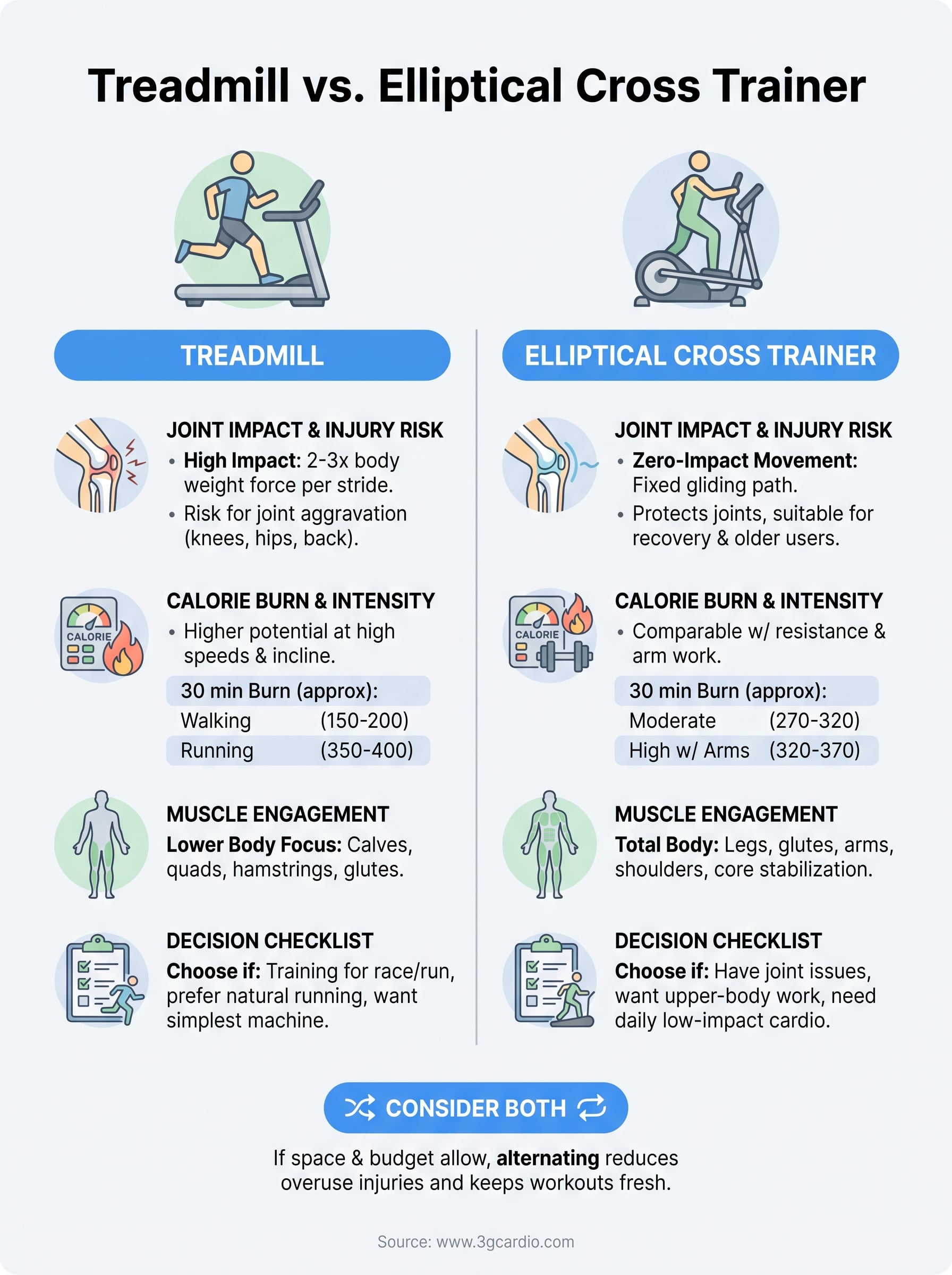
Numbers back this up better than opinions do. Runners generate forces of roughly 2 to 3 times their body weight through the hips, knees, and ankles with each footstrike, even on a well-cushioned treadmill deck. Elliptical trainers, by contrast, are classified as low-impact exercise by the National Institutes of Health, which notes that these modalities deliver real cardiovascular benefit without the joint loading associated with running or jogging (see MedlinePlus on exercise and physical fitness). If you’re recovering from a knee scope, managing arthritis, or you’re simply over 50 and want to protect the joints you have left, that difference matters more than any console feature.
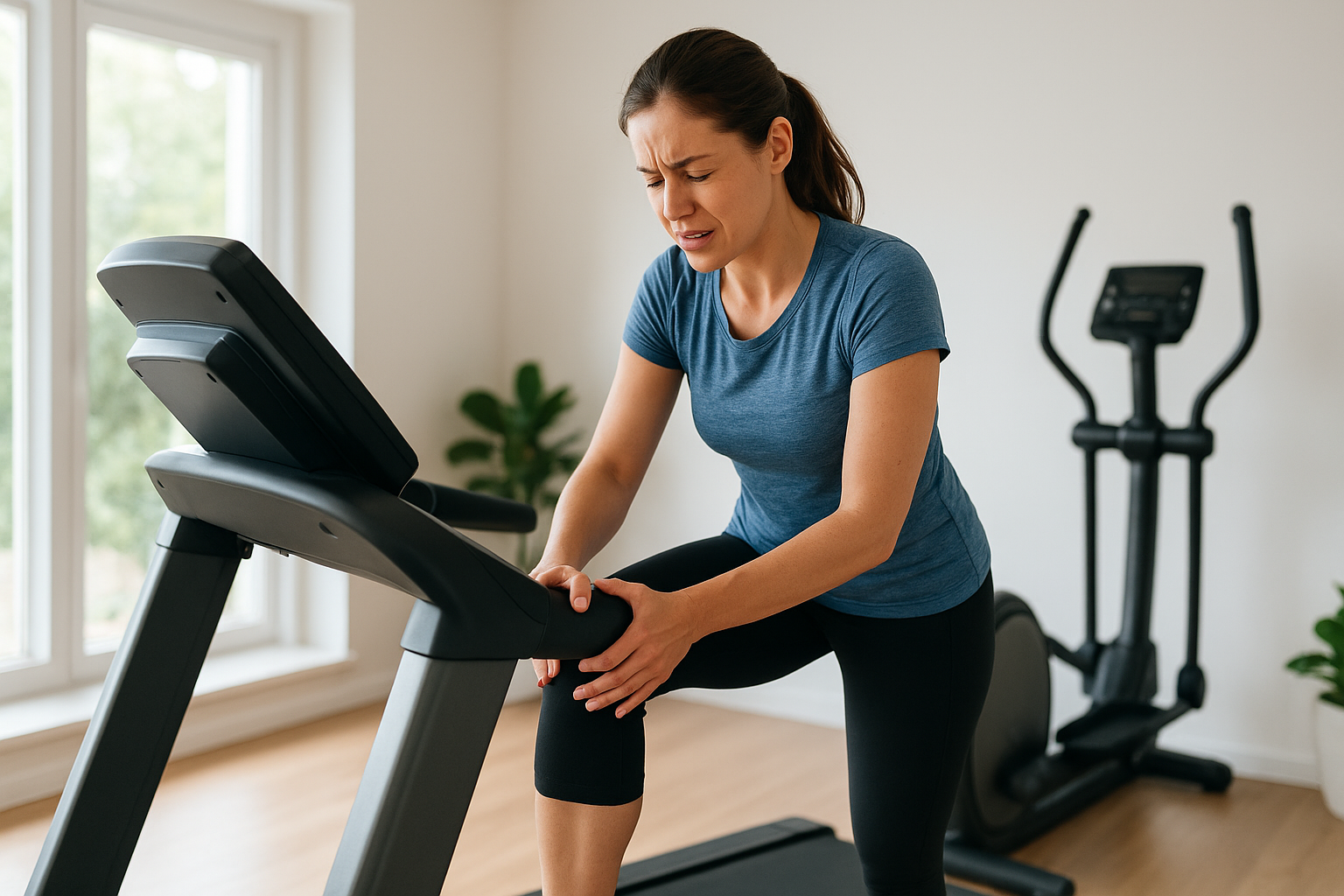
Your joints don’t care what the marketing says: less impact means more workouts before an injury sidelines you.
Calorie burn and workout intensity
Consider how each machine handles intensity before you assume one automatically burns more. Treadmills let you push incline and speed independently, which drives your heart rate up quickly and torches calories at a steep rate once you’re running rather than walking. Ellipticals rely on resistance and stride rate to create that same intensity, and because your upper body works through the handles, you recruit more total muscle mass per minute, which narrows the calorie gap considerably. For a 180-pound person working at a moderate-to-vigorous effort for 30 minutes, here’s roughly what to expect:
| Activity | Approx. Calories Burned (30 min) |
|---|---|
| Treadmill walking, brisk pace | 150-200 |
| Treadmill running, 6 mph | 350-400 |
| Elliptical, moderate resistance | 270-320 |
| Elliptical, high resistance with arms | 320-370 |
These figures shift with your weight, effort level, and whether you’re actually pushing the handles instead of just resting your hands on them.
Muscle engagement across your whole body
Beyond calories, the two machines train different muscle groups, and that’s worth thinking about if you have specific fitness goals. A treadmill is essentially a lower-body machine: calves, quads, hamstrings, and glutes do almost all the work while your arms swing passively. An elliptical distributes the load more evenly:
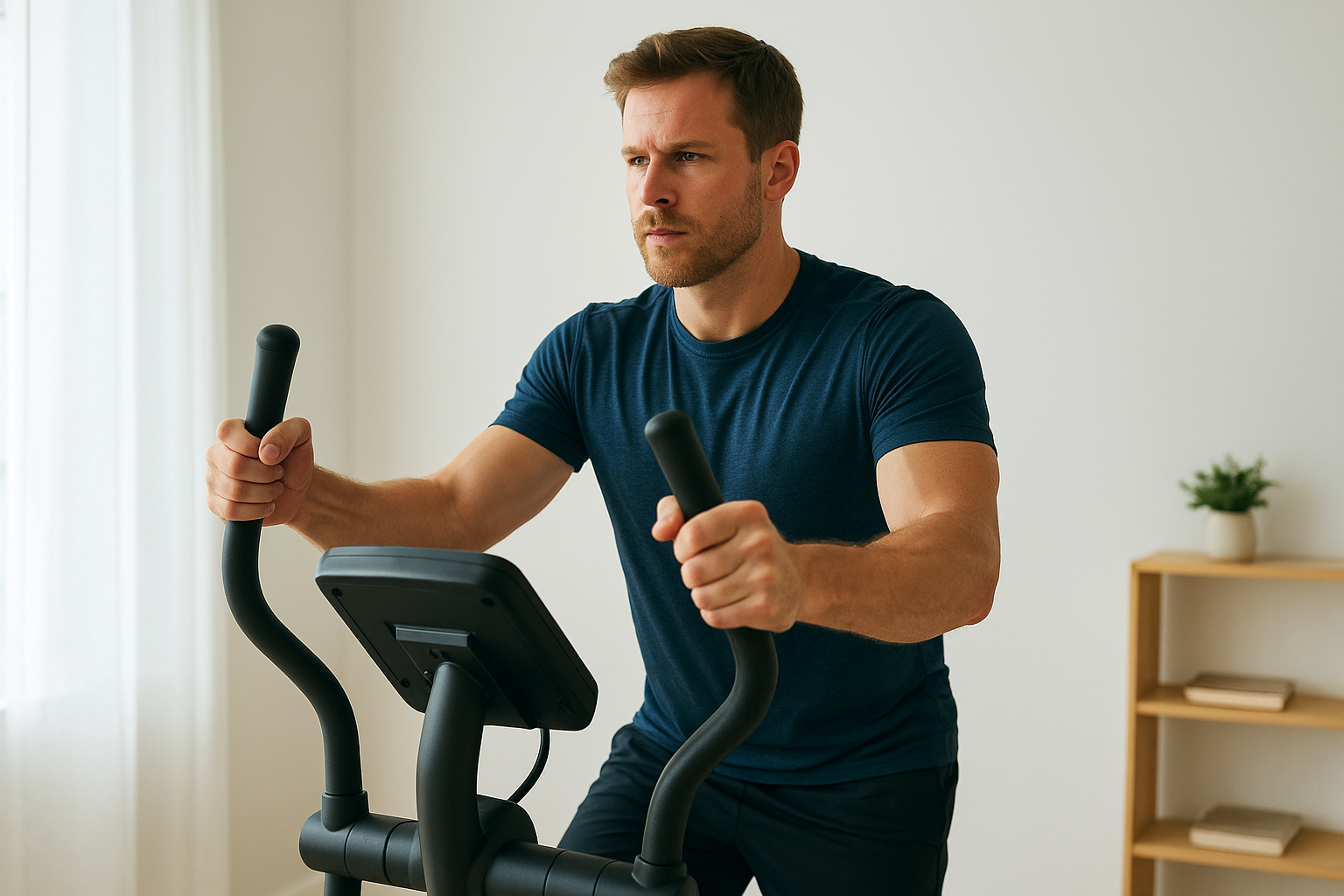
- Lower body: quads, hamstrings, glutes, and calves, similar to a treadmill but with less eccentric loading
- Upper body: shoulders, chest, and back through the moving handles
- Core: engaged continuously to stabilize your torso through the gliding motion
If you want a workout that doubles as light upper-body conditioning, the elliptical has a real edge here.
Long-term consistency and injury risk
Consistency beats intensity every time, and this is where the choice really pays off or backfires. A machine that leaves you sore, achy, or nursing a flare-up isn’t one you’ll use three times a week for the next five years. Pick the machine that matches your body’s tolerance for impact and your actual training goals, whether that’s marathon prep on a treadmill or joint-friendly cardio on an elliptical, and you’ll stick with it long enough to see results.
How to decide which machine fits your fitness goals
Goals should drive this decision more than brand names or console screens ever will. Before you compare specs, get honest about what you’re actually training for: weight loss, race prep, joint rehab, or just staying active without wrecking your knees. Matching the machine to that goal, rather than to whatever looks impressive in a showroom, is what separates equipment that gets used from equipment that becomes a clothes rack.
If you’re training for a race or building running fitness
Specificity wins here. If your goal involves an actual 5K, half marathon, or any event where you’ll be running on pavement, a treadmill trains the exact movement pattern you’ll use on race day. Ellipticals build cardiovascular capacity, but the gliding motion doesn’t translate directly to the biomechanics of running, so your legs won’t be prepared for the pounding of real-world miles. Runners training for events should lean toward a treadmill with a strong motor and adjustable incline, since hill work builds the leg strength that flat elliptical sessions can’t replicate.
If you’re managing joint pain, arthritis, or recovering from injury
Protection matters more than specificity when your joints are already compromised. An elliptical trainer lets you maintain cardiovascular fitness without the repetitive impact that aggravates knees, hips, or a sensitive lower back. This is also the better call if you’re returning from surgery and your physical therapist has cleared low-impact cardio but not running.
If your knees ache after a walk, they’ll ache more after a run, so choose the machine that lets you train pain-free instead of through pain.
If you want efficient, total-body conditioning
Time efficiency changes the calculation for busy schedules. Since an elliptical engages your arms, shoulders, and core along with your legs, you get more muscle recruitment per minute than a treadmill workout of the same length. That makes it a smart pick if you’re squeezing cardio into a lunch break and want maximum return on a short session.
Quick decision checklist
Use this list to narrow things down fast:
- Choose a treadmill if you’re training for a run or race, prefer walking or jogging outdoors normally, or want the simplest, most intuitive machine to step onto
- Choose an elliptical if you have knee, hip, or back issues, want upper-body engagement built in, or need a machine you can use daily without recovery days
- Consider both if you have the space and budget, since alternating machines reduces overuse injuries and keeps workouts from getting stale
Weighing these factors against your actual body and schedule, not an idealized version of your routine, gets you to the right answer faster than reading spec sheets alone.
Comparing calorie burn, muscle engagement, and joint impact
Putting all three factors side by side makes the elliptical cross trainer vs treadmill decision clearer than looking at any single stat in isolation. Numbers tell a more honest story than marketing copy, and once you see calorie burn, muscle recruitment, and impact force lined up together, the tradeoffs stop feeling abstract. Neither machine wins across the board, which is exactly why your personal goals and joint history should break the tie.
Calorie burn depends on effort, not just the machine
MET values, the standard researchers use to measure exercise intensity, show treadmills and ellipticals landing in a similar range once you match effort levels honestly. Running at 6 mph clocks in around 10 METs, while a vigorous elliptical session with active arm pushing lands around 5 to 8 METs depending on resistance. The gap closes further when you factor in that most people can sustain a harder elliptical effort for longer because there’s no impact fatigue building up in the joints.
| Factor | Treadmill | Elliptical |
|---|---|---|
| Calorie burn at matched perceived effort | Slightly higher at high speeds | Comparable at moderate-high resistance |
| Muscles primarily worked | Legs, glutes, calves | Legs, glutes, arms, shoulders, core |
| Peak joint force per stride | 2-3x body weight | Near zero impact |
| Sustainable session length for beginners | Shorter due to impact fatigue | Longer due to low impact |
Muscle engagement spreads out differently across your body
Electromyography studies on cardio equipment consistently show treadmills concentrating work in the lower body while ellipticals distribute the load. That difference shows up clearly once you break down which muscles fire during each workout:
- Treadmill: quadriceps, hamstrings, glutes, and calves do nearly all the work, with your arms swinging passively for balance
- Elliptical: the same lower-body muscles engage, plus shoulders, chest, and back through the moving handles, with your core stabilizing the whole motion
- Net effect: the elliptical recruits more total muscle mass per minute, which is part of why perceived exertion often feels lower even at a similar heart rate
Greater muscle recruitment doesn’t just burn more calories, it also builds functional upper-body strength most people neglect during cardio sessions.
Joint impact is where the real separation happens
Running form, shoe cushioning, and treadmill deck technology can all soften impact, but they can’t eliminate it. Studies cited by the National Institutes of Health confirm that low-impact activities like elliptical training deliver comparable cardiovascular benefit to running without the repetitive joint loading (see MedlinePlus). Someone with healthy joints and no injury history can absorb treadmill impact just fine for years. Someone managing early arthritis or a previous ACL repair is stacking risk with every mile.
Calorie burn numbers matter, but they mean nothing if joint pain stops you from finishing the workout.
How to get the most out of either machine
Owning the right equipment only solves half the problem. Plenty of treadmills and ellipticals collect dust in garages because their owners never learned how to structure a workout that keeps producing results. Whether you land on a treadmill or an elliptical after weighing the elliptical cross trainer vs treadmill tradeoffs, the techniques below apply to both machines and separate people who see real progress from people who just log time.
Build interval training into every session
Steady-state cardio at the same pace week after week trains your body to adapt and then plateau. Interval training forces adaptation to keep happening by alternating short bursts of high effort with recovery periods, and both machines handle this well. On a treadmill, try 60 seconds at a hard pace followed by 90 seconds walking, repeated 8 to 10 times. On an elliptical, spike resistance or stride rate for the same intervals, then ease off. This approach burns more calories in less time and improves cardiovascular fitness faster than a flat 30-minute session at one speed.
The machine doesn’t create the results, the intensity variation you apply to it does.
Use full range of motion and proper posture
Slouching over the console or gripping the handrails defeats the purpose of either workout. On a treadmill, keep your torso upright, let your arms swing naturally, and avoid holding onto the front bar, which reduces calorie burn and throws off your gait. On an elliptical, push and pull the handles with real effort instead of resting your hands on them, and keep your stride long and controlled rather than short and choppy. Proper form protects your joints and makes sure you’re actually working the muscle groups you think you’re working.
Track your heart rate and progress over time
Guessing at intensity leads to workouts that are either too easy to matter or too hard to sustain. Use a heart rate strap or a machine with built-in monitoring to stay in your target zone, typically 60 to 80 percent of your max heart rate for cardio conditioning. Logging your sessions, whether through a connected app or a simple notebook, shows you patterns your memory won’t catch:
- Weekly minutes trained, to confirm you’re hitting a consistent volume
- Average heart rate, to see if the same effort is getting easier
- Distance or resistance level, to track measurable progress
Rotate between machines when possible
Alternating between a treadmill and an elliptical across your weekly routine reduces overuse injuries and keeps your body guessing. Running two days, gliding on an elliptical two more days, and resting the rest gives your joints recovery time while still hitting your weekly cardio target. This combination approach also keeps workouts from feeling stale, which matters more for long-term consistency than any single spec on either machine.
What to look for when buying a home cardio machine
Specs on a showroom floor rarely tell you how a machine holds up after two years of daily use. Once you’ve settled the elliptical cross trainer vs treadmill question for your own body and goals, the next decision, which specific model to buy, determines whether that choice pays off or turns into an expensive regret. A handful of factors separate commercial-grade equipment built to last from big-box machines that wobble by month six.
Motor power and frame construction
Underneath the console, the motor and frame do the real work of keeping your machine reliable. Treadmill motors rated below 2.5 continuous horsepower tend to overheat and wear out faster under regular running use, while a motor in the 3.0 CHP range handles daily training without strain. On ellipticals, look at the flywheel weight and frame gauge instead, since heavier flywheels produce smoother, more consistent resistance through the pedal stroke. A commercial-grade frame, the kind built for gym use and sold at residential prices, will outlast a lightweight consumer frame by years, even if the price tag looks similar at first glance.
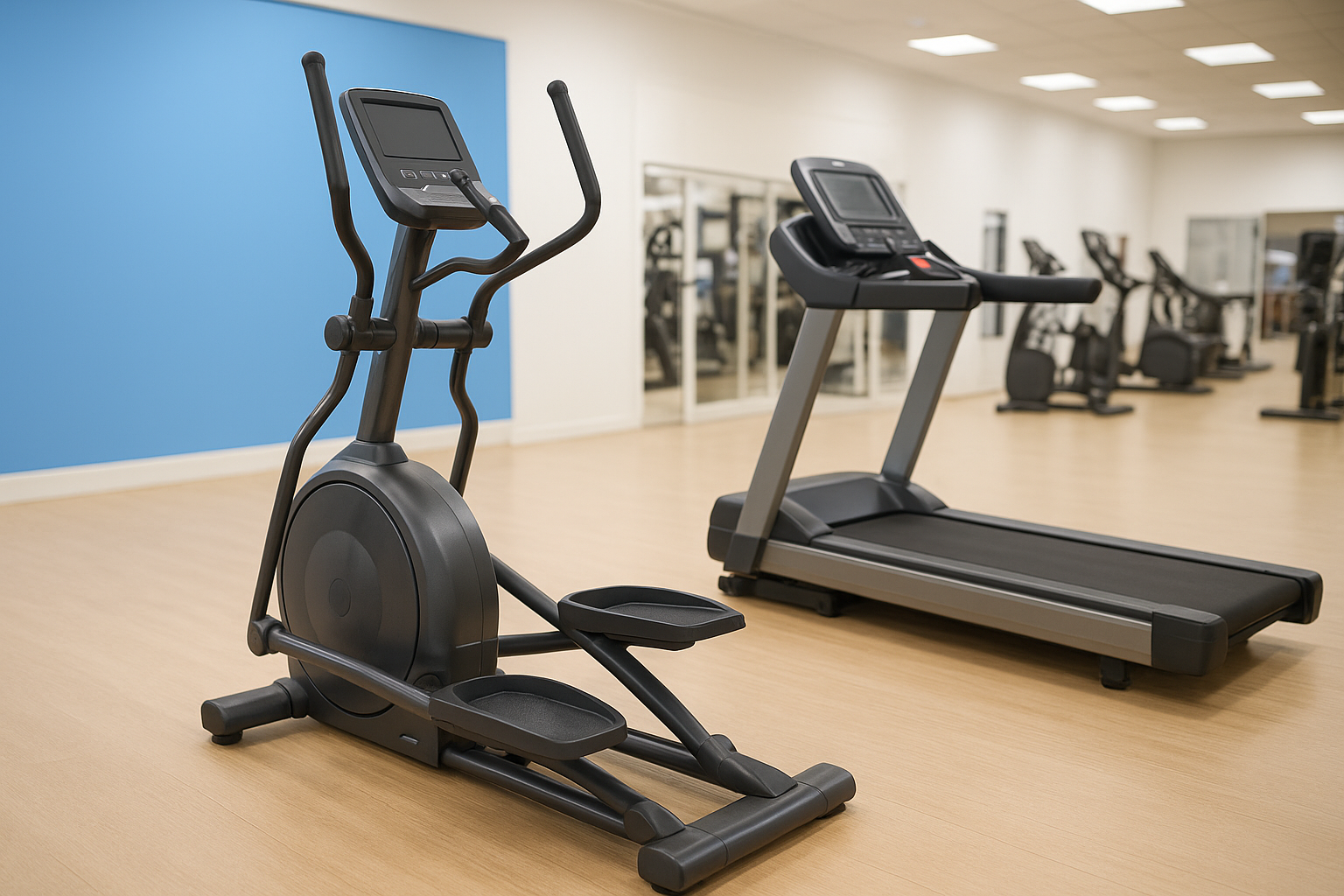
A machine’s motor and frame determine whether you’re buying five years of workouts or five months.
Connectivity and console features
App compatibility has become a real factor in whether people actually use their equipment, not just a marketing checkbox. Look for Bluetooth-enabled consoles that connect to fitness apps like Zwift, Peloton Digital, or Kinomap, so you’re not locked into one proprietary ecosystem. Machines that support "bring your own screen" setups let you prop up a tablet and skip paying for a built-in display you’ll outgrow anyway. Built-in heart rate monitoring, ideally with a wireless chest strap included rather than sold separately, keeps you training in the right zone without extra purchases.
Warranty coverage and what it actually protects
Warranty terms reveal more about a manufacturer’s confidence than any glossy brochure does. Compare what’s covered before you compare price:
| Coverage | What to look for |
|---|---|
| Frame | Lifetime coverage signals confidence in welds and materials |
| Parts | 5-7 years indicates commercial-grade components |
| Labor | At least 1 year, so early issues don’t cost you a service call |
| Delivery | Free curbside or White Glove installation reduces setup risk |
A thorough warranty, paired with real phone or email support from the company that built the machine, tells you they expect it to last.
Space, noise, and delivery logistics
Finally, measure your actual space before you fall for a feature list. Ellipticals generally need less floor length than treadmills but more width for the stride path, so a tape measure beats guessing every time. Consider noise level too, since a loud motor or squeaky flywheel becomes a real problem in an apartment or a shared living space. Ask about delivery options as well: curbside drop-off saves money, but White Glove delivery and installation is worth paying for on heavier machines you don’t want to assemble alone.
Finding the right fit for your home workouts
The elliptical cross trainer vs treadmill debate really comes down to your joints and your goals, not marketing claims. Choose a treadmill when you’re training for a race or want that natural running motion. Choose an elliptical when you need zero-impact cardio that still delivers a real calorie burn and works your upper body. Neither answer is wrong, since both machines build cardiovascular fitness when you use them consistently.
Guessing at specs from a showroom floor won’t tell you which machine survives years of daily training. What will is a commercial-grade build, a warranty that backs up the manufacturer’s confidence, and console features you’ll actually use instead of pay a subscription for. Once you know which movement pattern fits your body, browse 3G Cardio’s elliptical trainers and treadmills side by side, and pick the one you’ll still be using next year.




No Comments