

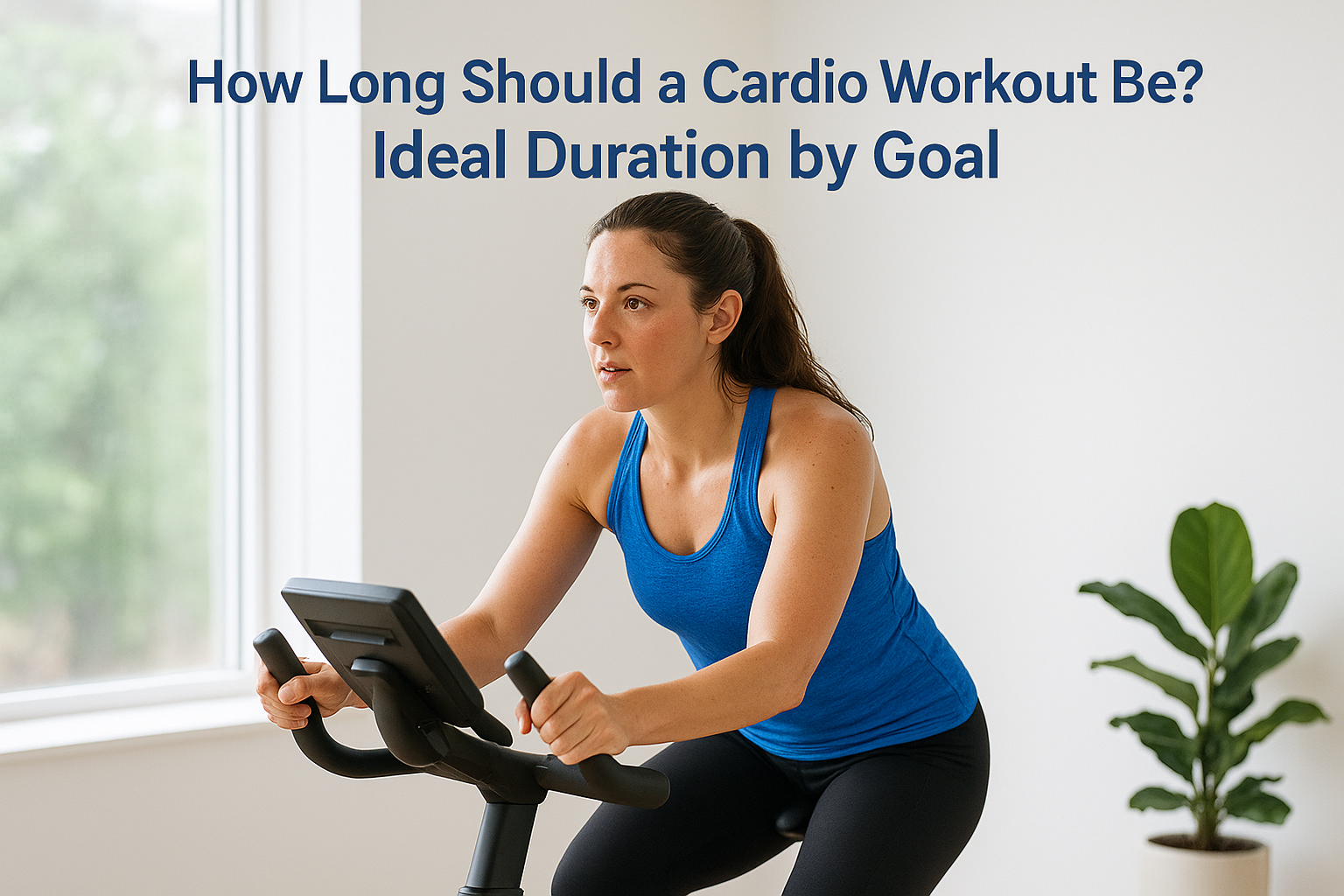
21 Jul How Long Should a Cardio Workout Be? Ideal Duration by Goal
You’ve got 30 minutes free before work, or maybe an hour on a Saturday morning, and you’re wondering if that’s actually enough to move the needle. So the real question, how long should a cardio workout be, doesn’t have one universal answer. It depends entirely on what you’re training for.
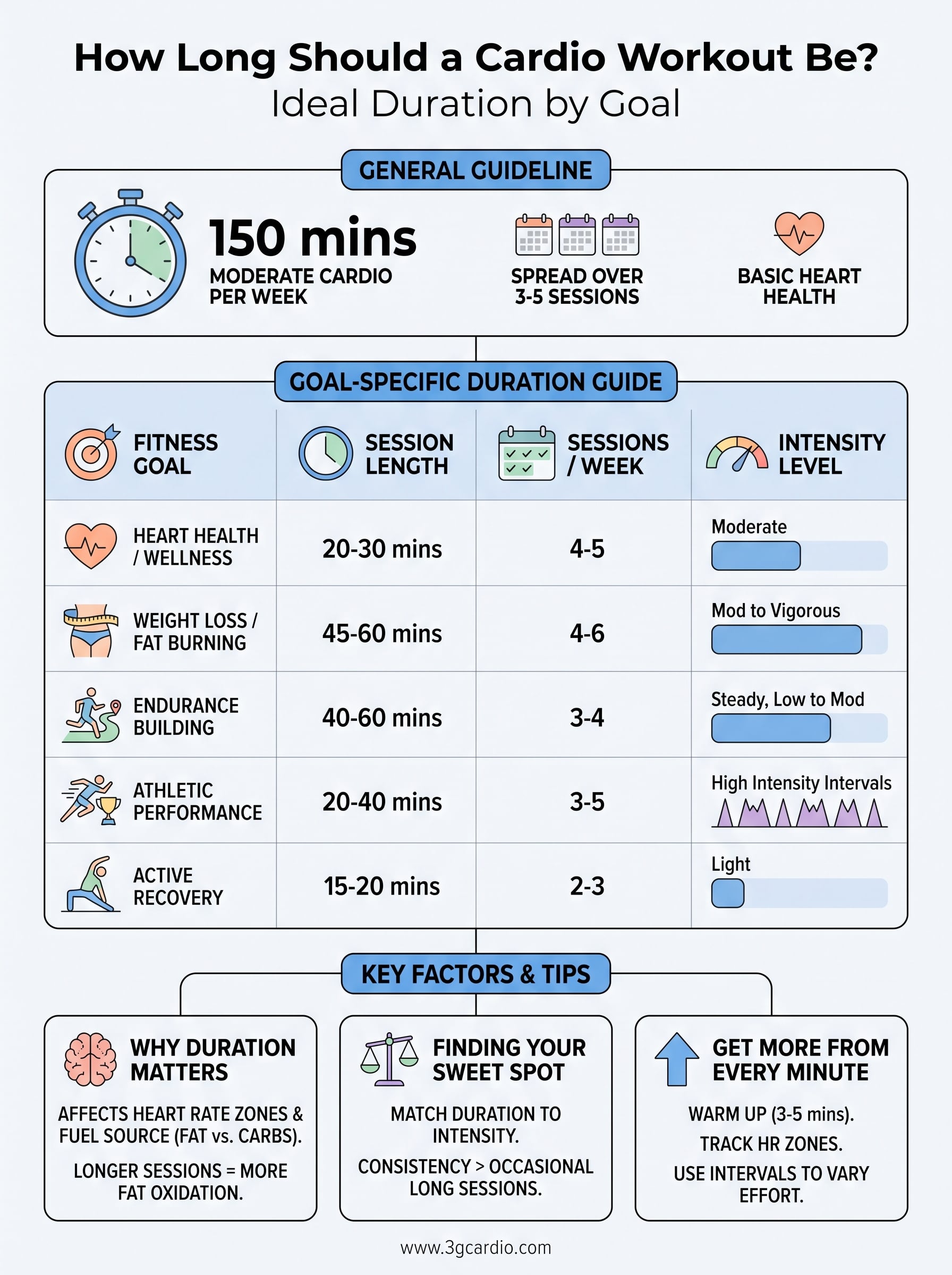
If you want the short answer: most healthy adults need 150 minutes of moderate cardio per week, spread across 3 to 5 sessions, to meet basic heart health guidelines. But that number shifts fast once you factor in your actual goal. Weight loss often calls for 45 to 60 minutes per session, while general endurance or heart health can be built in 20 to 30 minute blocks.
Below, we break down ideal cardio duration by specific goal, whether that’s fat loss, cardiovascular fitness, endurance training, or just staying active without burning out. We’ll also cover how session length interacts with intensity, and why the treadmill, recumbent bike, or elliptical you choose can make hitting these numbers a lot more sustainable week after week.
Why cardio duration matters for your results
Duration isn’t just a number you plug into a fitness app. It’s the variable that decides whether your workout builds real cardiovascular capacity or just burns time. Session length directly affects your heart rate zones, and those zones determine which energy systems your body taps into. A 15-minute sprint session trains something completely different than a 45-minute steady-state ride on a recumbent bike, even if both leave you sweaty.

Training time also affects your caloric burn and fat oxidation in ways that aren’t linear. Your body relies more heavily on stored carbohydrates in the first 20 minutes of moderate cardio, then gradually shifts toward burning a higher percentage of fat as the session continues. This is why fitness goals built around weight loss usually call for longer sessions, not just harder ones. Cutting a workout short at 15 minutes might feel productive, but it often stops right before your body settles into that fat-burning rhythm.
The right cardio duration isn’t about working out longer, it’s about matching your session length to what your body needs to accomplish.
Recovery capacity plays a role too. Overdoing session length without building up gradually leads to joint strain, mental burnout, and inconsistent training weeks. The American Heart Association recommends spreading your minutes across multiple sessions rather than cramming everything into one marathon workout, and that guidance exists because your body adapts better to consistent, moderate stress than to occasional overload. Someone doing 20-minute sessions five days a week typically sees steadier progress than someone doing one grueling 100-minute session and then skipping the rest of the week.
Understanding this relationship between time, intensity, and recovery is what separates a workout plan that actually works from one that just looks good on paper. Once you know why duration matters, figuring out your ideal length becomes a lot more straightforward, and that’s exactly what we’ll walk through next.
How to determine your ideal cardio workout length
Your ideal session length starts with an honest look at where you’re at physically, not where you wish you were. Beginners typically do better starting at 15 to 20 minutes and building up gradually, while someone with a solid training base can handle 45 to 60 minutes without the joint stress or burnout that derails consistency. Trying to jump straight to an hour when you haven’t exercised regularly in years usually backfires within two weeks.
Match duration to intensity
Intensity and duration work as a trade-off, not two separate variables. Higher intensity intervals need less total time to deliver cardiovascular benefit, while lower intensity steady-state work requires longer sessions to produce the same effect. A 20-minute interval workout on an elliptical can rival the benefit of 45 minutes at a relaxed pace, so figure out which style fits your schedule and joints better before locking in a number.
Your fitness level and chosen intensity should decide your session length, not the other way around.
Factor in recovery and consistency
Consistency beats intensity when you’re building a sustainable habit. Weekly minutes matter more than any single session, so a realistic 25-minute routine you’ll actually repeat five days a week outperforms an ambitious 60-minute plan you abandon after ten days. Check how your joints and energy feel the next morning. If you’re dragging, shorten the next session rather than pushing through and risking a setback that costs you an entire week.
Ideal cardio durations for common fitness goals
Every cardio goal has a different sweet spot, and matching your session length to that goal saves you from wasted workouts. Heart health maintenance needs the least time investment, while fat loss and endurance training demand longer, more consistent sessions to see real change. Use the table below as a starting framework, then adjust based on how your body responds.

| Fitness Goal | Session Length | Sessions Per Week | Intensity Level |
|---|---|---|---|
| Heart health / general wellness | 20-30 minutes | 4-5 | Moderate |
| Weight loss / fat burning | 45-60 minutes | 4-6 | Moderate to vigorous |
| Endurance building | 40-60 minutes | 3-4 | Steady, low to moderate |
| Athletic performance | 20-40 minutes | 3-5 | High intensity intervals |
| Active recovery | 15-20 minutes | 2-3 | Light |
Match the session to the goal, not the goal to whatever time you happen to have free.
Why these ranges work
Shorter, high-intensity sessions build VO2 max and speed efficiently, which is why athletic training doesn’t need an hour to be effective. Fat loss goals lean longer because your body needs sustained time in that fat-oxidizing zone before results show up on the scale. Recovery days stay brief on purpose, since the point is blood flow and joint mobility, not another hard training stimulus. Pick the row that matches your current priority, and don’t feel pressured to chase the longest number on the chart just because it looks more serious.
Tips for getting more from every cardio minute
Once you’ve settled on a duration, the next question is how to make sure those minutes actually count. Warming up for 3 to 5 minutes before ramping intensity primes your joints and heart rate, so you’re not wasting the first chunk of your session just getting loose. Skipping this step often means you spend a third of a 20-minute workout underperforming.
Zone tracking turns a guess into a plan. Heart rate monitoring through a chest strap or wrist monitor tells you whether you’re actually training in the zone your goal requires, since perceived effort is notoriously unreliable once you’re a few minutes into a session. A machine with built-in heart rate compatibility, like the consoles on 3G Cardio’s Elite series, makes this easier because the data is right in front of you instead of buried in a separate app.
Tracking your effort, not just your clock, is what turns a good-enough workout into a productive one.
Varying intensity within a single session also stretches the value of your time. Alternating between 2 minutes of harder effort and 2 minutes of recovery on a treadmill or bike builds more cardiovascular adaptation than holding one flat pace the entire time. Interval structure like this lets you get comparable benefit in less total time, which matters most on the days your schedule only gives you 20 minutes instead of 45.
Finding Your Cardio Sweet Spot
There’s no single magic number for cardio duration, but there is a right answer for you. Your goal drives the math: 20 to 30 minutes covers heart health, 45 to 60 minutes serves fat loss, and shorter high-intensity intervals build athletic performance without eating your whole evening. Start where your current fitness allows, track your heart rate zones instead of guessing, and adjust duration as your body adapts.
Consistency beats any perfect plan you never repeat. A realistic weekly routine you’ll actually stick to always outperforms an ambitious schedule that falls apart by week two. The right equipment makes that consistency a lot easier to maintain, especially when it’s comfortable enough that you look forward to your session instead of dreading it.
If you’re ready to build that routine on equipment designed for real, sustainable training, explore 3G Cardio’s lineup of treadmills, bikes, and ellipticals built for exactly this kind of consistency.




Sorry, the comment form is closed at this time.