

16 Jul How Often to Do Cardio to Lose Weight: Days & Duration
You bought a treadmill or bike, you’re motivated, and now you’re stuck on the actual math: how many days a week should you be sweating, and for how long? Figuring out how often to do cardio to lose weight matters more than picking the fanciest machine, because inconsistent workouts stall fat loss no matter how good your equipment is. Get the frequency wrong and you either burn out by week three or barely dent your calorie deficit.
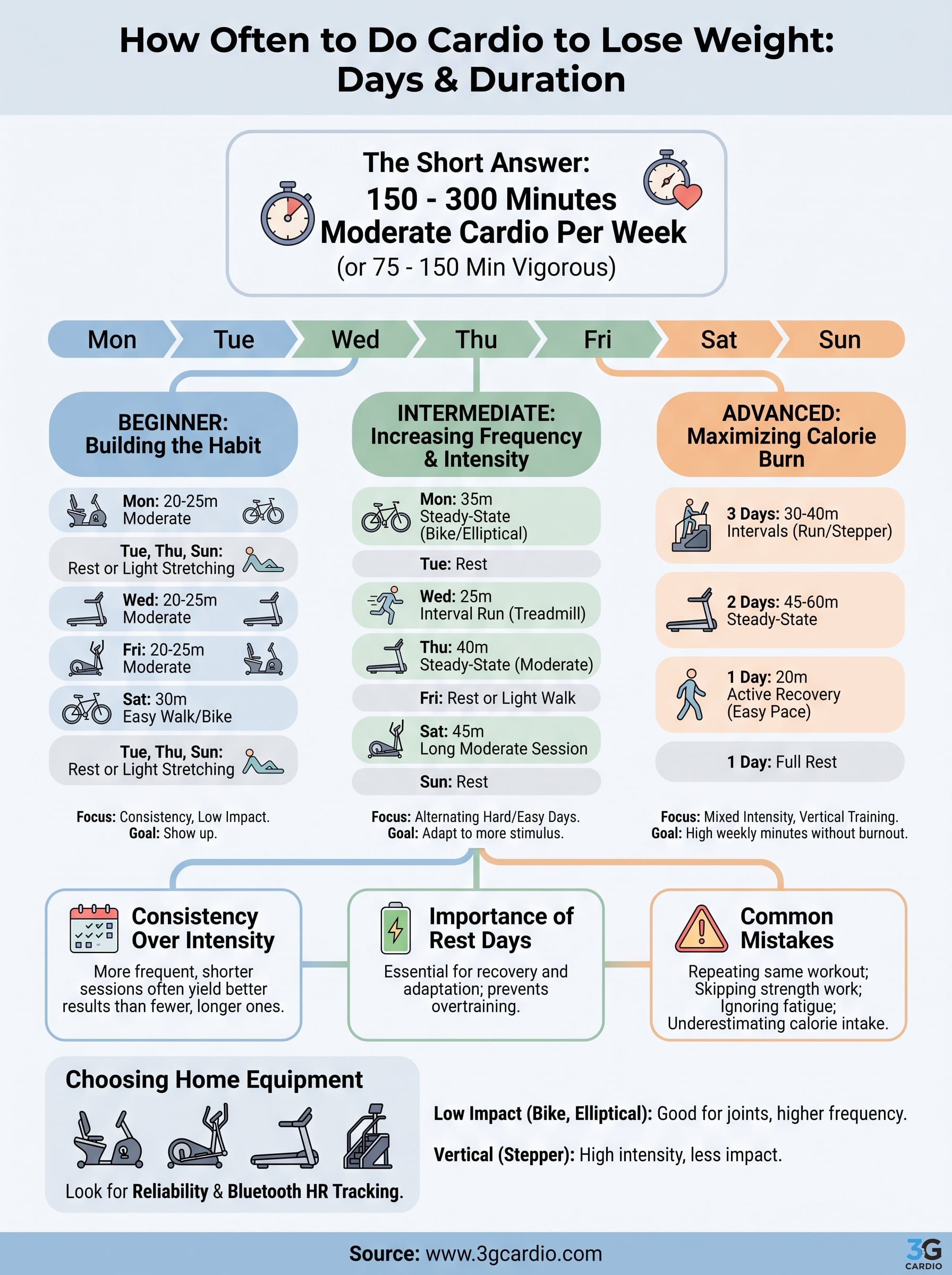
The short answer: most people need 150 to 300 minutes of moderate cardio per week, spread across 4 to 6 sessions, to see steady weight loss. That could mean 30 minutes daily or 45 to 60 minutes four times a week, depending on intensity and your recovery capacity. Session length and frequency work together, not separately, so a plan built around only one of them usually falls apart.
Below, we break down exact day-by-day schedules for beginners and experienced exercisers, how intensity changes the math, and why a reliable home machine with heart rate tracking makes it easier to stick to whichever plan fits your life.
Why cardio frequency matters for weight loss
Weight loss runs on a calorie deficit, plain and simple, and cardio frequency decides how much of that deficit you can create week after week without wrecking your knees or your schedule. One brutal 90-minute session might torch more calories on paper, but it also wipes you out for two days, and those missed days erase the benefit. Spreading the work across more sessions keeps your metabolism active, your joints happier, and your motivation intact.
The math behind weekly minutes
The Physical Activity Guidelines for Americans from the U.S. Department of Health and Human Services recommend 150 to 300 minutes of moderate cardio weekly, or 75 to 150 minutes if you push into vigorous intensity. That range exists because fat loss depends on total weekly output, not on any single heroic workout. A 30-minute walk five days a week and a 25-minute interval ride four days a week can land in the same calorie-burning neighborhood, even though they look completely different on a calendar.
| Intensity Level | Weekly Minutes Needed | Example Sessions |
|---|---|---|
| Moderate (brisk walk, easy bike) | 150-300 min | 5-6 sessions of 30-50 min |
| Vigorous (running, HIIT intervals) | 75-150 min | 3-4 sessions of 20-40 min |
| Mixed intensity | 100-200 min | 4-5 sessions varying pace |
Frequency beats single-session length
Research on exercise adherence consistently shows that people who train more often, even at shorter durations, lose more weight over six months than people who do fewer, longer sessions. Your body responds to repeated stimulus. Three or four sessions a week keep your heart rate variability and insulin sensitivity improving, while a single weekend workout barely nudges either.
Consistency across the week burns more fat than intensity crammed into one session.
How rest days affect fat-burning
Rest days aren’t wasted days, they’re where your body actually adapts. Skipping recovery invites overtraining, which raises cortisol and can stall weight loss even as you exercise harder. Two lower-intensity or fully off days per week give your joints and nervous system time to reset, which is exactly why the schedules later in this article alternate hard and easy days instead of stacking maximum effort back to back.
How to build a cardio schedule that fits your goals
Building a workout plan starts with picking a target and working backward, not grabbing a random routine off a fitness app. Decide first whether you’re chasing steady weight loss or trying to protect a joint injury, because those two goals point toward different frequency and duration combinations. Someone recovering from a knee issue needs more low-impact days on a recumbent bike, while someone with healthy joints can handle more running-based sessions.
Start with your available time, not your ambition
Most people overestimate how many days they’ll actually show up. Look honestly at your week and block out realistic windows, whether that’s four 40-minute slots or six 25-minute ones. Your schedule only works if you can repeat it, so build around the time you actually have instead of the time you wish you had.
Match intensity to your calendar
Once you know your available minutes, intensity fills in the gaps. Higher intensity sessions let you hit your weekly minimum in fewer days, which matters if your calendar is packed.
- 3-4 days available: lean toward vigorous intervals, 25-35 minutes each
- 5-6 days available: moderate steady-state, 30-50 minutes each
- Mixed schedule: alternate one hard day with one easy day
Build in a progression, not a plateau
Exercise adherence data from the CDC shows that people who gradually increase either frequency or duration over 8 to 12 weeks stick with cardio far longer than those who jump straight to maximum volume. Add five minutes or one extra session every two weeks instead of overhauling your routine overnight.
A schedule you can repeat for months beats a perfect plan you abandon after two weeks.
Track your sessions somewhere visible, a wall calendar or an app connected to your equipment’s console, so skipped days become obvious before they turn into a skipped month.
Sample weekly cardio routines for different fitness levels
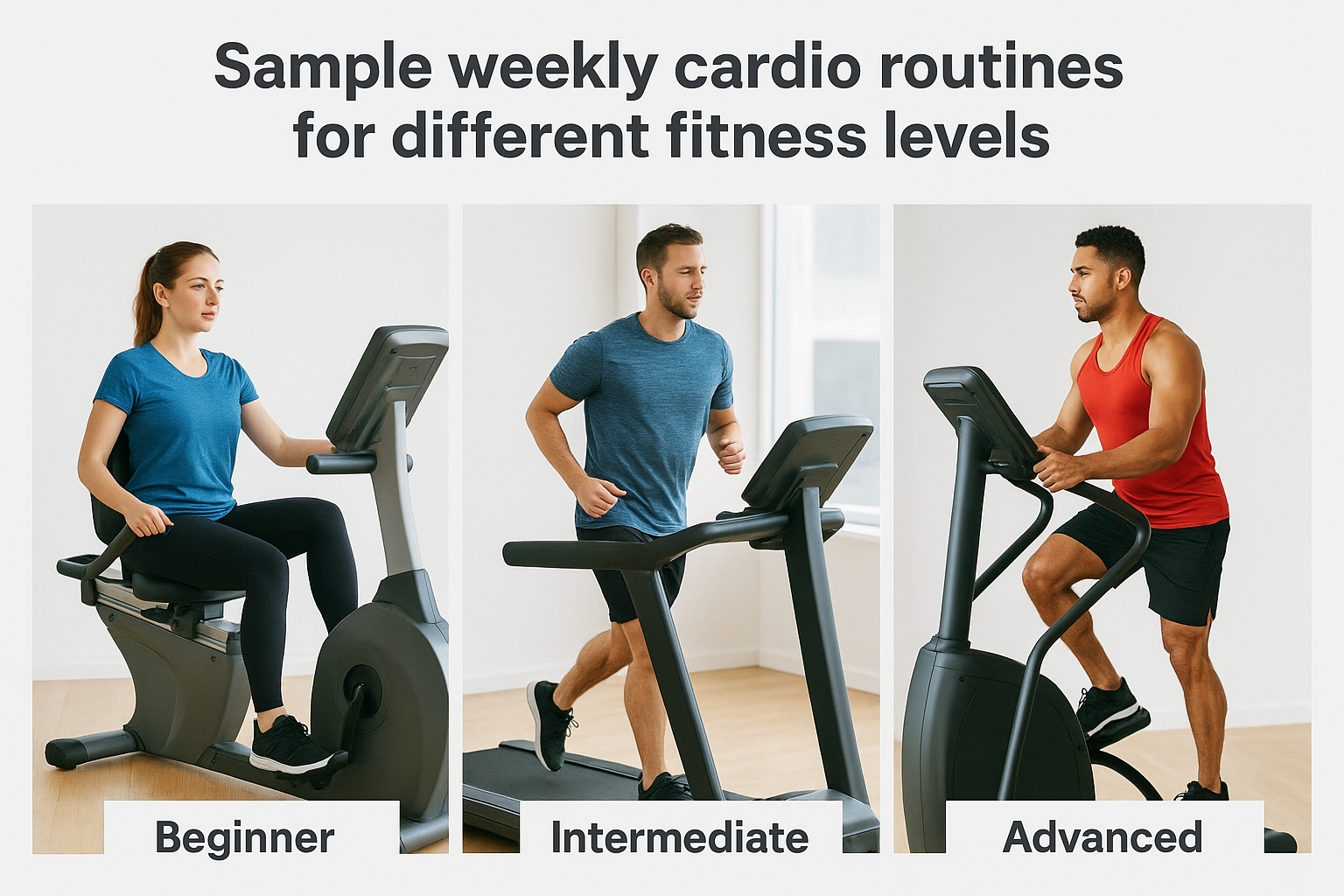
Generic advice falls apart the moment you try to apply it to your actual week, so here are three ready-to-use templates. Pick the one that matches your current fitness level, run it for four weeks, then reassess before you add volume.
Beginner: building the habit first
Someone just starting out needs consistency more than intensity, so the goal is simply showing up on a recumbent bike or treadmill without pain or burnout. Low-impact sessions protect joints that haven’t adapted to regular movement yet, and shorter durations keep motivation high.
- Monday, Wednesday, Friday: 20-25 minutes moderate pace
- Saturday: 30-minute easy walk or bike
- Tuesday, Thursday, Sunday: rest or light stretching
Intermediate: increasing frequency and intensity
Once you’ve held the beginner schedule for a month without missing sessions, weekly minutes should climb toward the higher end of the recommended range. This is where alternating hard and easy days starts to matter, since your body can now handle more frequent stimulus.
| Day | Activity | Duration |
|---|---|---|
| Mon | Steady-state bike or elliptical | 35 min |
| Tue | Rest | – |
| Wed | Interval treadmill run | 25 min |
| Thu | Steady-state, moderate | 40 min |
| Fri | Rest or light walk | – |
| Sat | Long moderate session | 45 min |
| Sun | Rest | – |
The right routine is the one you can repeat next week, not the one that looks impressive on paper.
Advanced: maximizing calorie burn
Experienced exercisers can push toward six sessions weekly, mixing vigorous intervals with longer steady efforts to hit 300 minutes without overloading any single day. Vertical stair steppers work well here since they add intensity without extra joint stress compared to running.
- 3 days: interval training, 30-40 minutes
- 2 days: steady-state, 45-60 minutes
- 1 day: active recovery, easy pace 20 minutes
- 1 day: full rest
Whichever version you choose, the schedule only works if your equipment supports it week after week.
Choosing home cardio equipment that keeps you consistent
Skipping a session because the belt squeaks or the console freezes isn’t a willpower problem, it’s an equipment problem. If your machine is uncomfortable, unreliable, or boring after week two, you won’t hit those weekly minutes no matter how good your schedule looks on paper. The right home cardio equipment removes friction so showing up becomes automatic instead of a daily negotiation.
Why reliability beats fancy features
Commercial-grade construction matters more than screen size. A treadmill built for gym use handles daily pounding for years, while a bargain model wears out belts and motors within a season, right when you’ve finally built momentum. Consistent frequency depends on a machine that still runs smoothly on day 200, not just day one.
The best cardio machine is the one still working reliably a year from now, not the one with the flashiest console.
Match the machine to your body and schedule
Low-impact options like recumbent bikes and elliptical trainers let you train more days per week without joint flare-ups, which directly supports the 5-to-6-day schedules covered earlier. Vertical stair steppers add intensity for advanced routines without the pounding of running. Treadmills remain the most versatile choice for mixing steady-state and interval days in one machine.
| Equipment Type | Best For | Impact Level |
|---|---|---|
| Recumbent bike | Beginners, joint issues | Very low |
| Elliptical trainer | Mixed intensity, all levels | Low |
| Treadmill | Intervals and steady-state | Moderate-high |
| Vertical stair stepper | Advanced calorie burn | Moderate |
Bluetooth heart rate tracking and app connectivity, like the FreeSync FTMS technology built into 3G Cardio consoles, let you follow the exact weekly minutes your schedule calls for without guessing. Pairing your own tablet through Bring Your Own Screen keeps costs down while still giving you real feedback on effort, which makes the difference between a machine that gathers dust and one that earns its spot in your routine.
Common mistakes that slow your weight loss progress
Even a solid schedule can stall if a few habits quietly sabotage your effort. Most plateaus trace back to a handful of repeatable mistakes rather than bad luck or a slow metabolism.
Doing the same session every single day
Repeating identical duration and intensity day after day trains your body to become efficient at that exact workout, which means it burns fewer calories doing it six months in. Your body adapts fast, so a 30-minute treadmill walk at the same pace stops challenging you within a few weeks. Rotating steady-state days with interval days, like the intermediate schedule above, keeps your metabolism guessing instead of coasting.
Skipping strength work entirely
Cardio alone can’t preserve the muscle mass that keeps your resting metabolism high. Losing muscle alongside fat means your body needs fewer calories to maintain itself, which slows progress even as the scale drops. Two short strength sessions a week, even just 20 minutes with bodyweight moves, protect the muscle that makes your cardio minutes count for more.
Ignoring recovery signals
Pushing through fatigue, soreness, or poor sleep to hit a streak usually backfires. Overtraining raises stress hormones and can stall fat loss even as workout volume climbs, which defeats the entire point of a structured schedule.
Forcing a hard workout on a depleted body burns willpower faster than it burns fat.
Underestimating calorie intake
A tough session can create a false sense of license to eat more than the workout actually burned. Tracking food loosely for a week or two reveals whether your deficit is real or accidentally erased at dinner.
- Repeating the exact same workout for months
- Skipping strength training entirely
- Training through fatigue or poor sleep
- Overestimating calories burned per session
- Abandoning the plan after one missed week
Fixing even two of these mistakes usually unsticks progress faster than adding another hard day to your schedule.
Making cardio a lasting habit
The frequency question has a clear answer: 150 to 300 minutes weekly, spread across 4 to 6 sessions, beats any single marathon workout. Duration and frequency work as a team, and the schedule you can actually repeat will always outperform the one that looks perfect on paper but gets abandoned after two weeks.
Getting there depends less on willpower and more on removing friction from your routine. Rotate hard and easy days, protect your rest days, and pair your plan with equipment that still runs smoothly a year from now instead of gathering dust in the garage. Reliable equipment turns your weekly minutes from a struggle into a habit, and that habit is what actually drives the scale down.
If you’re ready to build a schedule around a machine that won’t quit on you, explore 3G Cardio’s home cardio equipment and find the treadmill, bike, elliptical, or stair stepper built to keep up with your weekly minutes for years, not months.




Sorry, the comment form is closed at this time.