

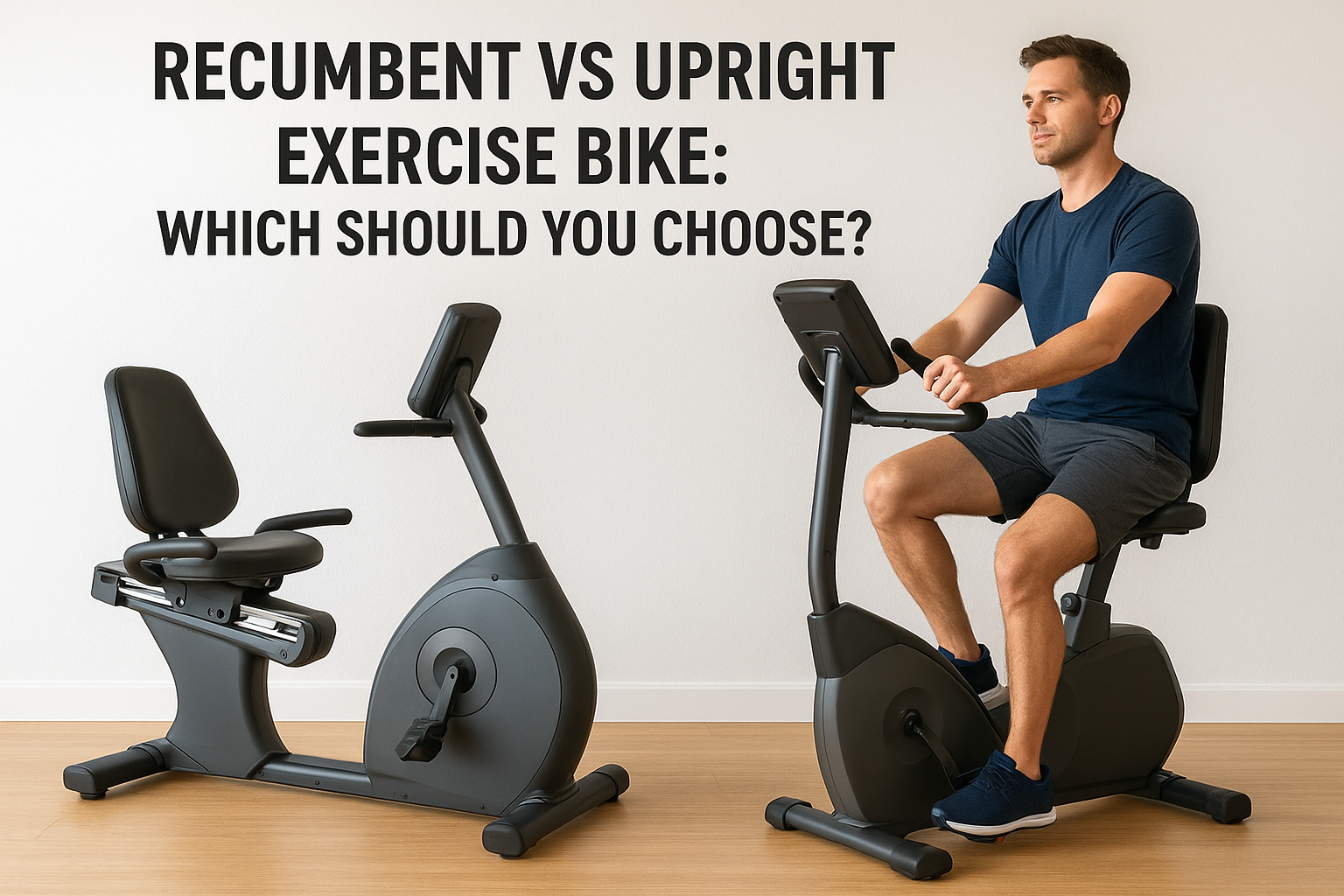
08 Sep Recumbent vs Upright Exercise Bike: Which Should You Choose?
You’re standing between two bikes at the gym, or scrolling through options online, and you can’t decide which one actually fits your body and your goals. The recumbent exercise bike vs upright exercise bike question comes up constantly because the two machines feel completely different to ride, even though they train the same muscles.
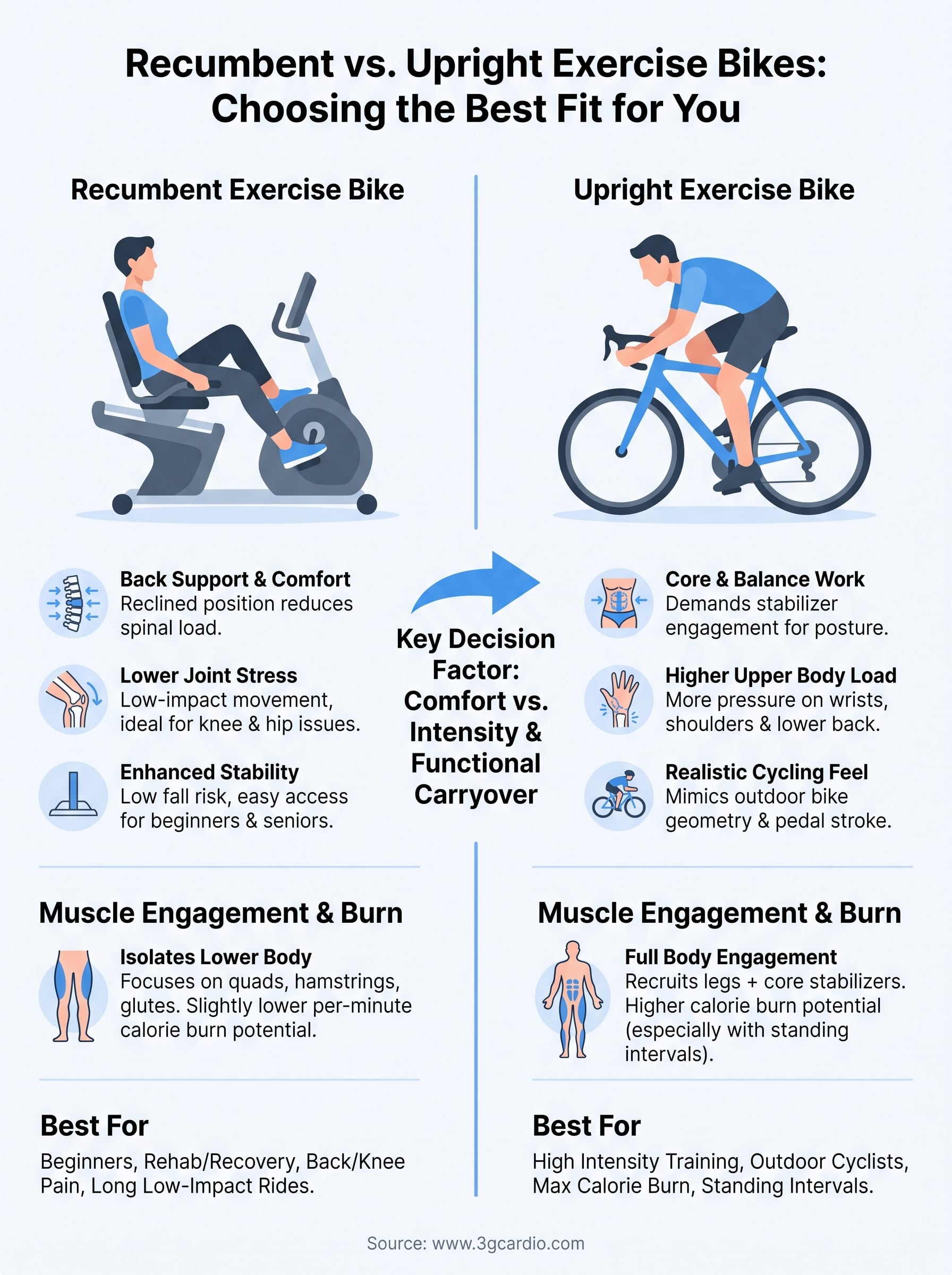
The short answer: recumbent bikes put you in a reclined seat with back support and lower joint stress, while upright bikes mimic a road bike position and demand more core and balance work. The difference between upright and recumbent exercise bike designs comes down to seat position, muscle recruitment, and how much impact your hips and knees absorb during a workout. Neither is objectively better, but one is almost always the better fit for your body and your training goals.
Below, we break down comfort and joint impact, muscle engagement, calorie burn, and who each bike style actually serves best, from beginners with back or knee issues to serious riders chasing higher intensity. By the end, you’ll know exactly which type belongs in your home gym.
Why choosing the right bike type matters for your goals
Picking the wrong bike doesn’t just waste money, it wastes your time and motivation too. A home cardio machine only works if you actually use it, and comfort is the single biggest predictor of whether a bike gets ridden daily or turns into a clothes rack within a month. Riders who choose a bike that fights their body, too much strain on the lower back, wrists going numb, knees aching after ten minutes, quietly stop showing up. That’s the real cost of getting this decision wrong, and it’s why the recumbent vs upright question deserves more thought than just picking whatever’s on sale.
The wrong bike stalls your progress
Consistency beats intensity almost every time in cardio training. Someone who rides a recumbent bike for 30 minutes, four days a week, will out-train someone who buys an upright bike, hates the saddle, and rides twice a month. Joint discomfort and poor posture are the two most common reasons people abandon a bike early, which is why so many riders end up on cardio equipment designed for low impact, and both problems trace directly back to seat design and body position. If you already know you struggle with an upright saddle at the gym, don’t assume a home version will feel different. It won’t.
The best exercise bike is the one you’ll actually ride tomorrow, not just today.
Your body and limitations should drive the decision
Everyone’s starting point is different, and that matters more than brand loyalty or what your gym buddy uses. Riders recovering from a knee replacement, managing lower back pain, or dealing with balance issues almost always do better on a recumbent frame, since the seat and backrest remove the stabilizing work your core and legs would otherwise handle, and that’s only the start of what a recumbent exercise bike does for you. Athletes chasing a harder cardio stimulus, or cyclists training for outdoor rides, usually prefer the upright bike’s forward-leaning stance because it mirrors real cycling mechanics and recruits more stabilizer muscles. Neither preference is wrong. It’s just a different training goal wearing a different shape.
Matching bike type to your fitness goal
Before you buy, it helps to see how the two styles line up against common goals side by side. This isn’t about which bike is "better" in general, it’s about which one actually solves your specific problem.
| Your Goal | Better Fit | Why |
|---|---|---|
| Lower back or knee pain | Recumbent | Reclined seat removes spinal load and reduces knee shear |
| Rehab or post-surgery cardio | Recumbent | Stable seated position, low fall risk |
| Maximum calorie burn per minute | Upright | Engages more muscle groups and core stabilizers |
| Training for outdoor cycling | Upright | Mimics road bike geometry and pedal stroke |
| Long, low-impact sessions | Recumbent | Back support allows longer rides without fatigue |
| Beginners easing into cardio | Recumbent | Easier to mount, lower intimidation factor |
| Interval or sprint training | Upright | Allows standing pedaling and faster cadence shifts |
The table makes the pattern obvious once you see it laid out: recumbent bikes solve for comfort, accessibility, and joint protection, while upright bikes solve for intensity and functional carryover to real cycling. Fitness goals should always come before machine preference, because a bike that doesn’t match what you’re trying to accomplish will either bore you or burn you out.
Deciding based on your actual limitations and objectives, rather than assumptions about what a "real" workout looks like, is what separates people who stick with home cardio equipment from people who don’t. Once you’re honest about your joints, your schedule, and what kind of intensity you can realistically sustain, the choice between recumbent and upright starts to feel a lot less like guesswork and a lot more like common sense.
How to decide between a recumbent and upright bike
Deciding between these two bike styles gets easier when you turn it into a short checklist instead of a gut feeling. Most buyers get stuck because they’re comparing specs and prices instead of asking the questions that actually predict daily use. Work through the list below honestly, and the right answer usually reveals itself in under five minutes.
Ask yourself these questions first
Start with your body, not the bike. The following questions cut through most of the confusion around shopping for a recumbent or upright exercise bike:
- Do you have existing back, hip, or knee pain that limits how long you can sit upright?
- Are you recovering from surgery or an injury that affects balance?
- Do you want a workout that mimics outdoor road cycling?
- Is your main goal steady, long-duration cardio, or short, high-intensity intervals?
- Will more than one person with different fitness levels be using the bike?
- Do you need to read, work, or watch something while you ride?
If you answered yes to the first two or the last one, a recumbent bike almost always wins. If you answered yes to the middle two, an upright bike is the better training tool.
If you can’t picture yourself on the bike for 30 minutes without shifting or wincing, you’ve already got your answer.
Weigh your space, budget, and household needs
Space matters more than people expect. Recumbent bikes have a longer footprint because of the extended seat rail and backrest, so measure your floor space before assuming one will fit where your old upright bike used to sit, and run through the rest of the recumbent bike shopping checklist while you’re at it. Households with multiple riders, a spouse with knee pain and a teenager training for a cycling team, often find the recumbent frame more forgiving across different body types and fitness levels, since the seated position doesn’t punish beginners the way a narrow upright saddle can.
Trust a short test ride over specs on paper
Specifications tell you what a bike can do, but only your body tells you what it will actually do for you. Testing both styles for ten minutes each, at a gym or a showroom, exposes discomfort faster than any spec sheet. Your knees, lower back, and wrists will tell you the truth before your brain finishes rationalizing the purchase. That real-world feedback, more than reviews or star ratings, should be the deciding factor when you’re choosing between a recumbent and an upright frame for years of regular use.
Comfort and joint impact: recumbent vs upright bikes
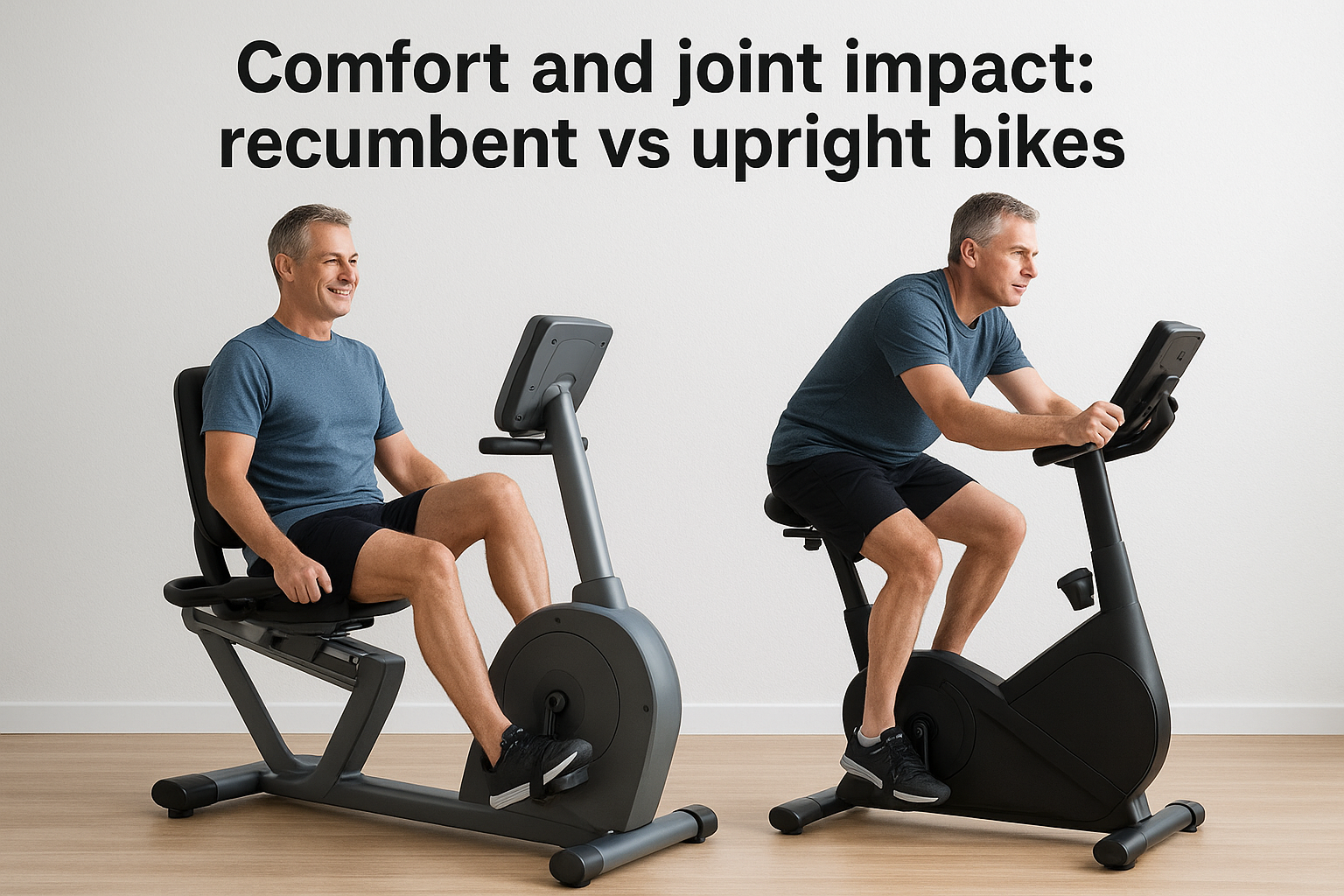
Seat design is where these two bikes stop being interchangeable. A recumbent bike puts your hips and knees at roughly the same height, so your leg drives forward and back through a shallow arc instead of pushing down against gravity. That geometry cuts the shear force on your knee joint dramatically, which is why physical therapists so often recommend recumbent models for rebuilding strength after ACL surgery or a knee replacement. The wide, cushioned bike seat and full backrest also remove the compression that a narrow upright saddle puts on your sit bones and lower spine.
Comfort isn’t a luxury feature on a cardio bike, it’s the mechanism that keeps your joints out of pain and your workout habit alive.
Why the upright position demands more from your body
An upright bike asks your torso to do work a recumbent frame does for you automatically. You’re balancing your own weight over a narrow saddle, gripping handlebars, and stabilizing through your core with every pedal stroke. That’s great for building functional strength, but it also means more pressure through your wrists, shoulders, and lower back, especially during longer rides. Riders with existing carpal tunnel symptoms or shoulder impingement often feel this within the first ten minutes, long before their legs fatigue.
Where each bike protects, and where it strains
Laying the two side by side makes the trade-offs obvious:
- Knees: Recumbent reduces shear force; upright increases load through a more vertical knee track
- Lower back: Recumbent’s backrest supports the spine; upright requires core engagement to maintain posture
- Wrists and shoulders: Recumbent has no handlebar weight-bearing; upright transfers upper body weight through the grips
- Hips: Recumbent’s open seat angle reduces hip flexor strain; upright’s forward lean can tighten hip flexors over time
- Balance and fall risk: Recumbent is nearly zero risk; upright requires ongoing stabilization
Running through that list against your own aches and old injuries usually settles the debate faster than any spec sheet. If you’ve got a bad back or sensitive knees, the recumbent column will read like a checklist of relief. If nothing on that list worries you, the upright bike’s extra demand on your stabilizer muscles becomes a feature instead of a drawback, since it builds the same core strength you’d use riding outdoors.
Muscle engagement and calorie burn for weight loss
Both bikes torch calories, but they recruit muscle differently, and that difference matters if losing weight with a home cardio machine is your main goal. An upright bike activates your quads, hamstrings, glutes, and core simultaneously because you’re stabilizing your own torso while pedaling. A recumbent bike isolates your lower body more, since the backrest and seated angle remove most of the core and stabilizer demand. That’s not a downside, it just means the calorie burn comes from a narrower set of muscles working a bit harder per stroke.
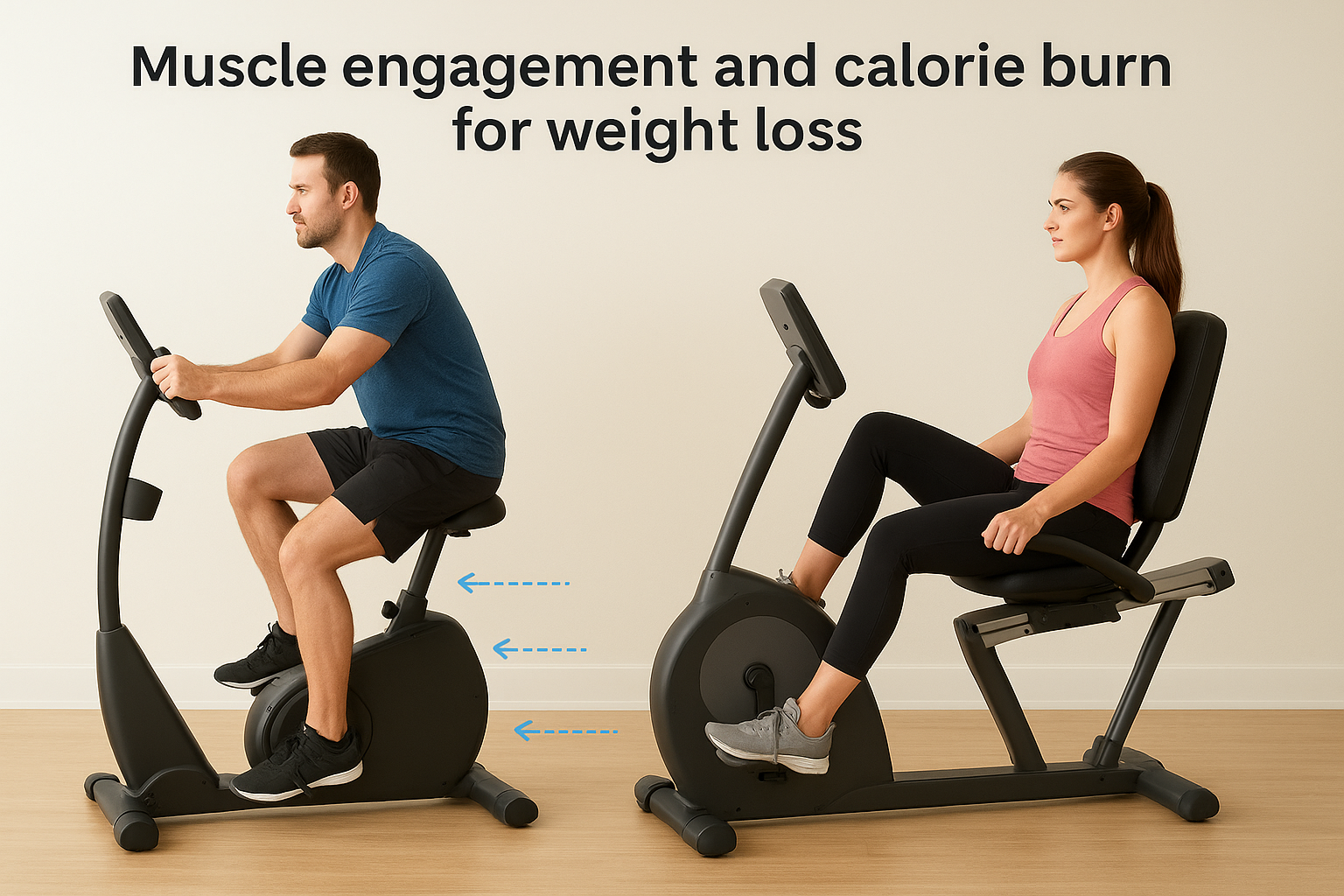
More muscle groups firing at once usually means more calories burned per minute, but only if you can sustain the intensity long enough to matter.
Why intensity beats muscle count for fat loss
Research on calorie burn consistently shows that total work output, not which muscles you use, drives fat loss over time. A rider who pushes hard on a recumbent bike for 45 minutes will out-burn someone who quits an upright session after 15 minutes because their back started aching. The CDC’s physical activity guidelines recommend at least 150 minutes of moderate cardio weekly, and consistency toward that number matters more than which bike style you choose.
Comparing the two for calorie burn potential
Here’s how the two styles typically compare during a 30-minute moderate-intensity session for a 165-pound rider:
| Bike Type | Estimated Calories Burned | Primary Muscles Worked |
|---|---|---|
| Recumbent | 210-260 | Quads, hamstrings, glutes |
| Upright | 240-300 | Quads, hamstrings, glutes, core, hip flexors |
These numbers shift depending on resistance level and cadence, but the upright bike’s edge comes from the extra stabilizer work, not from working your legs any harder.
Standing intervals and resistance changes the math
Upright bikes let you stand and pedal, which recruits your glutes and core in a way a recumbent frame simply can’t replicate because the seat and backrest hold you in place. Standing intervals spike your heart rate fast and add a strength component that seated pedaling misses entirely. Riders chasing aggressive fat loss often alternate seated and standing intervals on a sturdy machine like the Elite UB X upright exercise bike specifically for this reason. Still, don’t discount the recumbent option if standing intervals aren’t realistic for you: cranking resistance higher on a recumbent bike, model options like the Elite RB X recumbent bike include heavy-duty resistance ranges, builds the same muscular fatigue and calorie burn without ever leaving the seat.
Sample workouts to try on each bike type
Having a bike sitting in your living room doesn’t do much good without a plan for using it. Below are two starter workouts, one for each bike style, that you can run this week without any guesswork. Both build from an easy warm-up into intervals, then cool down, so your joints and heart rate ease in and out instead of shocking the system.
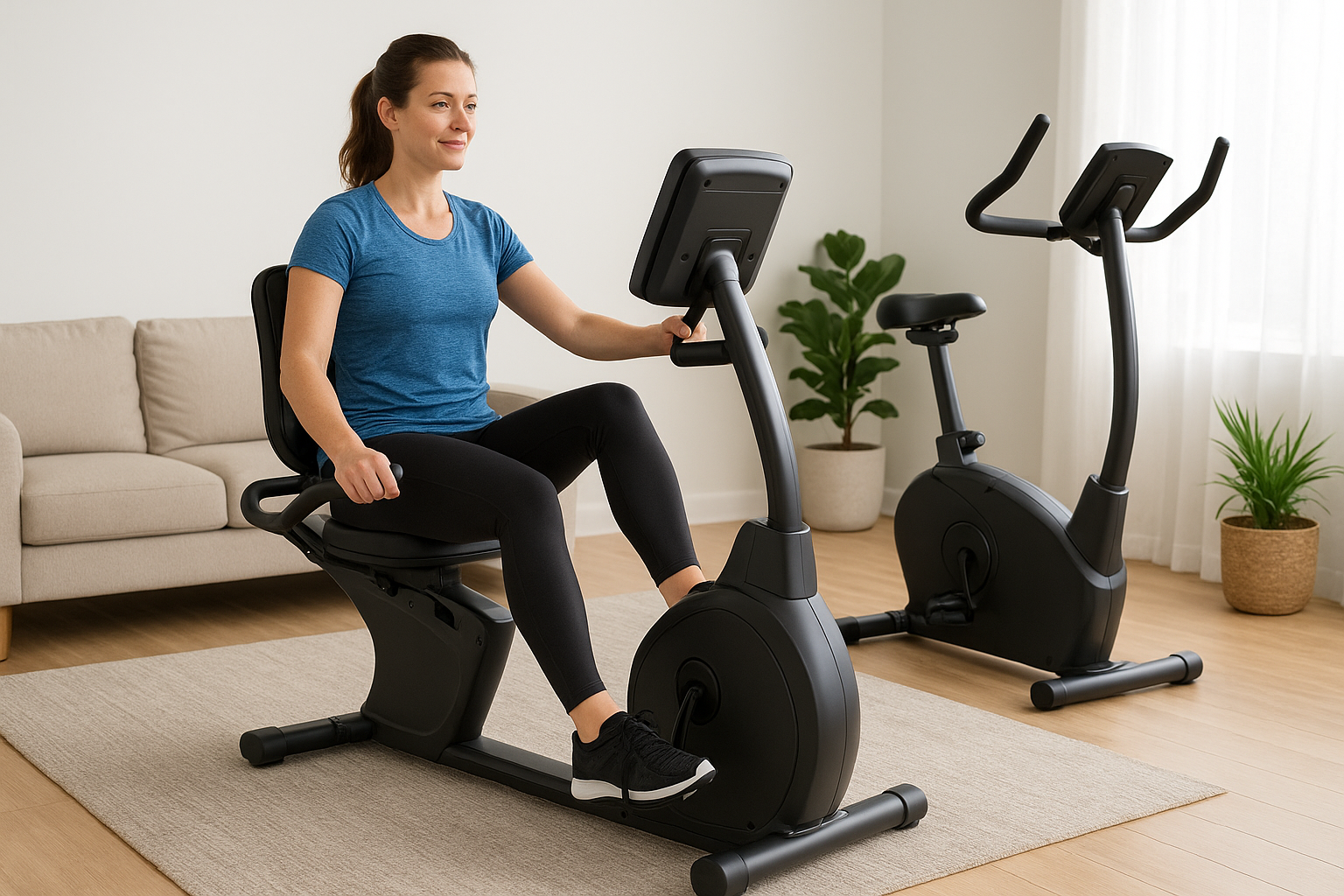
A 30-minute recumbent bike workout for steady cardio
Recumbent riders tend to do best with longer, steadier efforts rather than sharp bursts, since the seated position isn’t built for standing sprints. This workout leans on resistance changes instead of posture changes to keep things challenging, and you can rotate in other recumbent bike exercises as you progress.
0-5 min: Warm-up, light resistance, easy cadence
5-10 min: Increase resistance one level, steady pace
10-20 min: Alternate 2 min moderate resistance / 1 min higher resistance
20-27 min: Hold moderate-to-hard resistance, steady cadence
27-30 min: Cool down, light resistance
Quality recumbent models, like the Elite RB X, give you enough resistance range to make that middle block genuinely hard, which matters if you’re relying on resistance alone to drive intensity.
A 30-minute upright bike workout with standing intervals
Upright bikes reward workouts that mix seated and standing pedaling, since standing is the one thing a recumbent frame can’t offer you, and it’s the backbone of interval training on an upright bike. This structure uses that advantage on purpose.
0-5 min: Warm-up, seated, light resistance
5-9 min: Seated moderate resistance
9-10 min: Stand and pedal, moderate resistance
10-20 min: Repeat 4x (2 min seated hard / 1 min standing)
20-27 min: Seated, steady moderate pace
27-30 min: Cool down, seated, light resistance
Standing intervals push your heart rate up fast, so expect your breathing to spike within seconds of standing, that’s the point, not a sign something’s wrong.
A workout you’ll repeat three times a week beats a harder one you’ll quit after day two.
Progressing either workout over time
Don’t stay at week-one intensity forever. Progressing a recumbent workout usually means adding resistance or extending the moderate-to-hard intervals by a minute or two every week or so. Progressing an upright workout often means adding more standing blocks or shortening the seated recovery between them. Either way, track how you feel at the 20-minute mark: if it’s still comfortable, you’re due for more challenge next session. Consistency in showing up matters more than any single workout’s difficulty, so build intensity gradually rather than jumping straight to the hardest version you can find.
FAQs about recumbent vs upright bikes
Questions about the recumbent exercise bike vs upright exercise bike debate tend to repeat themselves, so here are direct answers to the ones that come up most in customer emails and gym conversations.
Is a recumbent bike as effective as an upright bike for weight loss?
Yes, as long as you match the intensity. A recumbent bike burns slightly fewer calories per minute than an upright bike at the same resistance because it recruits fewer stabilizer muscles, but total calories burned depends on how long and how hard you ride, not which bike you’re sitting on. Someone who rides a recumbent bike consistently for 45 minutes will out-perform someone who rides an upright bike for 15 minutes and quits from discomfort.
Consistency burns more fat than intensity ever will on its own.
Which bike is better for bad knees or joint pain?
Recumbent bikes win here almost every time. The seated position keeps your knee tracking through a shallow, low-impact arc instead of pushing down against gravity, which is exactly why physical therapists recommend them for post-surgery rehab and arthritis management. If your knees ache after ten minutes on an upright saddle, a recumbent frame will almost always feel like a different sport entirely.
Can beginners start on an upright bike safely?
Absolutely, though most beginners find the learning curve steeper. Balancing your weight over a narrow saddle while pedaling takes some adjustment, and new riders sometimes feel wobbly or sore in the wrists during the first week. If you’re brand new to cardio equipment and want the gentlest entry point, start on a recumbent bike and graduate to upright once your fitness base improves.
Do recumbent bikes build real muscle strength?
Definitely. Higher resistance settings on a quality recumbent bike build genuine strength in your quads, hamstrings, and glutes, even without the standing intervals an upright bike offers, which is why you can absolutely get a good workout on a recumbent bike. Muscle growth depends on resistance and effort, not seat angle, so don’t assume a reclined position means an easier workout.
Which bike works better for seniors or rehab patients?
Recumbent bikes are the clear choice for most seniors and rehab patients, and a few design details separate the best recumbent bike for senior citizens from the rest. The backrest, low mount height, and stable seated position remove fall risk almost entirely, which matters more than calorie burn when balance or fragility is a concern. Fall prevention alone justifies the recumbent choice for many older riders, regardless of fitness level.
Choosing the bike that fits your life
You don’t need a lab test to settle the recumbent exercise bike vs upright exercise bike debate for yourself. If your knees, back, or balance are a concern, or you just want long, comfortable sessions you’ll actually repeat, the recumbent frame wins. If you want a harder cardio stimulus, standing intervals, and carryover to outdoor riding, the upright bike earns its keep. The difference between upright and recumbent exercise bike designs isn’t about which is superior, it’s about which one matches your body and your training goals.
Whatever you choose, prioritize a machine built to handle years of regular use, not just the first few weeks of motivation. If comfort, low joint stress, and a seat that fits almost any body type matter most to you, take a closer look at the Elite RB X, the recumbent bike rated best in its class for 2025.




Sorry, the comment form is closed at this time.