

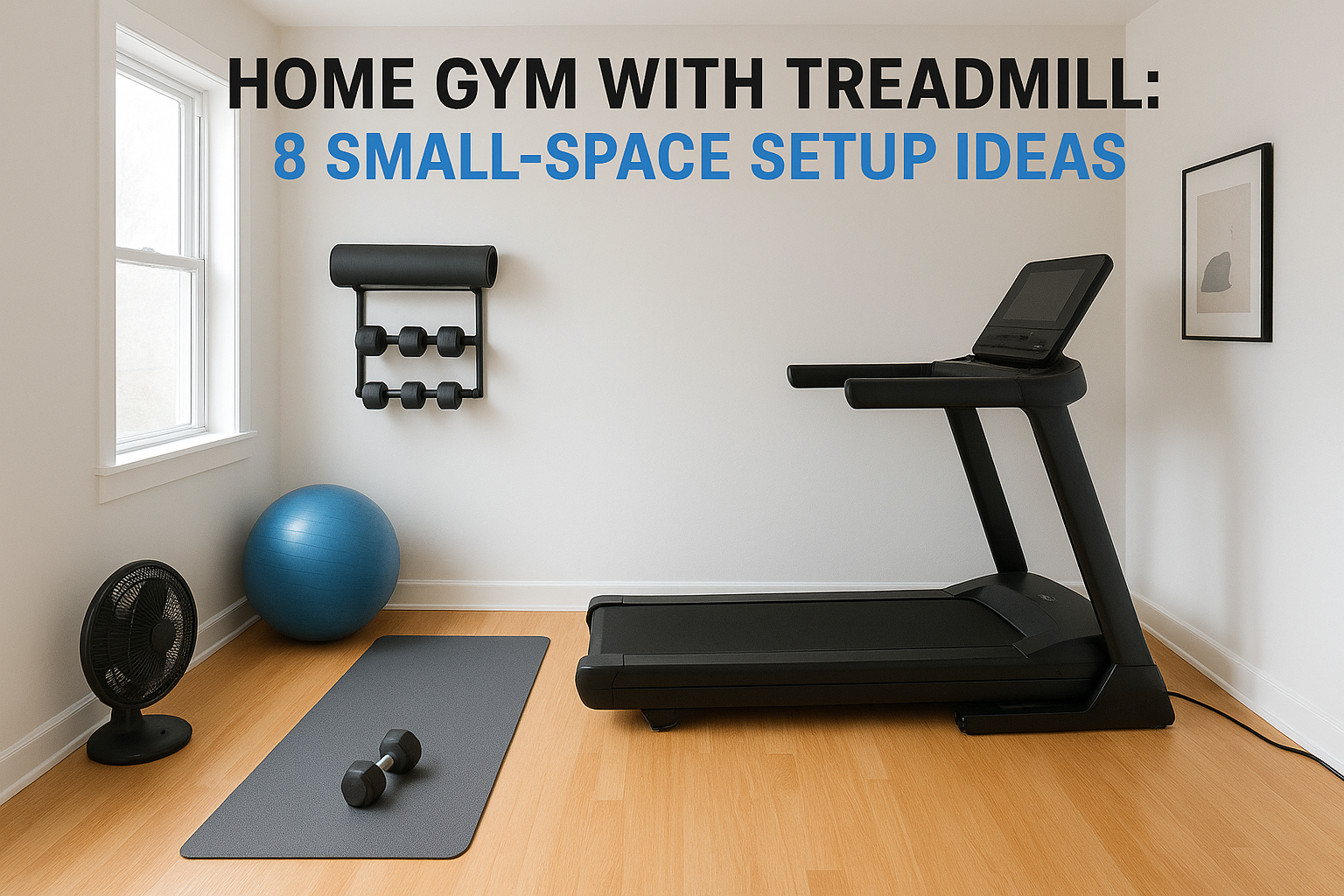
12 Sep Home Gym with Treadmill: 8 Small-Space Setup Ideas
You want a home gym with treadmill access, but your spare room, garage corner, or basement nook isn’t exactly a warehouse. That’s the real problem most people run into: treadmills feel bulky, and cramming one next to a bike or elliptical seems impossible until you actually measure things out and rethink the layout.
The good news is that small-space cardio setups work fine once you plan around folding designs, wall-mounted storage, and smart zoning instead of trying to fit a commercial gym floor into 80 square feet. You don’t need a mansion basement, you need a treadmill that folds flat, a console that doesn’t hog counter space, and a layout that lets you move between machines without stubbing your toe.
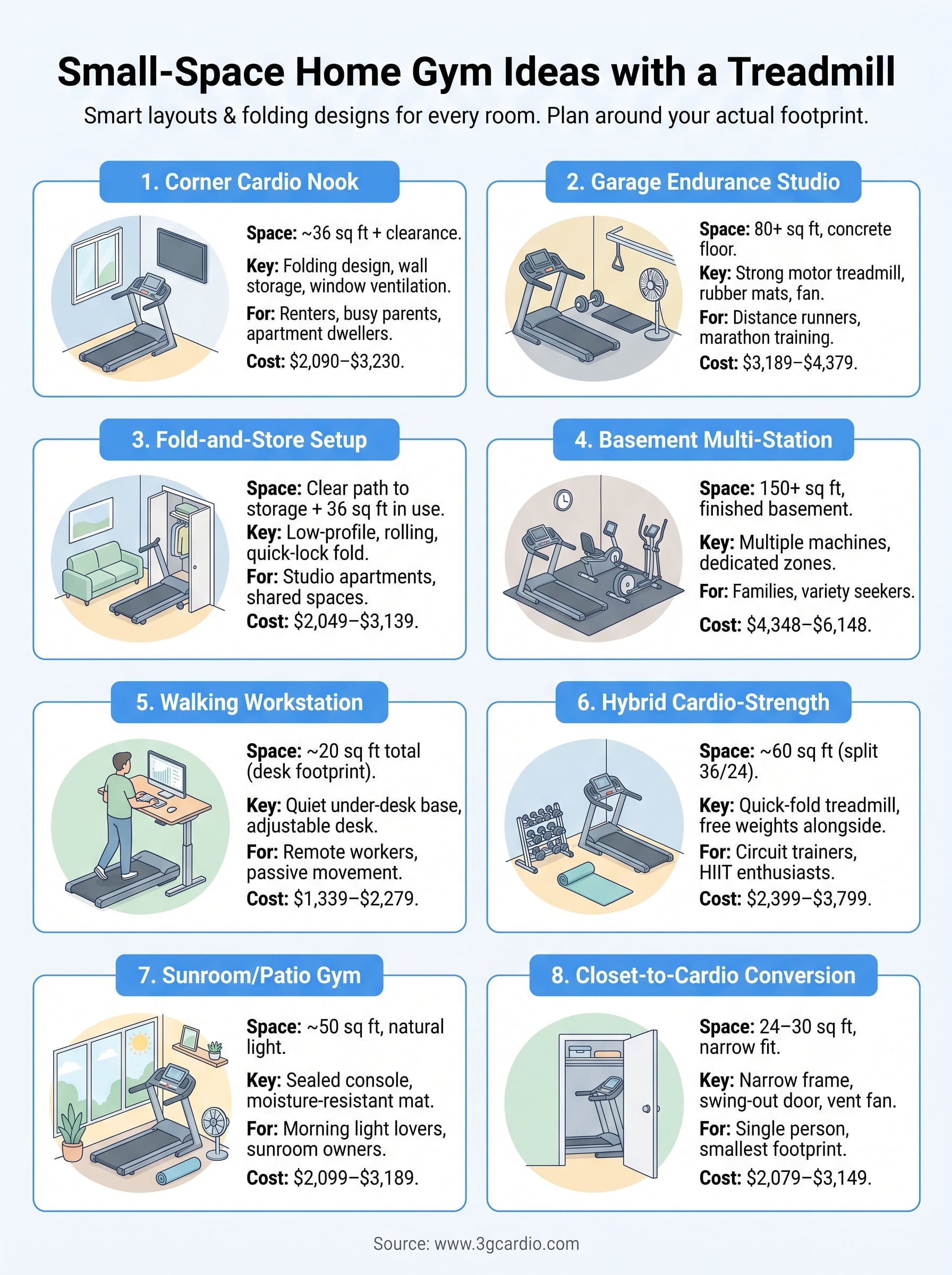
This article walks through 8 setup ideas that actually fit tight spaces, from single-room combos to garage conversions and closet-adjacent gyms. Each idea covers equipment sizing, storage tricks, and what to look for in a treadmill built for residential use, so you can build a space that gets used every day instead of becoming an expensive coat rack.
1. A corner cardio nook for small bedrooms and living rooms
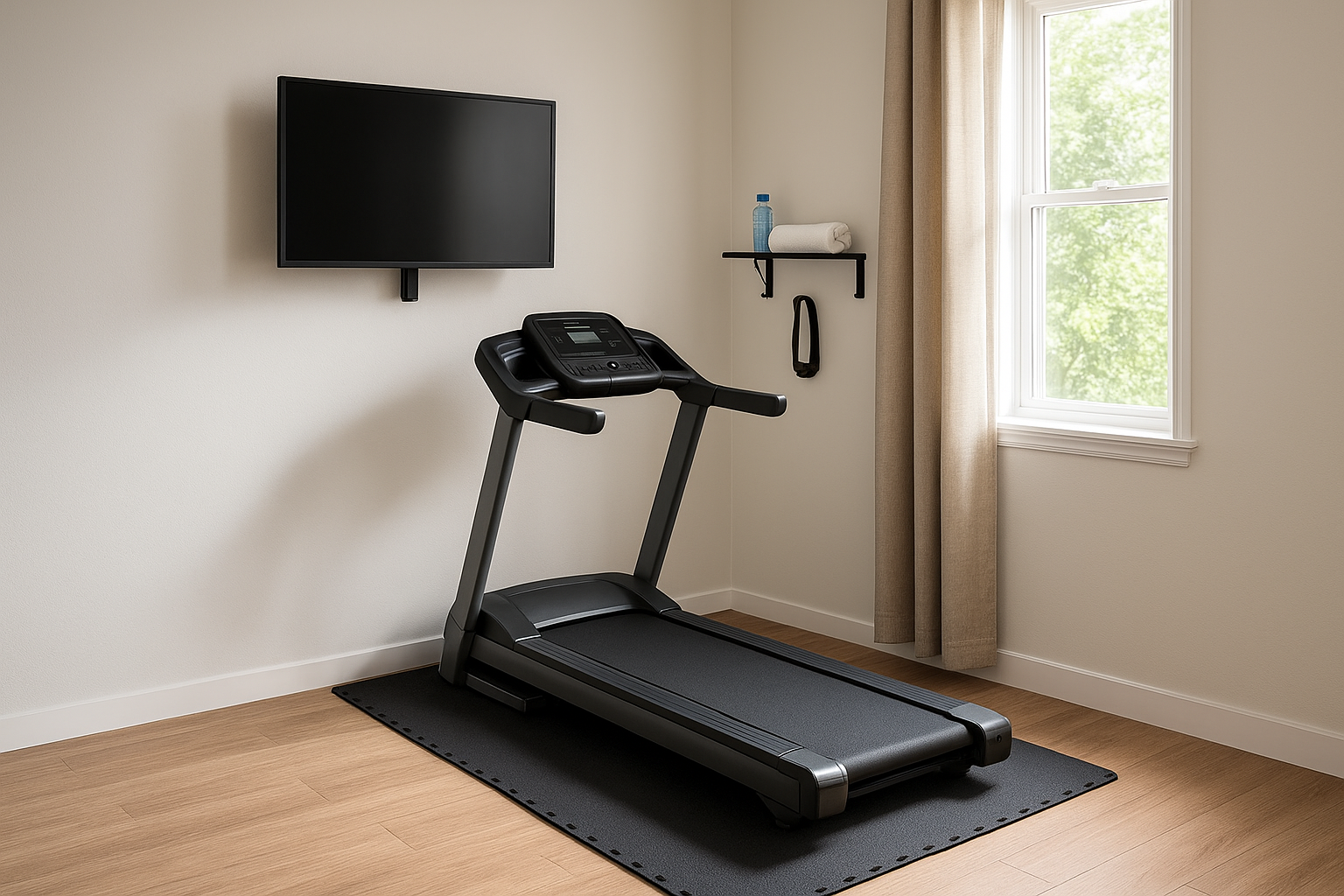
A corner cardio nook turns an unused 6×6-foot pocket of a bedroom or living room into a real workout zone without touching the rest of the floor plan. This setup works because you’re not trying to build a full home gym with treadmill and five other machines crammed together, you’re carving out one dedicated corner and outfitting it smart. It’s the entry point most people start with before expanding into a bigger room later.
Space and layout needed
You need roughly 36 square feet of clear floor, plus 2 feet of clearance behind the treadmill for safe stepping off and folding. Position the unit against a wall with an outlet nearby, and leave at least 8 inches on either side for airflow around the motor housing. A 7-foot ceiling height is the minimum for anyone over 5’10", so measure up before you buy. Corner placement near a window helps with ventilation, since small rooms heat up fast once you’re 10 minutes into an incline walk.
Recommended treadmill and gear
Look for a compact treadmill sized for a corner nook with a stable frame, since flimsy folding hinges are the number one complaint in small-space setups. The 3G Cardio Elite Runner X fits this bill with commercial-grade construction that still folds down for storage against a wall. Pair it with:
- A wall-mounted TV or tablet arm instead of a floor stand
- A thin interlocking foam mat sized to the treadmill’s footprint plus 6 inches on all sides
- A wireless heart rate strap so you’re not squinting at handlebar sensors
- A slim shelf or over-door hook for towels and water bottles
A corner nook only works long-term if the treadmill folds flat and rolls easily, otherwise it becomes permanent furniture you resent.
Who it’s best for
This setup suits renters, apartment dwellers, and anyone converting a guest bedroom or living room corner into flexible space. It’s ideal if you walk or jog most days but don’t need incline training or marathon-length runs, and if you’d rather not dedicate an entire room to fitness. Busy parents who need to squeeze in a 20-minute session while keeping an eye on the rest of the house also do well here, since the nook stays visible from adjoining rooms.
Estimated cost
| Item | Estimated Cost |
|---|---|
| Folding treadmill (residential-grade) | $1,999–$2,999 |
| Foam flooring mat | $60–$120 |
| Wall-mounted tablet arm | $30–$60 |
| Heart rate strap (often included) | $0–$50 |
| Total | $2,090–$3,230 |
Budget toward the higher end if you want a stronger motor and a longer warranty, since cheaper frames tend to wear out faster under daily use in tight quarters.
2. A garage endurance studio for serious training
A garage endurance studio works for runners who log real mileage, not just casual walkers looking to hit 5,000 steps. Garages already have the concrete floor, extra ceiling height, and electrical capacity that a bedroom nook can’t match, which makes this the setup of choice for anyone building a serious home gym with treadmill access for marathon training or interval work. You’re trading polish for performance here, and that trade-off pays off once you’re logging 30+ miles a week.
Space and layout needed
Plan for a minimum of 80 square feet, enough for the treadmill, a rowing machine or bike, and a stretching mat without gear overlapping. Garage floors are usually concrete, so add rubber interlocking tiles for shock absorption and to protect the treadmill’s motor from vibration. Insulate or seal gaps around the garage door if you’re running through winter, since a 45-degree garage makes for a miserable warm-up.
Recommended treadmill and gear
A treadmill with a stronger motor and wider belt handles daily high-mileage training better than an entry-level folding model. The Pro Runner X, a folding treadmill built for high-mileage training, is made for exactly this kind of use, with commercial-grade parts that hold up under repeated speed work. Add a box fan for airflow, a wall clock for interval timing, and a small shelf for electrolyte drinks and towels.
A garage studio only earns its space if the treadmill can handle real mileage without the belt slipping or the motor overheating.
Who it’s best for
This setup suits distance runners, triathletes in training, and anyone who treats cardio as a structured program rather than an occasional workout, so it’s worth comparing treadmill picks for distance training at home.
Estimated cost
| Item | Estimated Cost |
|---|---|
| Commercial-grade treadmill | $2,999–$3,999 |
| Rubber flooring tiles | $150–$300 |
| Fan and clock | $40–$80 |
| Total | $3,189–$4,379 |
3. An apartment-friendly fold-and-store setup
Apartment living means every square foot pulls double duty, so a treadmill that lives in a closet between workouts and disappears when guests come over is the only realistic option. This idea works best for anyone who wants a compact home gym setup without dedicating a permanent zone to it, since the whole point is that the room reverts to normal living space within minutes. You trade a bit of convenience for flexibility, and that trade-off is worth it when your lease doesn’t allow a dedicated fitness room.
Space and layout needed
You need a clear path from storage closet to workout spot, plus the same 36 square feet a corner nook requires while the treadmill is actually in use. Look for folding treadmills that store in a closet with built-in wheels and a deck that locks upright without extra tools, since fumbling with bolts every session kills the habit fast. A low-profile design under 8 inches tall when unfolded also matters if you’re rolling it over carpet or thin flooring.
Recommended treadmill and gear
The 3G Cardio Elite Runner X folds compactly and rolls on locking casters, making it one of the easier commercial-grade units to stash in a closet or behind a couch. Pair it with a slim rolling mat you can tuck alongside the folded frame, plus a Bluetooth heart rate strap so you skip a bulky console setup each time.
The best apartment treadmill is the one that folds, rolls, and locks in place without a fight every single time.
Who it’s best for
Renters, studio apartment dwellers, and anyone who shares living space with roommates or family will get the most out of this setup.
Estimated cost
| Item | Estimated Cost |
|---|---|
| Folding treadmill with casters | $1,999–$2,999 |
| Rolling storage mat | $50–$90 |
| Heart rate strap | $0–$50 |
| Total | $2,049–$3,139 |
4. A basement multi-station home gym
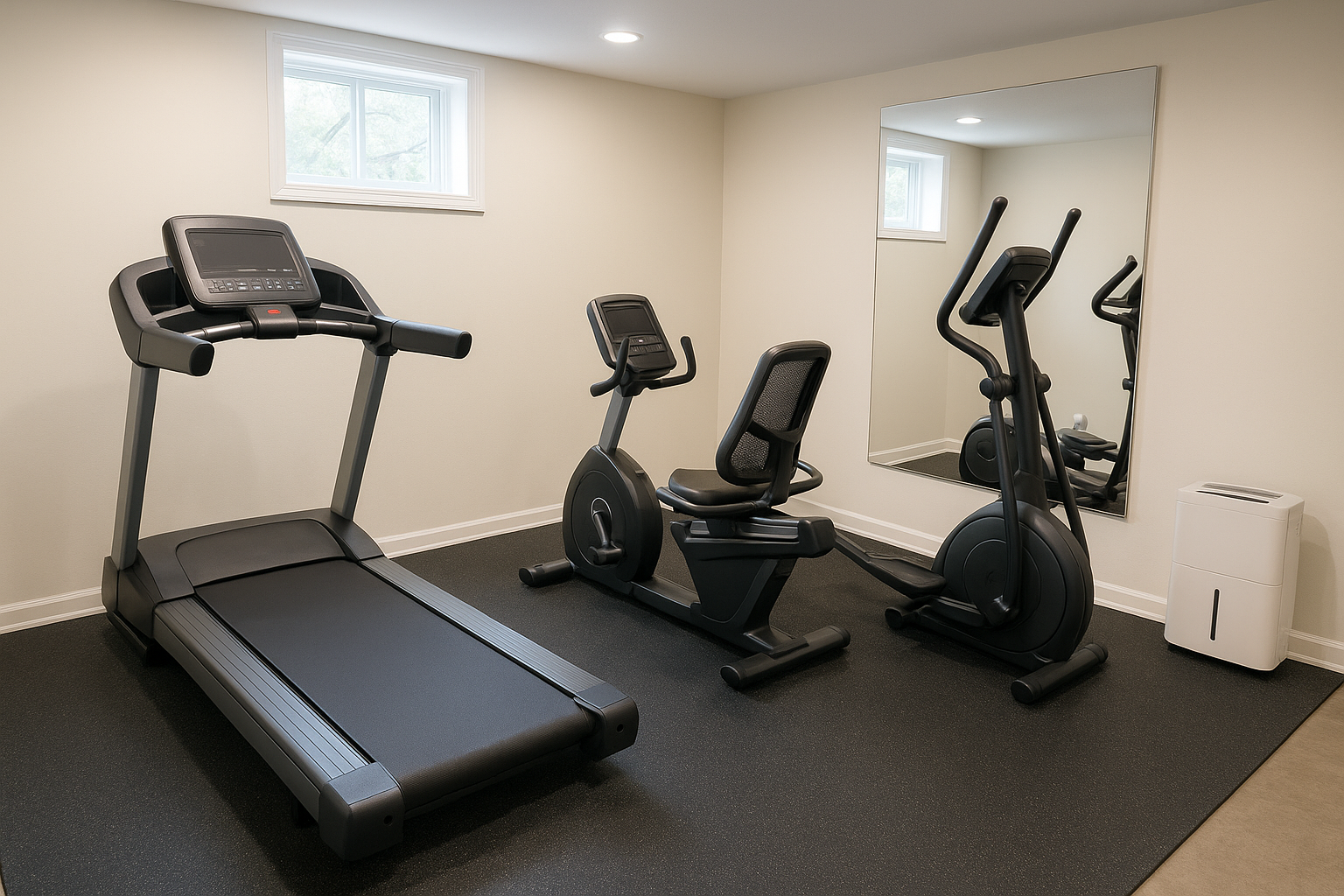
Basements give you the one thing small apartments never do: enough square footage to run a treadmill, a recumbent bike, and a compact elliptical trainer side by side without constant shuffling. This is the setup for households where more than one person trains, or where you rotate machines depending on the day instead of sticking to a single cardio mode. A finished basement with decent lighting turns into a real home gym with treadmill access plus strength options, all without touching your main living floor.
Space and layout needed
Budget at least 150 square feet to fit three machines with walking space between them, plus a stretching zone near a wall mirror if you have one. Basements often run cooler and have lower ceilings than the rest of the house, so measure clearance before you commit to a spot, and add a dehumidifier if the space tends toward damp.
Recommended treadmill and gear
Pair a folding treadmill with the Elite RB X, a compact step-thru recumbent bike, for low-impact days, since alternating machines cuts down on repetitive strain. Add rubber flooring under all three units to protect the concrete slab and reduce noise transfer to rooms above.
A multi-station basement gym only works if each machine has its own footprint, otherwise you’re back to a cramped nook with extra clutter.
Who it’s best for
Families with more than one active member, or anyone who wants variety across cardio and low-impact days, get the most value from this layout.
Estimated cost
| Item | Estimated Cost |
|---|---|
| Folding treadmill | $1,999–$2,999 |
| Recumbent bike | $1,999–$2,499 |
| Rubber flooring | $200–$400 |
| Dehumidifier | $150–$250 |
| Total | $4,348–$6,148 |
5. A walking workstation for all-day movement
A walking workstation flips the whole idea of a home gym with treadmill on its head. Instead of a dedicated workout block, you walk while you answer emails, take calls, or read reports, turning idle desk hours into low-intensity cardio with real walking treadmill benefits. This setup suits remote workers and anyone who sits most of the day but wants to rack up steps without carving out a separate 30-minute session.
Space and layout needed
You need a mini treadmill for under a desk, with roughly 20 square feet total once you include the desk footprint. Ceiling height matters less here since you’re walking, not running, so a converted office nook or even a corner of the living room works fine. Keep the desk height adjustable so your elbows stay at 90 degrees while walking at slow speeds, usually 1 to 2 mph.
Recommended treadmill and gear
Look for a low-profile walking base with a quiet motor, since you’ll be on calls while it runs. Pair it with a height-adjustable desk and a non-slip mat under the whole unit to keep it from shifting on hardwood or tile. A model with Bluetooth connectivity, like the FreeSync-enabled consoles on 3G Cardio’s Elite Runner X, lets you log steps to a fitness app without extra hardware.
A walking workstation only earns its keep if the motor is quiet enough that nobody on your call can tell you’re exercising.
Who it’s best for
This setup suits remote employees, writers, and anyone with a desk job who wants passive movement instead of a scheduled workout.
Estimated cost
| Item | Estimated Cost |
|---|---|
| Walking treadmill base | $999–$1,599 |
| Height-adjustable desk | $300–$600 |
| Non-slip mat | $40–$80 |
| Total | $1,339–$2,279 |
6. A hybrid cardio-and-strength corner
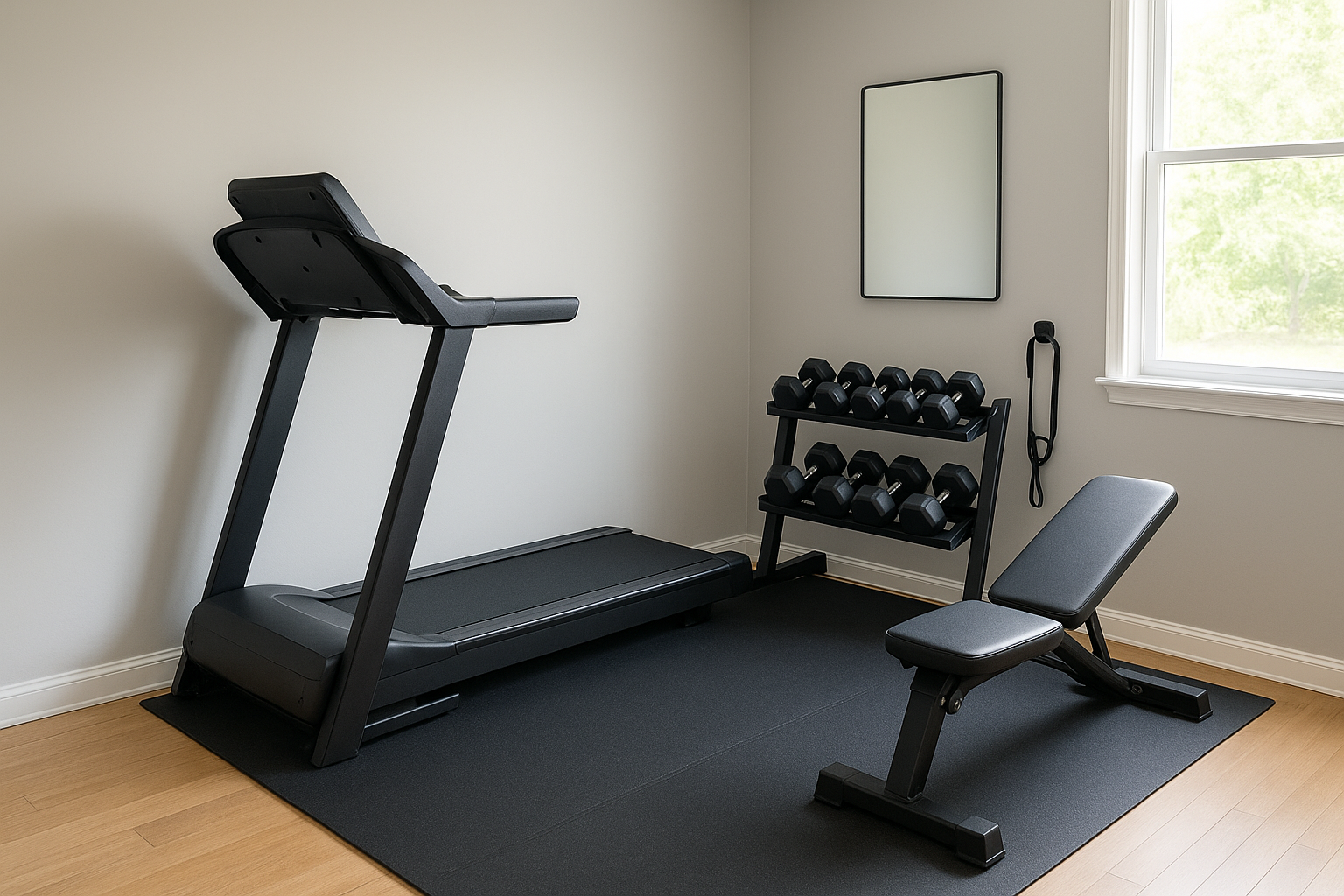
A hybrid cardio-and-strength corner packs a treadmill and a compact set of free weights into one zone, so you’re not running two separate rooms for two separate goals. This idea works well for anyone building a home gym with treadmill access who also wants to hit dumbbells or resistance bands between cardio intervals, since circuit-style training needs both in arm’s reach. Trading a slightly bigger footprint for versatility makes sense once you realize most effective workouts mix both anyway.
Space and layout needed
Plan for about 60 square feet, split roughly 36 for the treadmill and 24 for a weight rack, adjustable bench, or floor space for bodyweight moves, the same math behind how to set up a home gym in any room. Keep the treadmill against one wall and the strength gear along an adjacent wall so you can step off the belt straight into a set of squats without walking across the room. A rubber mat under the strength zone protects flooring from dropped weights and keeps noise down if you’re above a shared living space.
Recommended treadmill and gear
A folding treadmill with quick-fold hydraulics saves floor space the moment you switch to strength work. The 3G Cardio Elite Runner X folds up in seconds, freeing the full 60 square feet for kettlebell swings or floor exercises. Round out the corner with an adjustable dumbbell set, a resistance band anchor, and a wall-mounted mirror for form checks.
A hybrid corner only earns its keep if the treadmill folds fast enough that switching to strength work doesn’t feel like a chore.
Who it’s best for
This setup suits circuit trainers, HIIT enthusiasts, and anyone following a program that alternates cardio bursts with resistance sets.
Estimated cost
| Item | Estimated Cost |
|---|---|
| Folding treadmill | $1,999–$2,999 |
| Adjustable dumbbell set | $300–$600 |
| Rubber flooring | $100–$200 |
| Total | $2,399–$3,799 |
7. A sunroom or patio-adjacent gym
Sunrooms and patio-adjacent rooms bring natural light and fresh air into a workout that usually happens under fluorescent bulbs, and that alone changes how often you show up. Windows on three sides make a sunroom home gym with treadmill access feel less like a chore and more like a morning ritual, especially if you’re someone who dreads the basement grind. Glass walls also mean you need to think about temperature swings and glare, not just square footage.
Space and layout needed
You’ll want about 50 square feet, enough for the treadmill plus a small side table and maybe a yoga mat for cooldowns. Check the room’s insulation before committing, since sunrooms run hot in summer and cold in winter unless they’re properly sealed. Position the treadmill so morning or afternoon sun doesn’t hit the console screen directly, and add blinds or UV film if glare becomes an issue during peak workout hours.
Recommended treadmill and gear
Humidity and temperature swings are harder on electronics than a climate-controlled bedroom, so pick a treadmill with a sealed console and solid build quality. The 3G Cardio Elite Runner X holds up well in these semi-outdoor conditions thanks to its commercial-grade parts. Add a portable fan for airflow and a moisture-resistant mat underneath to protect the frame from condensation, which is worth weighing when you decide whether a mat belongs under your treadmill.
A sunroom gym works only if the equipment can handle temperature swings that a bedroom setup never faces.
Who it’s best for
This setup suits homeowners with an existing sunroom or three-season porch who want morning light without stepping outside, plus anyone who finds motivation harder in windowless rooms.
Estimated cost
| Item | Estimated Cost |
|---|---|
| Folding treadmill | $1,999–$2,999 |
| Moisture-resistant mat | $70–$130 |
| Portable fan | $30–$60 |
| Total | $2,099–$3,189 |
8. A closet-to-cardio-zone conversion
A walk-in closet or unused reach-in space might be the smallest footprint on this list, but it’s also the most overlooked option for a home gym with treadmill access in houses that are already packed room to room. Once you pull the clothes rod and shelving out, or shift them to another closet, you’re left with a narrow but usable box that fits a compact treadmill and almost nothing else. Zoning it off behind a door also means the mess of cables, mats, and towels stays hidden the rest of the day.
Space and layout needed
Measure before you get attached to the idea, since most reach-in closets run 24 to 30 square feet, barely enough for the treadmill deck plus a few inches of clearance on each side. A swing-out door or bifold works better than a sliding door, since sliders block full access to the console when you’re stepping on and off. Ventilation is the real issue here, so plan for a small fan or vent if the closet doesn’t already connect to house airflow.
Recommended treadmill and gear
Stick with the narrowest folding frame you can find, since closet conversions leave zero room for a wide-belt model. The 3G Cardio Elite Runner X folds down small enough to tuck flush against a closet wall between sessions, and its Bluetooth console skips the need for a separate tablet mount.
A closet gym only works if the door can stay open during workouts, otherwise you’re exercising in a sealed box with no airflow.
Who it’s best for
This setup suits single-person households, small homes without a spare room, and anyone who wants cardio machines that fit a closet-sized footprint without touching shared living space.
Estimated cost
| Item | Estimated Cost |
|---|---|
| Folding treadmill | $1,999–$2,999 |
| Small vent fan | $30–$60 |
| Thin foam mat | $50–$90 |
| Total | $2,079–$3,149 |
Finding the setup that fits your space
Every layout above solves the same problem in a different room: how to fit a home gym with treadmill access into square footage that wasn’t designed for it. Pick the idea that matches your actual floor plan, not the one that looks best in a photo. A corner nook or closet conversion beats a garage studio if you only have 30 square feet to work with, and a basement multi-station setup only makes sense once you’ve got the room to back it up.
Start with a tape measure, not a shopping cart. Once you know your real clearance, the treadmill choice narrows itself down fast, and the rest of the gear falls into place. If you’re ready to compare specs side by side, check the Elite Runner X treadmill’s full specs for a folding, commercial-grade option built to handle daily use in a space that’s smaller than a gym floor but still gets results.




No Comments