

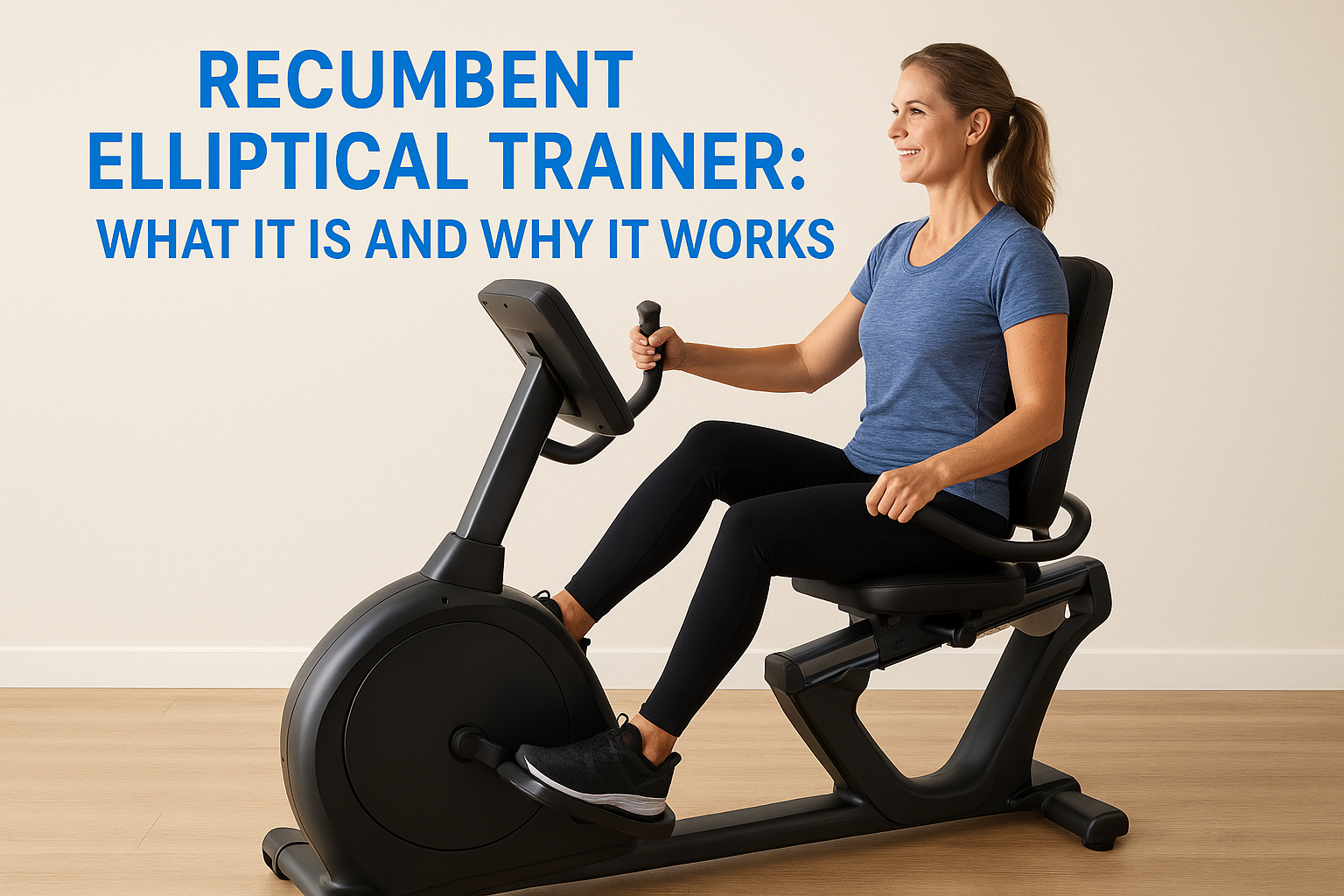
03 Aug Recumbent Elliptical Trainer: What It Is and Why It Works
If your knees ache after a run or you just want a cardio machine that won’t beat up your joints, you’ve probably come across the recumbent elliptical trainer in your search. It’s not as common a term as treadmill or exercise bike, so it makes sense if you’re not exactly sure what separates it from a standard upright elliptical or a recumbent bike.
Here’s the short answer: a recumbent elliptical trainer combines a seated, reclined position with the smooth, gliding foot motion of a regular elliptical. You get low-impact cardio that protects your hips, knees, and lower back while still working your legs through a natural elliptical path, not a fixed pedal stroke. That combination is why physical therapists and older exercisers often recommend it over pounding pavement or a treadmill.
In this article, we’ll break down exactly how these machines work, the specific benefits you can expect for weight loss and joint health, and what separates a well-built model from a flimsy one. We’ll also point you toward what to look for when you start shopping, so you can compare options with confidence instead of guessing based on marketing photos.
Why a recumbent elliptical trainer works so well
The seated design takes the impact out of cardio
Sitting back in a reclined seat changes the entire mechanics of the movement. Instead of standing and absorbing your body weight with every stride like you would on a treadmill or upright elliptical, you’re supported by the frame while your feet move through a smooth, oval path. That reclined seat position removes the compressive load that usually builds up in your knees and hips, which is exactly why so many physical therapy clinics keep a recumbent cross trainer in the rehab room. The pedals never leave the footplates, so there’s no landing force to manage, just continuous, controlled motion.
A recumbent elliptical trainer lets you train hard without your joints ever taking a hit.
It still moves your legs through a real elliptical path
Unlike a recumbent bike, where your feet are locked into a fixed circular pedal stroke, a recumbent elliptical machine lets your legs travel through a longer, more natural gliding motion. That elliptical path recruits your quads, hamstrings, glutes, and calves more evenly across the stride instead of concentrating force at the front of the knee. Because the stride mimics walking or light jogging without the ground contact, you get a natural stride pattern that trains the same muscle groups you’d use on your feet, just without the pounding. This is a big part of why people describe the workout as feeling more like real exercise than a stationary bike session.
The reclined posture protects your lower back too
Because the seat has a backrest and the pedals sit out in front of you rather than underneath, your spine stays in a supported, neutral position throughout the workout. This matters if you’ve dealt with lower back pain in the past, since an upright elliptical or treadmill often puts more strain on your core and lower back to keep you balanced. The supported spine posture on a recumbent elliptical means you can focus your effort on your legs instead of stabilizing your torso, which lets you push harder without discomfort creeping in halfway through the session.
The intensity is still there when you want it
Low-impact does not mean low-effort. Most recumbent elliptical trainers, including 3G Cardio’s models, offer adjustable resistance levels and stride lengths, so you can dial up the workout until your heart rate climbs just as high as it would running intervals outside. The difference is that you control the intensity through resistance and cadence rather than through impact force, which gives you more precise control over the workout. Here’s what that flexibility typically looks like across resistance settings:
- Low resistance, steady pace: warms up joints and builds cardiovascular base without fatigue
- Moderate resistance, longer stride: targets glutes and hamstrings for strength endurance
- High resistance, shorter bursts: pushes heart rate up for interval-style calorie burn
- Reverse pedaling: shifts emphasis to hamstrings and calves for muscle balance
The Centers for Disease Control and Prevention notes that adults need at least 150 minutes of moderate aerobic activity a week, and a recumbent elliptical makes it realistic to hit that target consistently because your joints aren’t accumulating wear with every session.
Consistency beats intensity for weight loss
Weight loss ultimately comes down to showing up regularly, and that’s where this machine has an edge over higher-impact options. Since there’s no landing shock, you can train most days of the week without the joint fatigue that limits how often you can run or use a standard elliptical. Sessions that feel sustainable rather than punishing are the ones people actually keep doing six months later, which is the real variable behind long-term results. That’s the practical case for choosing a low impact elliptical over something flashier: it’s the machine you’ll still be using next year.
How to use a recumbent elliptical trainer correctly
Getting real results from a recumbent elliptical trainer depends on setup just as much as effort. A poorly adjusted machine can leave you slouching, straining your knees, or barely engaging your glutes, even though the design is supposed to protect you from exactly those problems. Take a few minutes before every early session to dial in the fit, and the payoff shows up in both comfort and calorie burn.
Adjust the seat and stride length first
Before you start pedaling, set the seat distance so your knee stays slightly bent at the farthest point of the stride, never fully locked out. Most 3G Cardio models let you fine-tune stride length adjustment independently of seat position, which matters if you’re tall, short, or recovering from a knee issue and need a shorter range of motion. A seat that’s too far back forces you to reach with your toes, which strains the hip flexors instead of working the glutes and hamstrings the way it should.
Keep your posture upright against the backrest
Once you’re seated, press your lower back into the backrest rather than leaning forward toward the console. Good elliptical form here means your shoulders stay relaxed, your core stays lightly engaged, and your hands rest on the moving handles only for balance, not to pull yourself along. Gripping the handles too hard is a common mistake that steals work from your legs and puts unnecessary strain on your shoulders.
Correct seat and posture setup is what turns a recumbent elliptical from a gentle glide into a real leg workout.
Start at low resistance and build gradually
During your first few sessions, keep resistance low and focus on smooth, even pedaling rather than pushing hard immediately. This lets your body adapt to the elliptical path, which uses your hips and calves differently than walking or cycling does. Increase resistance in small increments every session or two once the movement feels natural, rather than jumping straight to a high setting that forces you to rock your torso to keep the pedals moving.
Check your foot pressure and pedal path
Throughout the workout, pay attention to where your foot pressure lands. If you feel pressure concentrated in your toes or heels rather than spread evenly across your foot, adjust your seat position slightly. Here’s a quick checklist to run through before every session:
- Seat distance lets your knee bend slightly at full extension
- Lower back stays flush against the backrest
- Shoulders relaxed, hands light on the handles
- Resistance set low enough to maintain smooth cadence
- Foot pressure feels even across the pedal, not concentrated at toe or heel
Getting these details right every time is what separates a workout that builds strength safely from one that just feels like sitting and moving your feet.
Recumbent elliptical vs. upright elliptical and recumbent bike
Comparing a recumbent elliptical trainer to its two closest relatives makes the differences click faster than any spec sheet alone. All three machines deliver cardio, but they load your body, engage your muscles, and demand different amounts of balance and core work. Picking the right one comes down to your joints, your goals, and how much standing effort you actually want in your workout.
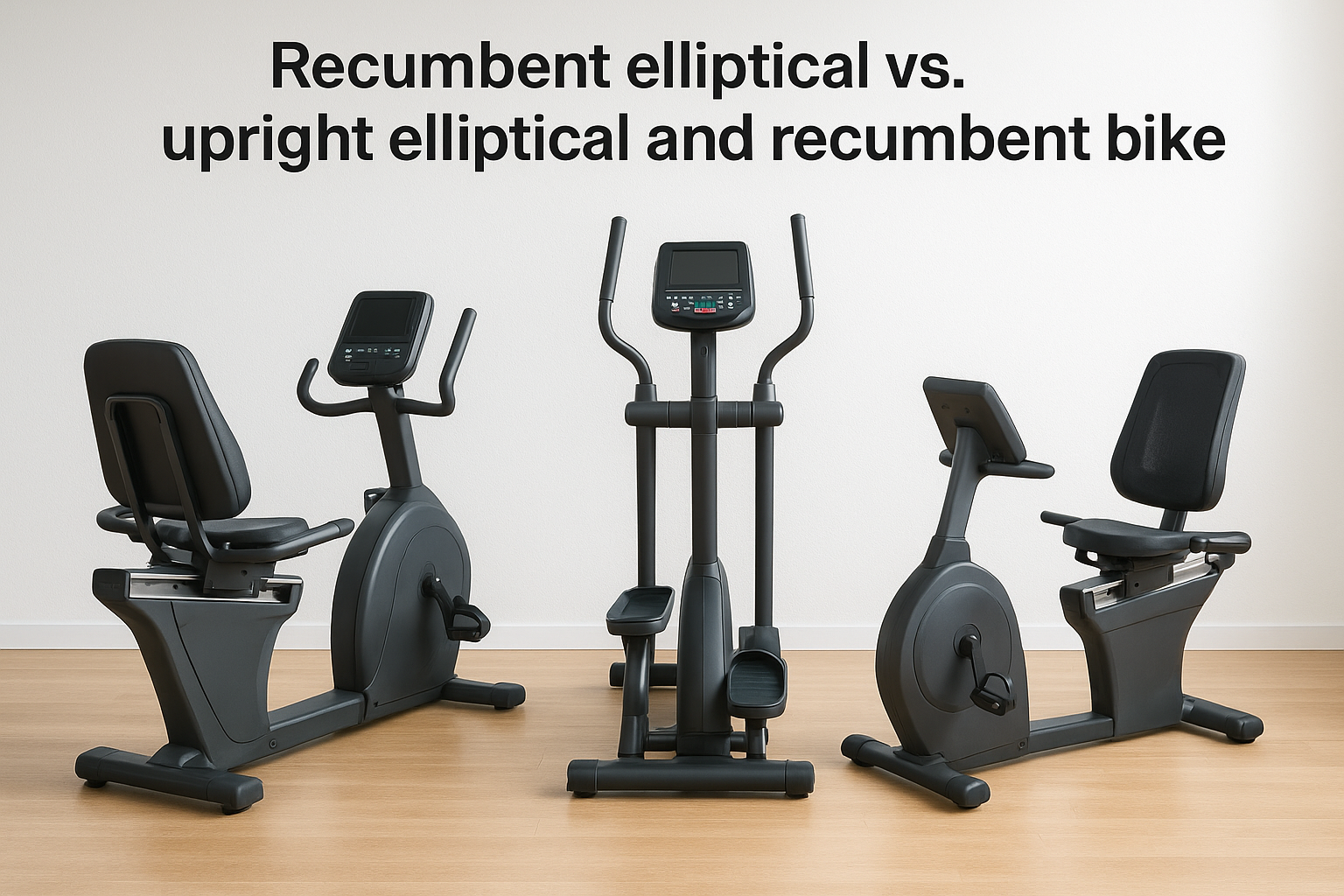
Side-by-side comparison
Looking at the three machines side by side shows how much the seated position changes the workout, even though all three are technically low-impact compared to running.
| Feature | Recumbent Elliptical | Upright Elliptical | Recumbent Bike |
|---|---|---|---|
| Body position | Seated, reclined | Standing | Seated, reclined |
| Impact level | Very low | Low | Very low |
| Foot motion | Elliptical glide | Elliptical glide | Fixed circular pedal |
| Core engagement | Minimal | High | Minimal |
| Muscle groups worked | Quads, hamstrings, glutes, calves | Quads, hamstrings, glutes, calves, core | Quads, hamstrings, glutes |
| Best for | Bad knees, back pain, longer sessions | Full-body calorie burn, balance training | Beginners, rehab, easy recovery days |
Why the upright elliptical demands more from your body
Standing on an upright elliptical forces your core and stabilizer muscles to work constantly just to keep you balanced, which burns more calories per minute but also fatigues you faster. That extra demand is great if your goal is a full-body workout and your knees, hips, and back can handle standing for 30 to 45 minutes at a stretch. It’s a poor fit, though, if joint pain or balance issues are the reason you started looking at low-impact machines in the first place.
Choose based on what your joints can tolerate for 30 minutes straight, not on which machine burns marginally more calories.
Why a recumbent bike falls short on muscle engagement
A recumbent bike vs elliptical comparison usually comes down to range of motion. The bike locks your feet into a fixed circular stroke, which is gentle and great for easy recovery days, but it never asks your hips or calves to work through the fuller stride that an elliptical path provides. Riders often plateau faster on a bike because the muscle recruitment stays narrow session after session, while the elliptical’s longer glide keeps recruiting hamstrings and glutes more evenly. If you already own a bike and feel your progress stalling, that narrower motion is usually why.
Each machine has a legitimate place in a home gym, but if you want the joint protection of a recumbent bike combined with the fuller muscle engagement of an elliptical, the recumbent elliptical trainer is the one built to do both at once.
Who benefits most from a recumbent elliptical trainer
Some people will get more out of a recumbent elliptical trainer than others, and knowing where you fall on that list helps you decide if this is the right machine before you spend the money. It’s not that other exercisers can’t benefit, it’s that certain conditions and goals line up almost perfectly with what this design solves.
People managing joint pain or arthritis
If you’ve been told to avoid high-impact cardio because of knee or hip arthritis, this machine solves the exact problem you’re dealing with. The seated position removes body-weight loading from the joints while still letting you move through a full range of motion, which keeps cartilage and connective tissue active without the grinding that stairs or running can cause. Doctors frequently point patients with osteoarthritis toward recumbent equipment for this reason, since staying active matters as much as protecting the joint itself.
Anyone recovering from surgery or injury
Rehab patients need controlled, low-force movement, and that’s precisely what a reclined stride delivers. Whether you’re a few weeks out from knee replacement or working back from a lower back strain, the supported spine posture and adjustable stride length let you rebuild strength at whatever pace your physical therapist recommends. Because there’s no impact to manage, you can often return to cardio training sooner than you could on a treadmill.
If your doctor has ever told you to avoid high-impact cardio, this is the machine built for exactly that restriction.
Older adults staying active without added strain
Balance and joint durability both decline with age, and a recumbent design removes both concerns from the equation. Seniors get a machine that supports the back, doesn’t demand standing balance, and still delivers a real cardiovascular workout, which makes it far more sustainable than an upright elliptical or treadmill for daily use over years, not just months.
People focused on long-term weight loss
Weight loss depends on consistency, and consistency depends on comfort. Exercisers who’ve struggled to stick with running or high-impact classes because of soreness or joint flare-ups tend to find they can train far more often on a recumbent elliptical, which adds up to more total calories burned over a month than a harder workout done half as frequently.
Here’s a quick rundown of who tends to see the biggest payoff:
- Adults with knee, hip, or lower back pain
- Post-surgery or physical therapy patients
- Seniors prioritizing joint-friendly, low-fall-risk cardio
- Beginners easing into a consistent routine
- Anyone whose weight loss efforts keep stalling due to injury setbacks
Each group shares the same core need: real cardiovascular effort without the physical cost that usually comes with it.
What to look for when choosing a recumbent elliptical
Not every recumbent elliptical trainer on the market is built the same, and the differences show up fast once you’re a few months into daily use. Cheaper machines flex under load, resistance motors burn out, and consoles freeze up right when you’ve built a routine around them. Knowing what separates a durable machine from a disposable one before you buy saves you from replacing the thing twice in three years.
Frame construction and weight capacity
Start by checking the frame gauge and the stated weight capacity, since these numbers tell you more about long-term durability than any marketing copy. A commercial-grade steel frame with a 300-plus pound capacity is built to handle years of daily use without developing wobble at the pedals or seat rail, while a lighter frame rated closer to 250 pounds is cutting corners to hit a lower price point. Look for a lifetime frame warranty too, since manufacturers only offer that guarantee when they trust the welds and steel they’re using.
A machine that flexes or wobbles under load will never let you train with real intensity, no matter how good the workout program looks on paper.
Resistance type and adjustable stride
Opposite of frame quality, resistance quality is easy to overlook because every machine claims to have it. Push past the marketing and check whether the resistance is magnetic, since magnetic systems run quieter and need far less maintenance than older friction-based designs. You also want adjustable stride length built into the machine, not just adjustable resistance, since a fixed stride locks you into one body type and limits how naturally the elliptical path matches your legs.
Console features and app connectivity
A good console does two things well: it tracks your workout accurately and it connects to the apps you actually use. Bluetooth connectivity through something like FreeSync FTMS technology lets the machine pair with fitness apps and tablets without forcing you into a proprietary subscription, which matters if you’re the type who wants data without ongoing fees. Built-in heart rate monitoring with a wireless chest strap included, rather than sold separately, is a detail that tells you a manufacturer priced the machine honestly instead of nickel-and-diming you after the sale.
| Feature | Why it matters |
|---|---|
| Steel frame, lifetime warranty | Signals long-term durability |
| Magnetic resistance | Quiet, low maintenance |
| Adjustable stride length | Fits different body types |
| Bluetooth/FTMS connectivity | Works with your existing apps |
| Included heart rate strap | Accurate tracking, no extra cost |
Delivery, warranty, and support
Setup and support matter just as much as specs once the box arrives at your door. Verify what the residential warranty actually covers beyond the frame, since parts and labor coverage varies widely between brands, and confirm whether delivery includes assembly or leaves you with a 100-pound box and an instruction sheet.
Sample workouts to try on a recumbent elliptical
Having a plan matters more than having motivation on any given day. A recumbent elliptical trainer rewards structure because the resistance and stride adjustments let you build real variety into sessions that would otherwise feel identical. Below are three workouts you can rotate through each week, whether you’re just starting out or already training for weight loss goals.
Beginner steady-state session
Getting comfortable with the machine comes first, so keep this session simple and focused on smooth cadence rather than heart rate targets. This 20-minute session builds the habit without overwhelming your legs:
- 3 minutes at low resistance to warm up
- 12 minutes at low-to-moderate resistance, steady pace
- 3 minutes reverse pedaling to balance hamstrings and calves
- 2 minutes cool-down at very low resistance
Just twenty minutes at a conversational pace, done three or four times a week, builds the aerobic base that makes harder workouts possible later.
Interval workout for calorie burn
Once steady-state feels easy, intervals are where a low impact elliptical starts to compete with harder cardio for calorie burn. Because there’s no landing force, you can push resistance hard for short bursts without worrying about joint strain the way you would sprinting on pavement.
5 min warm-up: low resistance, easy pace
8 rounds:
  45 sec: high resistance, fast cadence
  75 sec: low resistance, recovery pace
5 min cool-down: very low resistance
The reason intervals work so well here is simple: your joints recover as fast as your heart rate does.
This format takes about 30 minutes total and is one of the more efficient sessions you can run for weight loss, since the effort spikes push your heart rate up without requiring the recovery days a high-impact interval session would demand.
Recovery and active rest day
Training every single day at high effort backfires, so build a lighter session into your week on purpose. Set resistance low, keep the seat and stride comfortable, and pedal for 20 to 30 minutes at a pace where you could hold a conversation the entire time. Sessions like this flush soreness from harder workouts and keep you moving toward your 150 minutes of moderate aerobic activity target without adding fatigue that derails the rest of your week.
Building a weekly rotation
Mixing these three sessions across a week gives you variety without overcomplicating things. A realistic pattern looks like steady-state on Monday and Thursday, intervals on Wednesday, and a recovery session on Saturday, leaving two full rest days. Adjust the exact days to your schedule, but keep the mix, since repeating the same session every time is how progress stalls and motivation fades faster than it needs to.
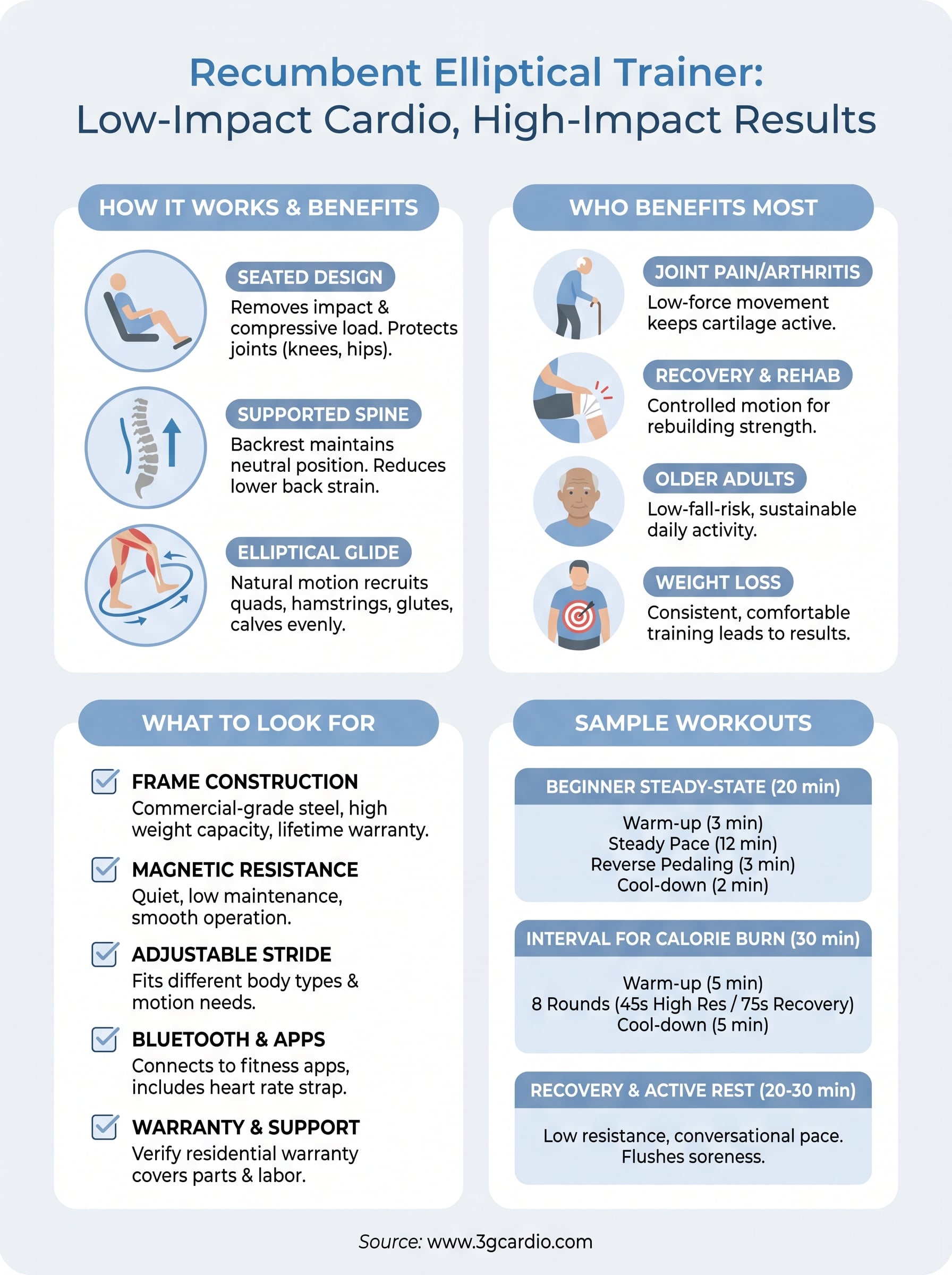
Finding the right fit for your home cardio routine
A recumbent elliptical trainer earns its place in a home gym by solving a real problem: how to get consistent, effective cardio without wrecking your knees, hips, or back in the process. You’ve seen why the reclined seat and elliptical stride work together, how to set the machine up correctly, and what separates a durable frame from one that will wobble apart in a year. None of that matters, though, if you buy a machine that’s underbuilt or skips the features that make daily use easy.
Before you commit to a specific model, put frame quality, adjustable stride, and honest warranty coverage ahead of flashy screens. Those details determine whether the machine still feels solid five years from now, not just on day one. If you’re ready to compare a commercial-grade option built without subscription fees or gimmicks, check out the 3G Cardio Elite EM X Elliptical Trainer and see how it fits your routine.




Sorry, the comment form is closed at this time.