

05 Aug 5 Best Elliptical Trainer Exercises for Every Fitness Level
You bought an elliptical because it’s easy on your joints, but now you’re stuck doing the same 20-minute shuffle every day and wondering if it’s actually doing anything. That’s the problem with most home cardio routines: the machine works fine, the plan doesn’t. Good elliptical trainer exercises need variety and purpose, not just movement.
This article gives you five elliptical trainer workouts built for different goals and fitness levels, from a beginner steady-state session to interval training that pushes your heart rate and stamina work that builds real endurance. Whether you’re rehabbing an injury, trying to drop weight, or training for something specific, you’ll find a routine here that matches where you’re at right now, not where some generic program assumes you are.
We designed these workouts around how ellipticals actually perform, including adjustable stride lengths and resistance levels, so you can scale intensity without switching machines. If you’re running one of our Elite EM X trainers with FreeSync connectivity, you can pair these routines with a fitness app and heart rate strap to track progress. Let’s get into the exercises.
1. Beginner steady-state elliptical workout
How it works
Steady-state training means you pick one resistance level and one stride pace, then hold both steady for the entire session. There’s no ramping up or backing off, just consistent movement that lets your body settle into a rhythm. This approach works because it teaches your cardiovascular system to operate efficiently at a moderate effort, which is exactly what you need before you layer on anything harder. Set the resistance low enough that you can hold a conversation but high enough that you’re breathing noticeably heavier by minute five.
A steady 20-minute session done consistently beats an intense workout you can only manage once a week.
Who it’s for
This routine suits anyone new to elliptical trainer workouts, people rebuilding fitness after time off, and older adults who want a low-impact option that doesn’t stress the knees or hips. Runners recovering from an injury also lean on steady-state sessions because the elliptical’s fixed foot path removes the joint impact of pavement without sacrificing cardio benefit. Small commercial gyms often program this exact workout for new members because it’s nearly impossible to do wrong.
Duration and intensity
Start with 20 minutes and add five minutes per week until you reach 40. Keep resistance in the range of 3 to 5 out of 10 on most consoles, and use your talk test as the real guide rather than the number on the screen.
- Weeks 1-2: 20 minutes, resistance 3, stride length short if adjustable
- Weeks 3-4: 25-30 minutes, resistance 4
- Weeks 5+: 30-40 minutes, resistance 4-5, longer stride
Once 30 minutes feels routine rather than draining, you’re ready to add intervals. That’s your cue to move to the next workout on this list.
2. HIIT elliptical workout for fat burn
How it works
High-intensity interval training alternates short bursts of near-maximum effort with brief recovery periods, and it’s one of the most efficient elliptical trainer exercises for burning fat fast. You push resistance and stride speed hard for 30 to 60 seconds, then drop back to an easy pace for the same length of time or longer. That spike-and-recover pattern keeps your metabolic rate elevated for hours after you step off the machine, an effect steady-state cardio simply doesn’t produce.
Twenty minutes of real intervals burns more fat than forty minutes of comfortable pedaling.
Who it’s for
This workout suits people who’ve already built a base with steady-state training and want faster results without spending an hour on the machine. It’s not the place to start if you’re new to exercise or managing joint pain, since the effort spikes demand more from your joints and heart than beginners should push right away.
Duration and intensity
Keep total workout time between 20 and 25 minutes, including warmup and cooldown.
- Warm up 5 minutes at resistance 3
- Repeat 8 rounds: 30 seconds hard (resistance 7-8) / 90 seconds easy (resistance 3)
- Cool down 5 minutes at resistance 2
Adjust round count as your recovery improves week to week.
) this section:if if incline function exulator increases legwork, and steady lower cadence turn.on the elliptical closer to old rearial.). We’ll write actual content..>{
4. Full-body elliptical workout with arm intervals
How it works
Most people grip the handlebars and let their arms coast, which wastes half the machine’s potential. This workout forces you to actually drive the moving handlebars, alternating between legs-only intervals and full-body pushes and pulls that engage your chest, back, and shoulders. The pattern trains your upper body to contribute real power instead of just balancing you, which raises your overall calorie burn and turns a leg workout into genuine full-body conditioning. You’ll notice your arms fatigue before your legs do the first few times you try this, which tells you they’ve been coasting all along.
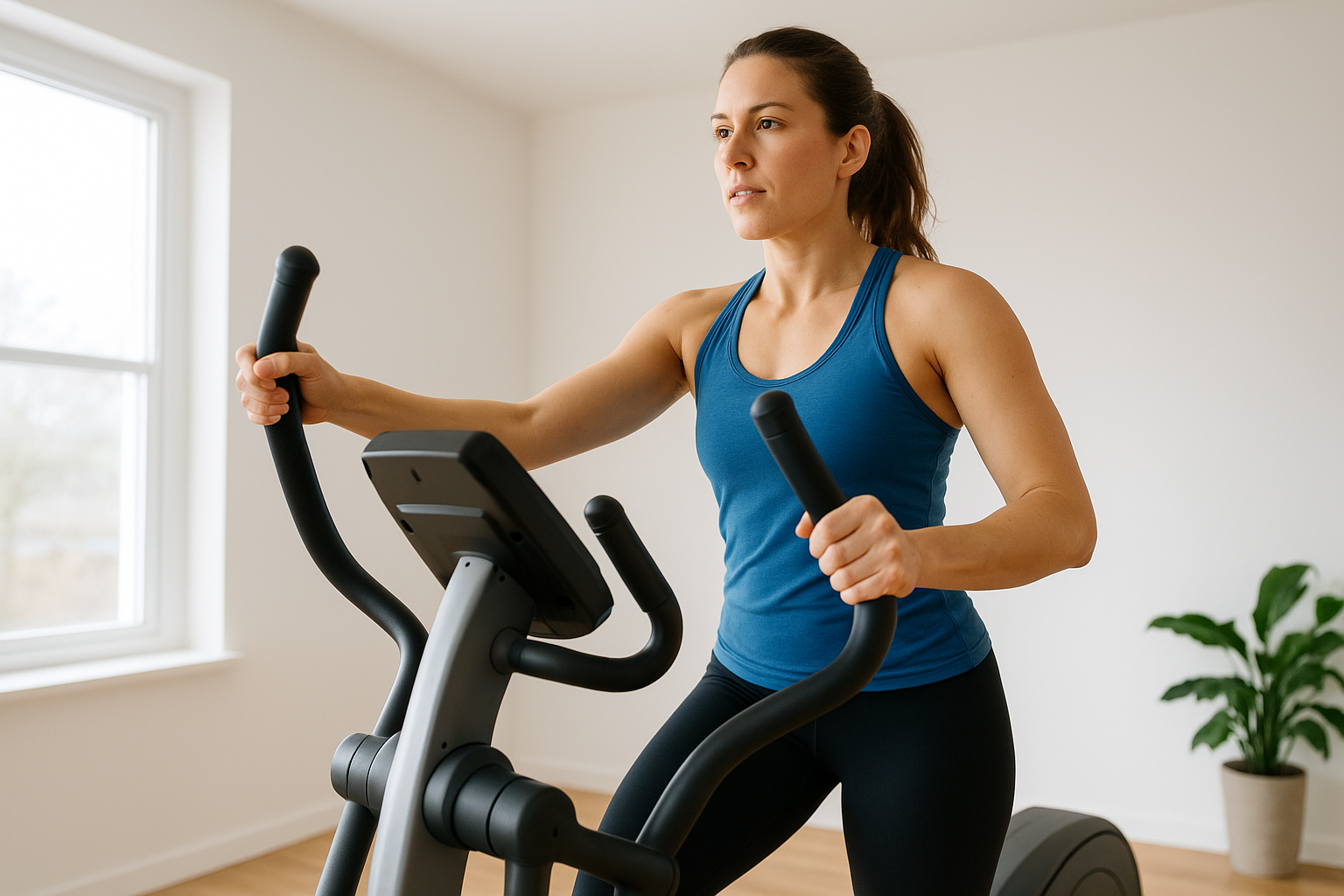
Push and pull the handlebars like you mean it, or you’re only training half your body.
Who it’s for
This routine fits people who already have a steady-state base and want more muscle engagement without adding a separate strength session. It also works well if you’re short on time and need one machine to cover both cardio and light upper-body work.
Duration and intensity
Plan for 25 to 30 minutes total, cycling through these phases:
- 5 minutes warmup, legs only, resistance 3
- 4 rounds: 3 minutes full-body push/pull at resistance 5, 2 minutes legs only at resistance 4
- 5 minutes cooldown, easy pace
Focus on smooth, controlled arm movement rather than speed.
5. Heart-rate based elliptical workout
How it works
This workout ditches resistance numbers entirely and uses your heart rate zones as the only guide. You wear a chest strap or use the machine’s grip sensors, then adjust resistance and stride pace to keep your heart rate inside a target zone for the whole session. Most consoles with FreeSync connectivity display your live heart rate next to a target range, so you’re constantly correcting effort up or down rather than guessing. Training this way removes the guesswork from elliptical trainer workouts because your body, not the display, tells you when you’re working hard enough.
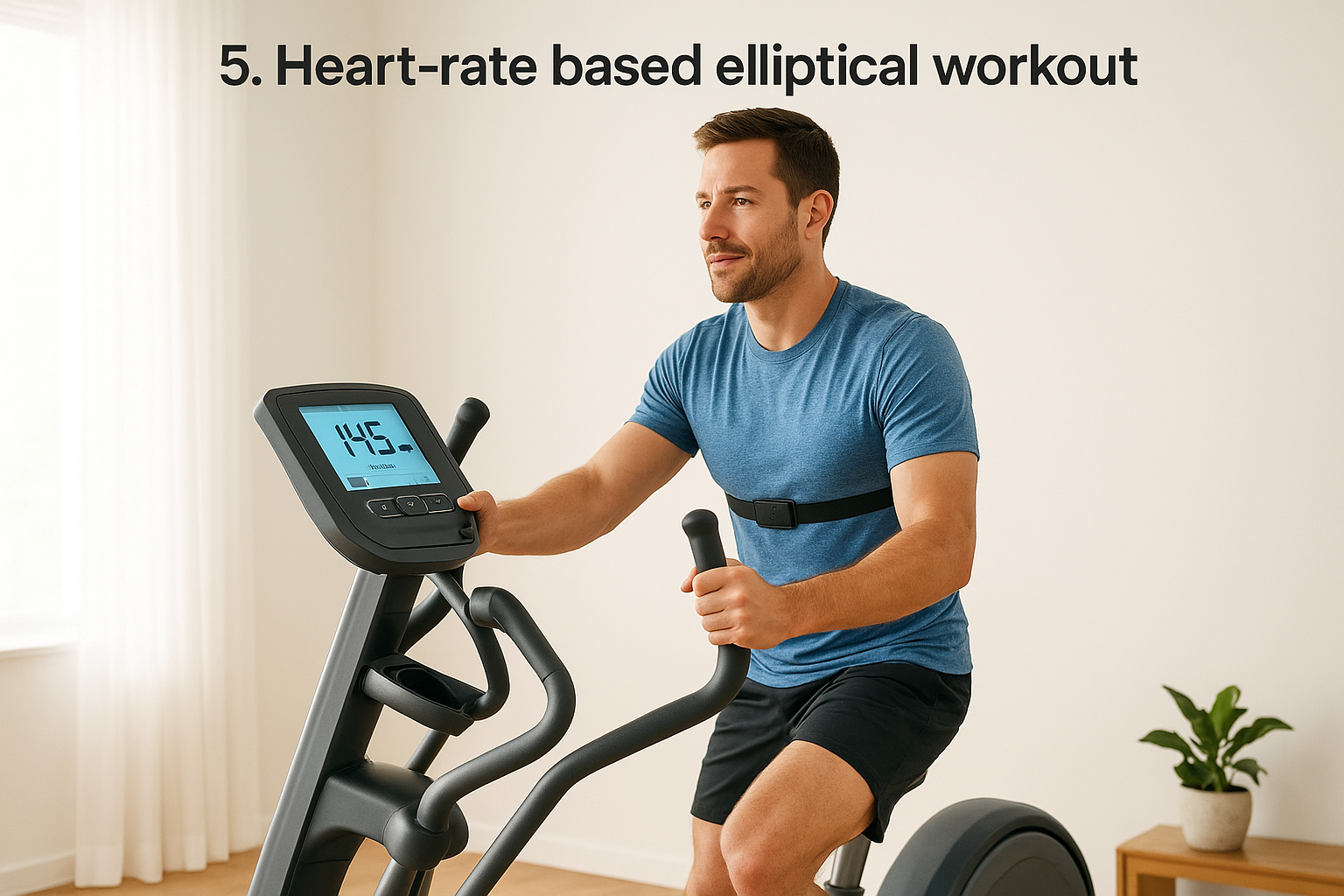
Your heart rate doesn’t lie about effort the way a resistance number does.
Who it’s for
Anyone tracking fat loss, cardiovascular improvement, or general fitness benefits from this approach, especially if you’ve plateaued using fixed resistance routines. It also suits people managing blood pressure or heart conditions who need to stay within a doctor-approved range rather than push blindly.
Duration and intensity
Aim for 30 minutes total, targeting 60 to 70 percent of your max heart rate for fat burning or 70 to 80 percent for cardiovascular gains.
- Warm up 5 minutes, building toward your target zone
- Hold 20 minutes inside your chosen zone, adjusting resistance as needed
- Cool down 5 minutes, letting heart rate drop gradually
Recalculate your zones every few months as fitness improves.
6. Tips to get the most from every elliptical session
Getting real results from elliptical trainer exercises depends as much on form and habits as on which workout you pick. Small adjustments to posture, grip, and pacing change how much benefit you pull from every minute on the machine, so it pays to get these details right before you chase more advanced routines.
Good form on an easy day beats sloppy form on a hard one.
Use this checklist during your next few sessions to fix the habits that quietly limit your progress:
- Stand tall instead of leaning on the handlebars; leaning removes resistance from your legs and shifts strain to your lower back.
- Vary your stride length if your console allows it, since a longer stride recruits your glutes and hamstrings more than a short, shuffling step.
- Pedal backward for five minutes once or twice a week to work your calves and hamstrings from a different angle.
- Track heart rate, not just time or distance, so you know your effort is actually matching the workout’s intent.
- Change resistance every few weeks even within the same workout type, since your body adapts faster than most people expect.
- Hydrate before, not just during, especially on interval or heart-rate based days when sweat loss climbs fast.
Small corrections like these compound over weeks, turning an average elliptical trainer workout into one that actually moves the needle.
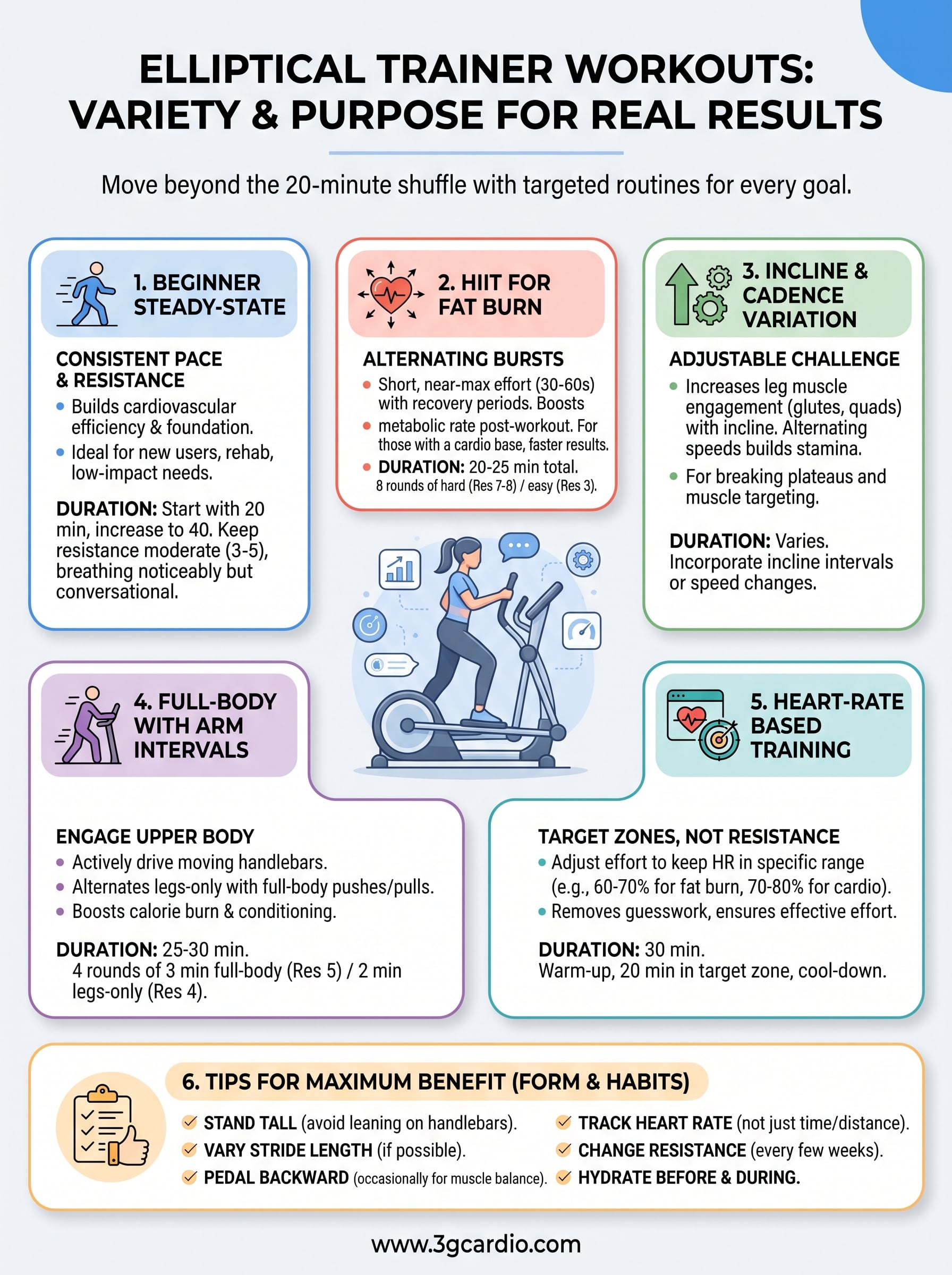
Building your elliptical routine
Five workouts give you more than enough to stop guessing and start progressing. Pick the steady-state session if you’re just starting out, rotate in HIIT and incline climbs once you’ve built a base, and use the heart-rate workout whenever you want proof your effort matches your goal. The point isn’t to do all five every week. It’s to match the right elliptical trainer exercises to where your fitness actually stands right now, then adjust as that changes.
Rotate through two or three of these elliptical trainer workouts weekly rather than repeating one on autopilot, and you’ll see progress that a fixed routine never delivers. Consistency beats intensity over time, but variety keeps your body from plateauing.
If your current machine can’t handle stride adjustments, resistance changes, or app connectivity, the routines above will feel harder than they should. Check out the Elite EM X Elliptical Trainer and see if it’s the upgrade your routine needs.




Sorry, the comment form is closed at this time.