

04 Aug 6 Best Elliptical Trainer Cardio Workouts to Burn Calories
You bought an elliptical to burn calories, not to shuffle along at the same pace for 30 minutes while you stare at the wall. A solid elliptical trainer cardio workout does more than log time. It builds intervals, resistance changes, and stride adjustments into your session so your heart rate actually climbs and your body keeps adapting instead of coasting.
If you’re searching for routines that produce real results, here’s the direct answer: mix steady-state sessions with high-intensity intervals, change your stride length and resistance regularly, and track your heart rate to stay in the zone that burns fat rather than just breaks a sweat. The specific numbers matter more than vague advice to "go harder."
Below are six workouts you can start using today, each with exact intervals, durations, and resistance settings. Whether you’re on an Elite EM X at home or any quality elliptical, these routines are built to maximize calorie burn without wrecking your joints or your motivation.
1. Steady-state beginner cardio workout
Every good elliptical trainer cardio workout plan starts here. This is the workout you build endurance on before you touch intervals or hill climbs, and it’s the one most home users skip because it looks too easy on paper. Don’t skip it. Your joints, lungs, and long-term consistency depend on this base being solid.
How it works
Start pedaling at a comfortable, sustainable pace and hold it for the entire session without stopping. Set your resistance to a level where you can still hold a conversation but couldn’t sing along to a song. On the Elite EM X, that usually means resistance level 4 or 5 out of 20, with a stride length around 18 to 20 inches. Keep your stride smooth and your grip relaxed on the moving handles so your arms share the work with your legs.
Duration and intensity
Aim for 30 to 45 minutes at a steady heart rate between 60 and 70 percent of your max heart rate. That’s zone 2 territory, the range the American Heart Association points to for building aerobic base fitness without overtaxing your recovery. Use the built-in heart rate monitor or a wireless chest strap to confirm you’re staying in range rather than guessing.
A steady-state session isn’t filler, it’s the foundation every other elliptical workout on this list builds on.
Who it’s for
Beginners, anyone returning to exercise after time off, and people managing joint issues benefit most from this low-impact cardio workout. It’s also the right call on rest days between harder sessions, since it promotes blood flow and recovery without adding fatigue. If you’re new to elliptical training entirely, spend your first two weeks here before adding intervals.
Calorie-burning potential
A 180-pound person burns roughly 300 to 400 calories in a 30-minute steady-state session at moderate resistance, according to standard MET-based estimates from the Centers for Disease Control and Prevention. Lighter individuals will burn somewhat less, heavier individuals more. Extend the session to 45 minutes and you’re looking at 450 to 550 calories, which makes this workout a reliable, repeatable way to build a calorie deficit without the burnout risk that comes with daily high-intensity training.
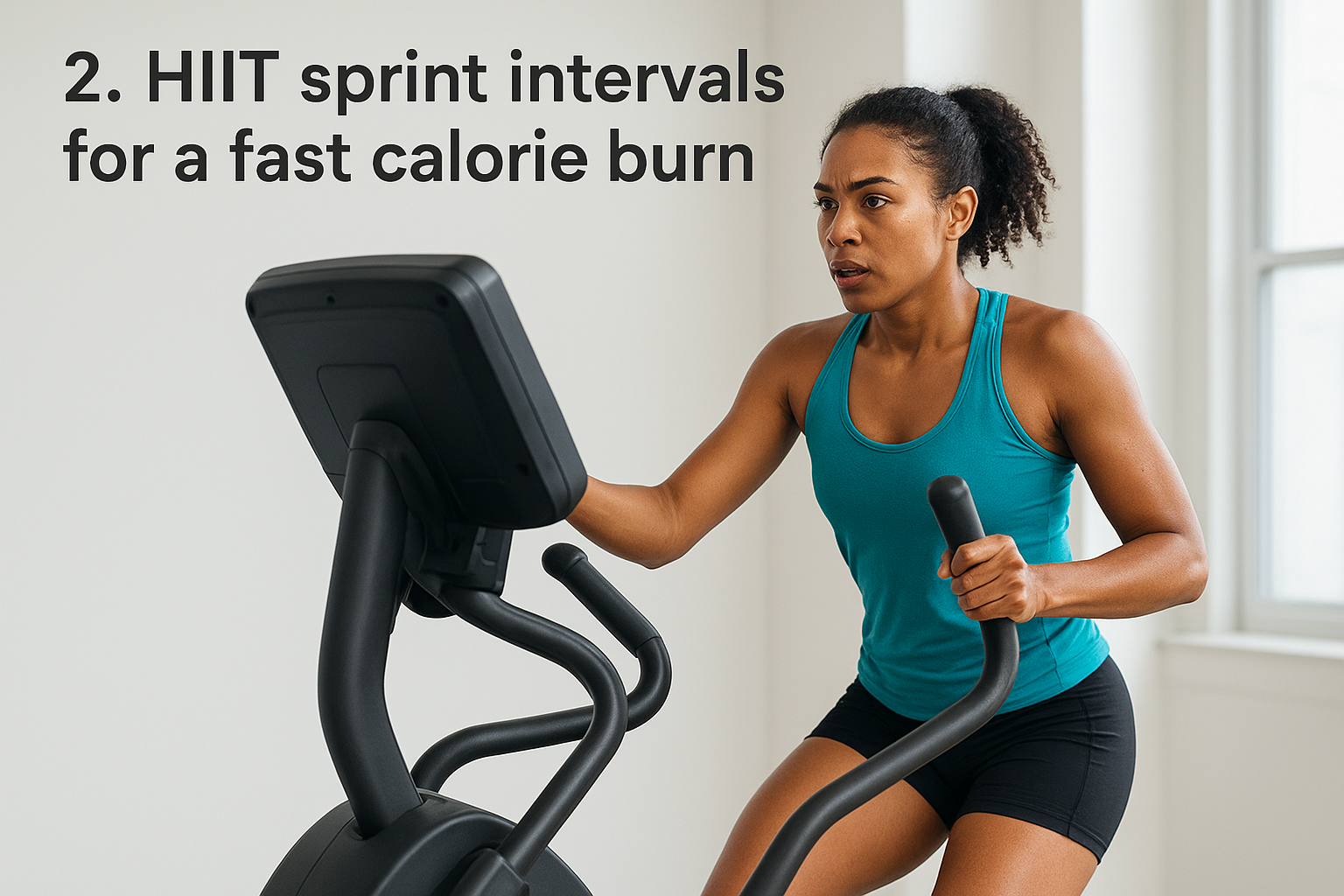
2. HIIT sprint intervals for a fast calorie burn
Once your base is solid, this workout becomes the fastest way to burn calories on an elliptical in the least amount of time. High-intensity interval training trades a long, even effort for short bursts of near-maximum output followed by brief recovery, and it keeps your metabolism elevated long after you’ve stepped off the machine.
How it works
Crank the resistance up for 30 to 60 seconds of all-out effort, then drop it back down for 60 to 90 seconds of easy pedaling. Repeat that cycle 8 to 10 times. On the Elite EM X, push resistance to level 12 or higher during sprints and drop to level 4 or 5 during recovery. Keep your stride quick and powerful during the work interval instead of long and smooth.
Duration and intensity
| Phase | Duration | Resistance | Effort |
|---|---|---|---|
| Sprint | 30-60 sec | 12-16 | 85-95% max HR |
| Recovery | 60-90 sec | 4-5 | 60-65% max HR |
Total session length runs 20 to 25 minutes including a 5-minute warmup and cooldown.
Short, hard sprints beat long, moderate sessions when your goal is maximum calorie burn in minimum time.
Who it’s for
Experienced exercisers with healthy joints and no cardiac concerns get the most from this elliptical HIIT workout. Skip it if you’re brand new to cardio or managing a heart condition without medical clearance first.
Calorie-burning potential
Expect 300 to 400 calories burned in just 20 minutes for a 180-pound person, plus continued afterburn from the metabolic boost, according to CDC MET data on vigorous exercise.
3. Hill climb incline intervals
Switching from sprint work to sustained resistance changes gives your legs a different kind of challenge. Hill climb intervals simulate outdoor terrain by raising resistance in stages instead of alternating between all-out and easy, so you build strength and cardio endurance at the same time without the joint pounding of running actual hills.
How it works
Increase resistance every 2 to 3 minutes, climbing from a moderate base level up to your hardest sustainable setting, then reset and repeat the climb two or three times. On the Elite EM X, start at resistance level 6, then step up to 8, 10, and 12 across four stages before dropping back to level 6 to recover. Shorten your stride slightly as resistance climbs, since a shorter, more powerful stride handles heavy resistance better than a long glide.
Duration and intensity
Build each climb-and-recover cycle to about 10 minutes, and run two to three cycles for a total session of 25 to 35 minutes. Your heart rate should climb toward 75 to 85 percent of max during the hardest stage of each climb, then settle back toward 65 percent during recovery.
Gradual resistance builds, not sudden bursts, are what train your legs to handle sustained hard efforts.
Who it’s for
This workout suits anyone who wants strength gains alongside cardio, including runners training for hilly races and lifters who need conditioning without extra joint stress.
Calorie-burning potential
A 180-pound person burns roughly 350 to 450 calories in a 30-minute hill climb session, per CDC MET-based estimates for vigorous resistance-based cardio.
4. Upper-body push-pull workout
Most elliptical sessions leave your arms doing almost nothing, just resting on stationary rails while your legs handle the work. This upper-body push-pull workout fixes that by putting the moving handles to real use, turning your elliptical into a full-body machine instead of a leg-only machine.
How it works
Grip the moving handlebars and drive them with intention instead of letting your legs pull your arms along passively. Push forward hard with one arm while pulling back with the other, syncing the motion to your stride so your chest, shoulders, back, and core all engage. On the Elite EM X, keep resistance moderate, around level 6 to 8, so you can focus on arm drive without your legs burning out first. Squeeze your abs throughout to stabilize your torso as you push and pull.
Duration and intensity
Run this as a 20 to 30 minute session at a steady pace, alternating 3 minutes of full push-pull engagement with 1 minute of arms-relaxed pedaling to recover. Keep your heart rate around 65 to 75 percent of max throughout.
Engaging your arms on the elliptical turns a leg workout into a full-body calorie burner.
Who it’s for
Anyone bored with leg-only sessions, or looking for a total body cardio workout without adding separate strength training, will benefit here. It’s also useful for runners who want upper-body conditioning without impact.
Calorie-burning potential
Expect 250 to 350 calories burned in 25 minutes for a 180-pound person, per CDC MET data, with added muscular fatigue in the arms and core that steady pedaling alone won’t produce.
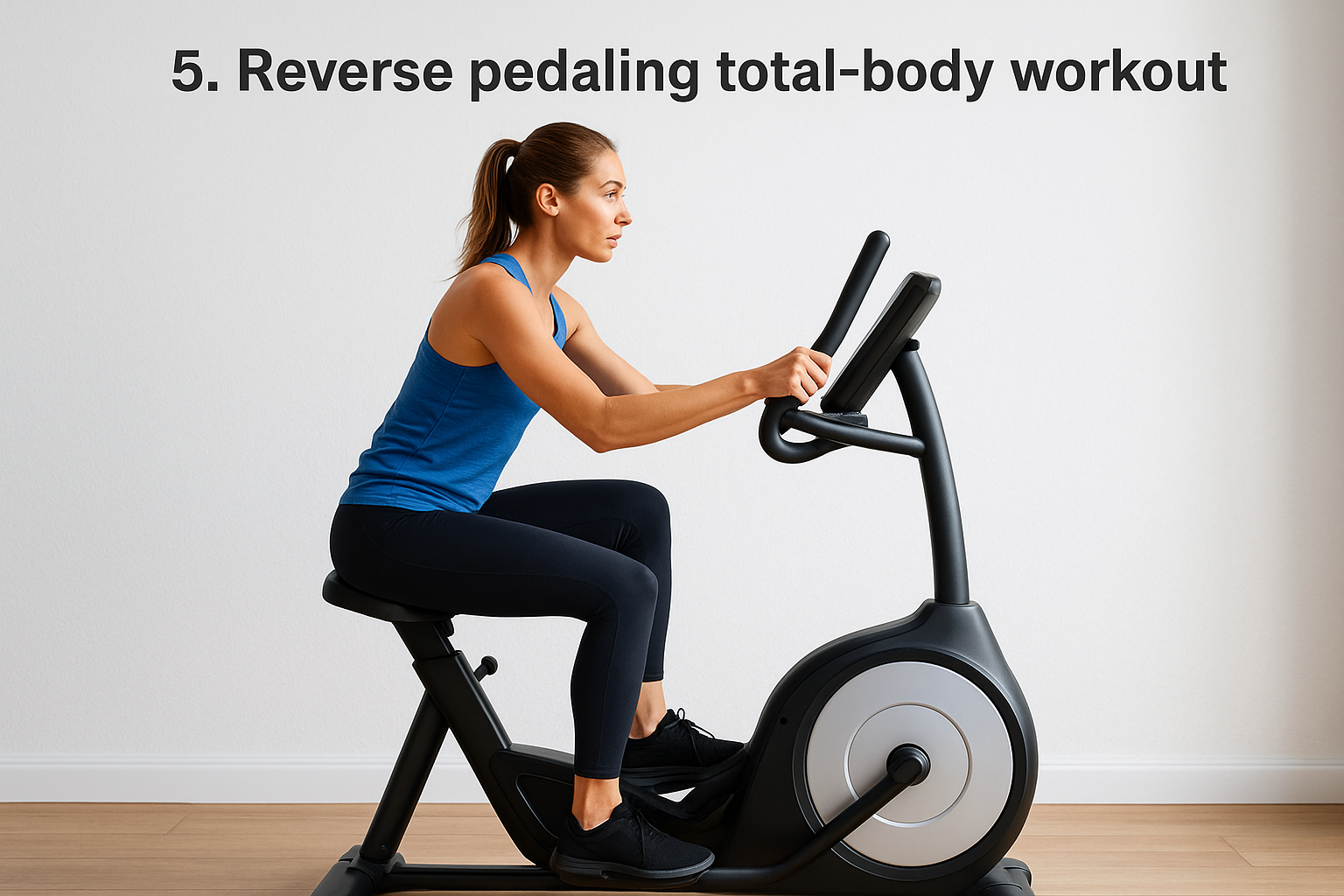
5. Reverse pedaling total-body workout
Pedaling backward feels awkward the first time you try it, but that awkwardness is the point. This reverse pedaling workout shifts the load from your quads to your hamstrings and glutes, hitting muscles your forward stride barely touches and giving your joints a different movement pattern to adapt to.
How it works
Switch your stride direction to reverse for set intervals, keeping resistance moderate so your form stays controlled instead of sloppy. On the Elite EM X, drop resistance to level 5 or 6 when you first switch directions, since reverse pedaling recruits smaller stabilizer muscles that fatigue faster than your quads. Keep your stride length shorter than usual, around 16 to 18 inches, until you’re confident with the motion.
Duration and intensity
Alternate 3 minutes forward with 2 minutes reverse for a total of 24 to 30 minutes. Hold your heart rate around 65 to 75 percent of max throughout, and don’t push resistance higher than level 8 during reverse segments until you’ve practiced the pattern for a few sessions.
Reverse pedaling isn’t a gimmick, it’s a way to train muscles your forward stride ignores.
Who it’s for
This suits people who’ve plateaued on standard elliptical routines and anyone rehabbing knee issues under guidance, since reverse motion reduces shear stress on the kneecap. Skip it if you have balance concerns.
Calorie-burning potential
A 180-pound person burns roughly 220 to 320 calories in a 25-minute session, per CDC MET estimates, slightly less than forward-only sessions but with added muscular balance benefits.
6. Heart-rate zone endurance workout
This final workout closes out the list by teaching you to train by heart rate instead of feel, which is the single biggest upgrade you can make to any elliptical trainer cardio workout. Numbers on a monitor don’t lie the way your perceived effort can, especially on days when you’re tired but still capable of more.
How it works
Wear a wireless heart rate strap or use the console’s built-in monitor and adjust resistance to hit a specific target zone rather than a specific resistance number. On the Elite EM X, that means watching the display and nudging resistance up or down every few minutes to stay locked in range, typically somewhere between level 5 and 9 depending on your fitness level. Keep your stride length consistent throughout so resistance is the only variable you’re managing.
Duration and intensity
Target 70 to 80 percent of your max heart rate for 30 to 40 minutes straight, a range often called tempo or threshold training. The American Heart Association notes this moderate-to-vigorous zone builds real endurance gains over time.
Training by heart rate, not by feel, is what separates a good cardio habit from a guessing game.
Who it’s for
Intermediate to advanced exercisers who’ve built a base with steady-state sessions and want measurable, repeatable endurance training benefit most here.
Calorie-burning potential
Expect 300 to 420 calories burned in 35 minutes for a 180-pound person, per CDC MET-based estimates, with the added benefit of a rising fitness threshold each week.
Finding your best elliptical routine
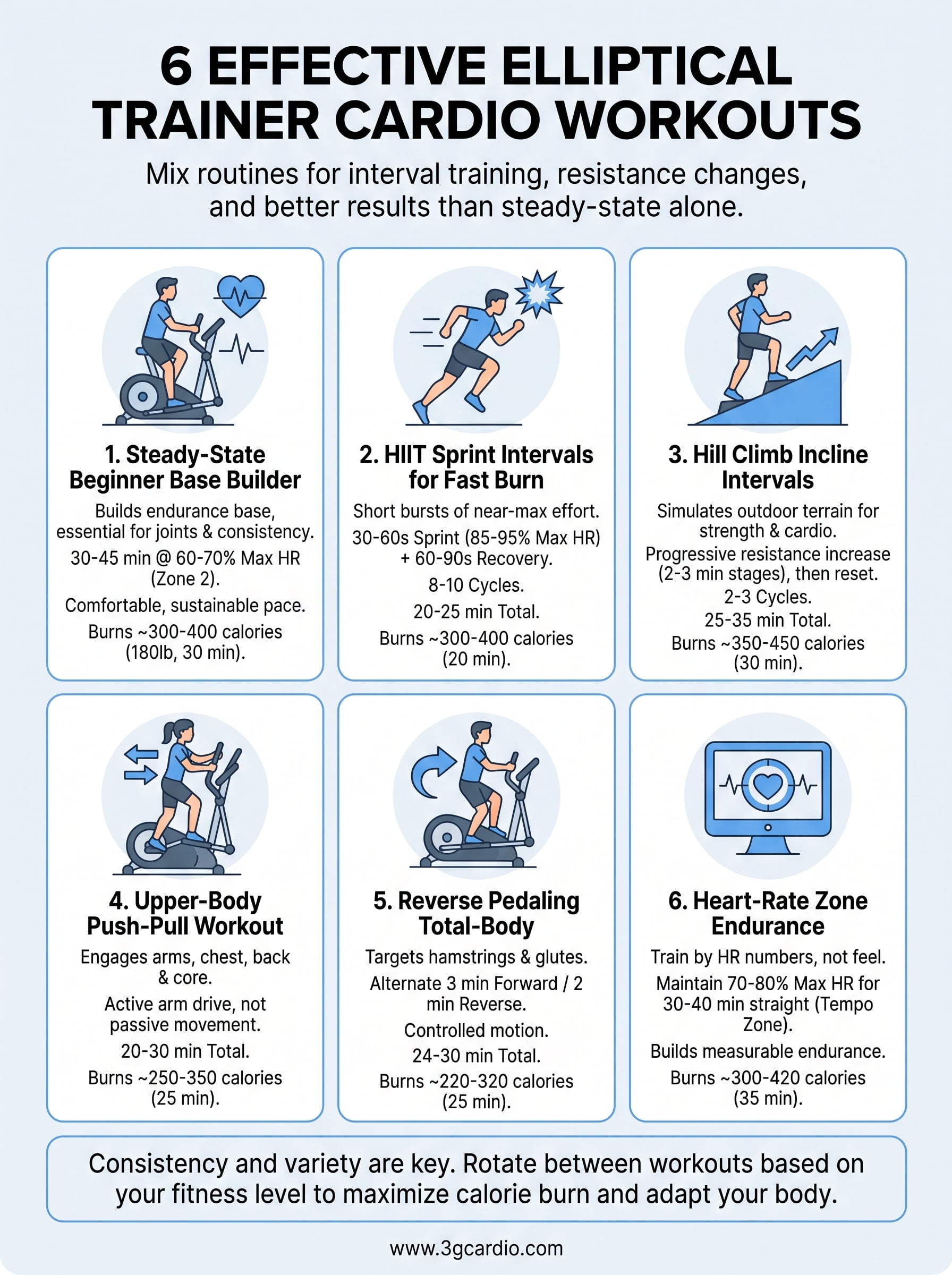
Six workouts give you real options instead of one default setting you never change. Rotate between steady-state sessions for base building, HIIT sprints and hill climbs for hard efforts, and the push-pull, reverse pedaling, or heart-rate zone routines when you want variety without buying new equipment. Pick two or three that match your current fitness level and rotate them weekly rather than trying to master all six at once.
Results come from consistency, not from finding one magic interval pattern. Track your heart rate, adjust resistance honestly instead of coasting, and let your calorie-burning potential climb as your fitness improves. The elliptical rewards people who show up and change something each session, whether that’s stride length, resistance, or direction.
If your current machine can’t hold resistance steady or track your heart rate accurately, the workouts above will only take you so far. Check out the Elite EM X Elliptical Trainer for a commercial-grade machine built to handle every routine on this list.




Sorry, the comment form is closed at this time.