

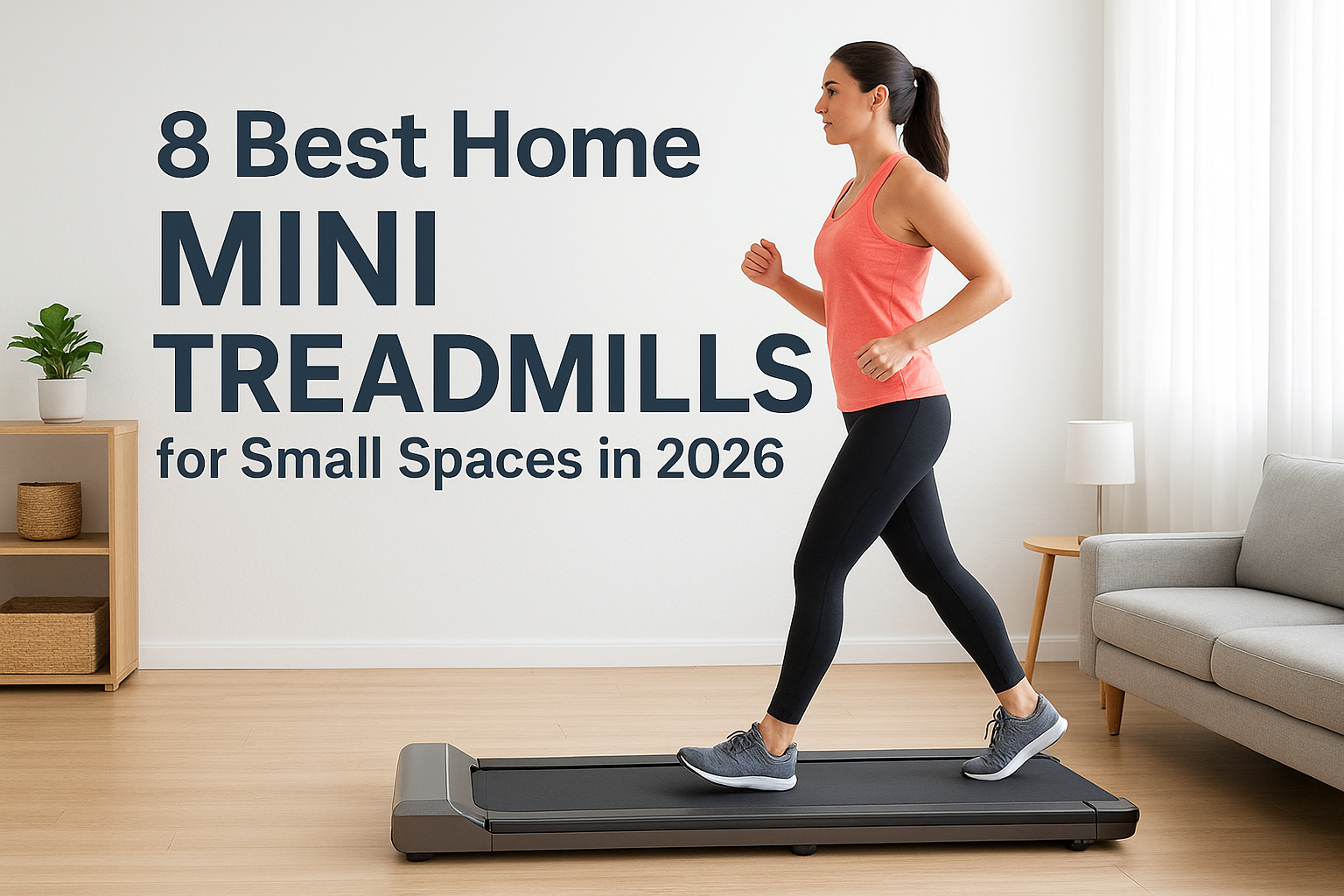
17 Aug 8 Best Home Mini Treadmills for Small Spaces in 2026
Living room, apartment, home office corner, whatever space you’ve got, squeezing in a treadmill without sacrificing your walkway is a real challenge, and it’s why small-space cardio picks get so much attention. That’s exactly why the home mini treadmill market has exploded, and why so many options now flood your search results with confusing specs and questionable build quality. We build cardio equipment for a living at 3G Cardio, and we’ve seen firsthand how many compact treadmills cut corners on the motor and belt just to hit a lower price point.
If you’re trying to figure out which compact treadmill actually holds up under daily use, you need more than a features list, you need a real sense of how to choose a treadmill that lasts. You need to know how each model handles incline and speed, whether the folding mechanism will survive years of use, and if the deck is long enough for your stride.
This list breaks down eight of the best mini treadmills for 2026, covering build quality and storage footprint for every budget and space constraint. We compare motor power, weight capacity, connectivity, and warranty coverage so you can match a machine to your actual workout habits, not just your square footage.
1. WalkingPad C2 for walking while you work
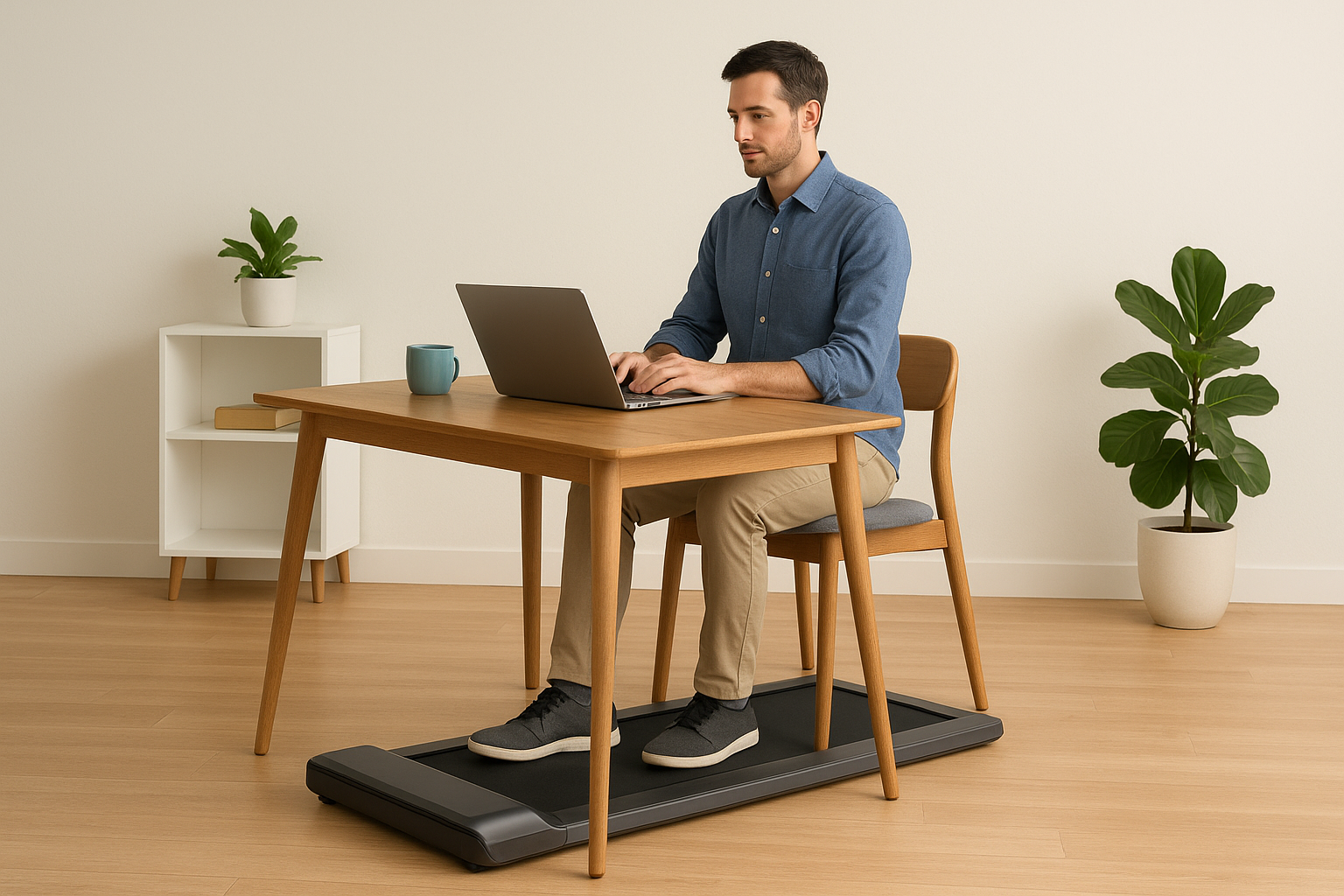
Working from a kitchen table or a spare bedroom means your treadmill has to disappear the moment your workday ends, and that’s the exact problem the WalkingPad C2 solves. This is the machine that popularized the "walking pad" category: a slim, low-profile deck that folds in half with a single motion and slides under a bed or couch. If you’ve been searching for a treadmill for small apartments that won’t dominate the room, this is usually the first name you’ll run into.
Key features
Building on that space-saving design, the C2 runs in two distinct modes. In manual mode, you control speed with a remote or your phone while walking or slow jogging up to 3.7 mph on a flat deck about four inches off the floor. Unfold the safety handlebar and it switches to standard mode, where speed climbs to 7.5 mph for actual running. The brushless motor stays quiet enough for video calls, and the Bluetooth connectivity links to the WalkingPad app or third-party fitness apps to log steps, distance, and calories. A remote clip lets you speed up or slow down without breaking stride, which matters more than it sounds once you’re trying to answer emails mid-walk.
A mini treadmill only earns its keep if it actually gets used every day, and the C2’s fold-and-roll design removes the biggest excuse for skipping a workout.
Who it’s for
Remote workers and hybrid employees who want to log steps during calls are the obvious fit here, since people who sit too much benefit most from a treadmill within arm’s reach. Renters and apartment dwellers who can’t dedicate permanent floor space to a full-size treadmill also do well with it, since the whole unit weighs around 62 pounds and rolls on built-in wheels. Anyone chasing serious marathon training should look at a health-club-quality treadmill built for marathon miles instead, since the C2’s frame and motor are tuned for walking and light jogging, not sustained high-speed running.
Pros and cons
Setting expectations before you buy saves you a return shipment, so here’s the honest breakdown after comparing it against other under-desk treadmill options:
- Pro: Folds flat in seconds and rolls away like a suitcase
- Pro: Quiet motor works well in open-plan apartments and shared offices
- Pro: Dual-mode design covers both walking and light running
- Con: Running mode requires unfolding the handlebar, which takes floor space back
- Con: Deck length feels tight for runners over 6 feet tall
- Con: Warranty coverage is shorter than what you’ll find on commercial-grade frames
Price and specs
Pricing typically lands in the $500 range, positioning it as a mid-tier investment compared to bargain walking pads and full-size cardio machines alike. Here’s how the core specs stack up:
| Spec | WalkingPad C2 |
|---|---|
| Speed range | 0.5-3.7 mph (manual), up to 7.5 mph (standard) |
| Folded dimensions | Roughly 43" x 27" x 6" |
| Weight capacity | 220 lbs |
| Motor | 2.0 HP brushless |
| Connectivity | Bluetooth, companion app |
| Warranty | 1-year limited |
Compare that weight capacity and warranty length against sturdier frames before you commit, especially if multiple people in your household plan to use it. A one-year warranty on a machine you’ll use daily is short, and it’s worth weighing that against treadmills built with a longer parts and labor commitment when durability matters more than portability.
2. UREVO SpaceWalk for budget-friendly walking
Not everyone wants to spend $500 on a walking pad, and the UREVO SpaceWalk exists for exactly that budget-conscious shopper. It’s a stripped-down under-desk treadmill that skips the fancy touchscreen and premium materials in favor of a low price point, usually landing under $300. If your goal is simply logging more steps during the day without financing a piece of equipment, this home mini treadmill covers the basics without the markup.
Key features
Unlike the dual-mode C2, the SpaceWalk sticks to a single walking mode with speeds from 0.5 to 3.7 mph, which keeps the motor and frame simpler and cheaper to produce. Its remote control handles speed adjustments, and a basic LED display tracks time, distance, speed, and calories without needing an app for core functionality. Folding is manual rather than the C2’s spring-assisted mechanism, so you’ll bend down to lift the deck yourself, but it still tucks into a closet or under a bed once folded. Some versions include Bluetooth speed sync with fitness apps, though the connection is less polished than what you get from dedicated walking pad brands.
Budget treadmills earn their price tag by doing one thing reliably instead of many things poorly, and the SpaceWalk sticks to walking without pretending to be a running machine.
Who it’s for
First-time buyers testing whether a walking pad fits their routine benefit most from this lower entry cost, since it removes the financial risk of an expensive purchase you might not use. Anyone furnishing a small home office on a tight budget also fits the profile, especially if walking on a treadmill as your main cardio and step-count goals matter more than speed or incline. Skip this one if you want to run, jog, or eventually upgrade to higher speeds, since the motor simply isn’t built for that kind of demand.
Pros and cons
Comparing the SpaceWalk against pricier walking pads makes the tradeoffs clear:
- Pro: Among the lowest prices in the walking pad category
- Pro: Simple controls with no learning curve
- Pro: Compact folded footprint fits tight closets
- Con: No running mode limits long-term versatility
- Con: Manual folding feels less convenient than assisted designs
- Con: Motor and belt durability lag behind commercial-grade construction
Price and specs
Here’s the quick spec rundown for comparison shopping:
| Spec | UREVO SpaceWalk |
|---|---|
| Speed range | 0.5-3.7 mph |
| Folded dimensions | Roughly 42" x 24" x 5" |
| Weight capacity | 265 lbs |
| Motor | 2.25 HP |
| Connectivity | Bluetooth (select models) |
| Warranty | 1-year limited |
Treat the SpaceWalk as an entry point rather than a forever machine. If you outgrow the 3.7 mph ceiling within a year, that’s a sign to shop for a treadmill with a stronger motor and longer warranty next time around.
3. Sole F63 for running and long-term durability
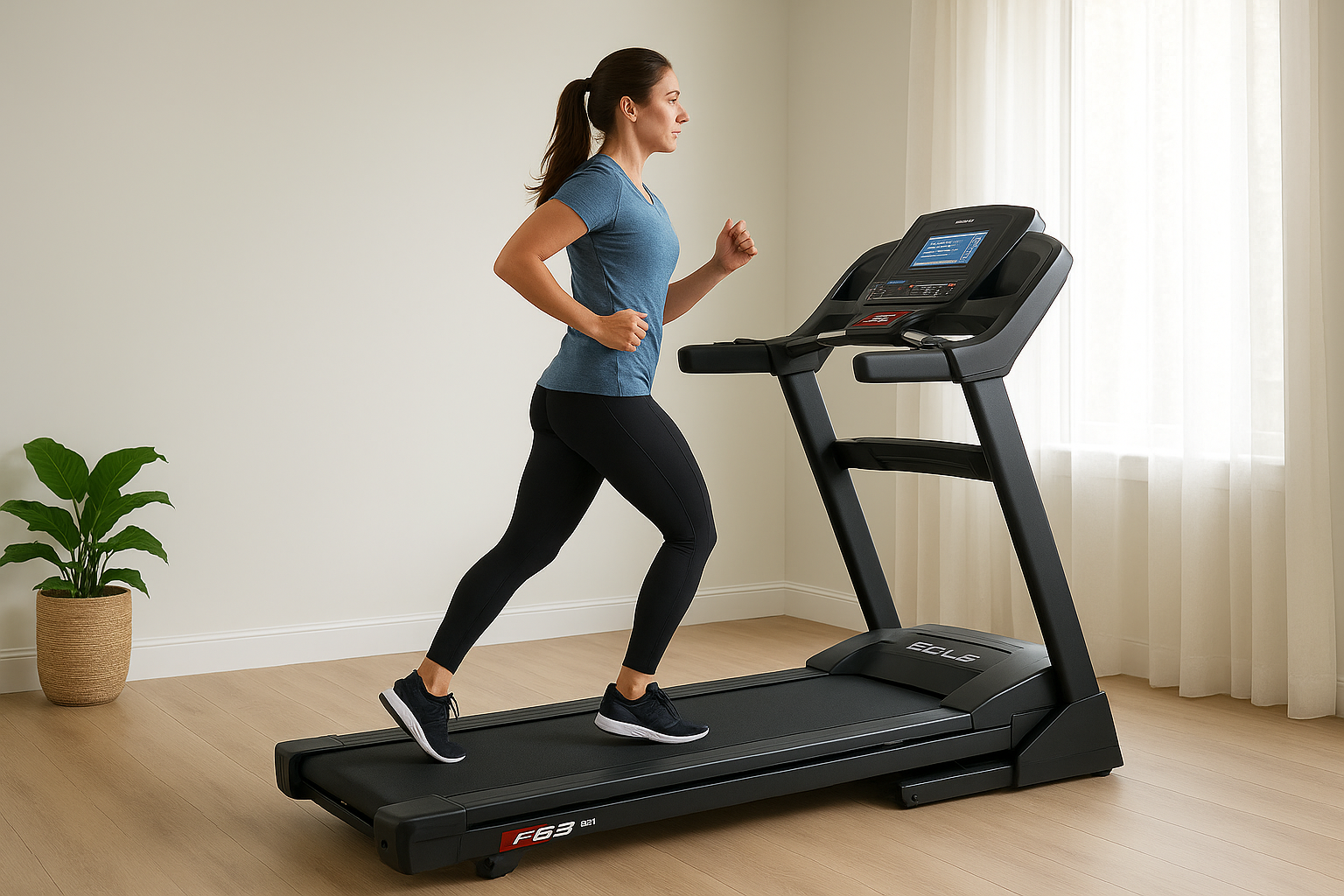
Switching gears from walking pads to a machine built for actual running, the Sole F63 targets a different buyer entirely. This isn’t a fold-flat walking pad you slide under a bed. It’s a full-featured folding treadmill with a stronger motor and a longer deck, designed for people who want to run on a fold-up treadmill at real speeds without outgrowing the equipment in six months. If you’ve been comparing a home mini treadmill against something more substantial, the F63 sits in that middle ground: it still folds up to save space, but it’s built like a machine meant to last a decade.
Key features
Driving that durability is a 3.0 CHP motor paired with a 60" x 20" running surface, long enough for taller runners to stretch out a stride without feeling boxed in. Incline adjusts from 0 to 15 percent in 0.5 percent increments, which gives you real hill-training options that most compact treadmills skip entirely. Speed tops out at 12 mph, well past jogging pace, and the cushioned deck uses Sole’s Cushion Flex Whisper Deck to reduce joint impact on knees and ankles. A 7.5-inch LCD console tracks your stats, and Bluetooth connectivity syncs with the Sole Fitness app for workout tracking. The hydraulic folding system lifts the deck with one hand and locks it upright, cutting the footprint nearly in half when you’re done.
A treadmill that can handle years of daily running only stays useful if the motor and deck are built to match that demand, and that’s where the F63 separates itself from lighter walking pads.
Who it’s for
Serious runners who log multiple miles per week and need incline variety for hill workouts get the most value here, and they’re the buyers who should know what makes a good running treadmill before spending. Households with more than one user also benefit, since the 350-pound weight capacity and commercial-grade parts hold up better under shared, frequent use than lighter walking pads do. Skip the F63 if floor space is your top priority, since it doesn’t fold flat enough to slide under furniture the way a walking pad does.
Pros and cons
Weighing the F63 against lighter compact treadmills highlights where the tradeoffs land:
- Pro: Motor and deck built for sustained running, not just walking
- Pro: Incline range adds real training variety
- Pro: High weight capacity suits multiple users
- Con: Folded footprint is bigger than dedicated walking pads
- Con: Heavier unit makes moving it around a two-person job
- Con: Higher price point than budget walking pads
Price and specs
Expect to pay in the $1,700 to $1,900 range depending on retailer promotions.
| Spec | Sole F63 |
|---|---|
| Speed range | 0-12 mph |
| Incline | 0-15% |
| Folded dimensions | Roughly 38" x 35" x 65" |
| Weight capacity | 350 lbs |
| Motor | 3.0 CHP |
| Warranty | Lifetime frame and motor, 5-year parts, 2-year labor |
That warranty length matters more than most buyers realize until something breaks, so weigh it against the shorter one-year coverage common on lighter walking pads before you decide how much running capacity you actually need.
4. Horizon Fitness 7.0 AT for everyday exercise
After the running-focused Sole F63, the Horizon Fitness 7.0 AT brings the conversation back to the middle ground most households actually live in. This is one of those folding treadmills for home use with incline built for daily walks, jogs, and the occasional interval session rather than marathon training or ultra-compact storage. If you want a home mini treadmill that still folds up but doesn’t feel flimsy under regular use, the 7.0 AT is the workhorse option that shows up on a lot of "best value" lists for good reason.
Key features
Powering the 7.0 AT is a 3.0 CHP motor matched to a 60" x 20" deck, so taller users get the same stride room as pricier running machines without paying running-machine prices. Horizon’s Variable Response Feedback (VRF) cushioning adjusts deck stiffness based on where you’re stepping, softer near the edges for warmups and firmer in the center for faster pace, which cuts down on joint strain during longer sessions. Incline runs from 0 to 15 percent and speed tops out at 12 mph, matching the F63’s range in a lighter, more affordable package. Bluetooth connectivity pairs with the Horizon app and third-party platforms, and the folding hydraulic arm brings the deck up and locks it with minimal effort.
A treadmill built for everyday exercise doesn’t need every bell and whistle, it just needs a motor and deck that won’t quit after the first few months.
Who it’s for
Households that want one treadmill to cover walking, jogging, and light hill training fit the 7.0 AT best, especially if more than one person will use it regularly. Buyers upgrading from a bargain walking pad who’ve outgrown its 3.7 mph ceiling land here often, since the stronger motor and full incline range give real room to grow. Skip it if your main goal is sliding a treadmill under a bed daily, since the folded footprint is closer to a traditional folding treadmill than a slim walking pad.
Pros and cons
Here’s how the 7.0 AT stacks up against both the running-focused F63 and the lighter walking pads earlier on this list:
- Pro: Motor and incline range handle everyday jogging and hill training
- Pro: VRF cushioning reduces joint impact over long sessions
- Pro: Priced below comparable running treadmills with similar specs
- Con: Folded footprint is larger than dedicated walking pads
- Con: Console lacks the touchscreen interactivity of pricier interactive models
- Con: Assembly takes longer than plug-and-play walking pads
Price and specs
Pricing typically falls between $999 and $1,199 depending on promotions.
| Spec | Horizon Fitness 7.0 AT |
|---|---|
| Speed range | 0-12 mph |
| Incline | 0-15% |
| Folded dimensions | Roughly 35" x 36" x 65" |
| Weight capacity | 325 lbs |
| Motor | 3.0 CHP |
| Warranty | Lifetime frame and motor, 5-year parts, 2-year labor |
Compare that motor and warranty combination against lighter walking pads before assuming a smaller footprint always wins. If daily use across multiple household members matters more than sliding the deck under furniture, this is where your budget should go.
5. NordicTrack T Series 10 for interactive workouts
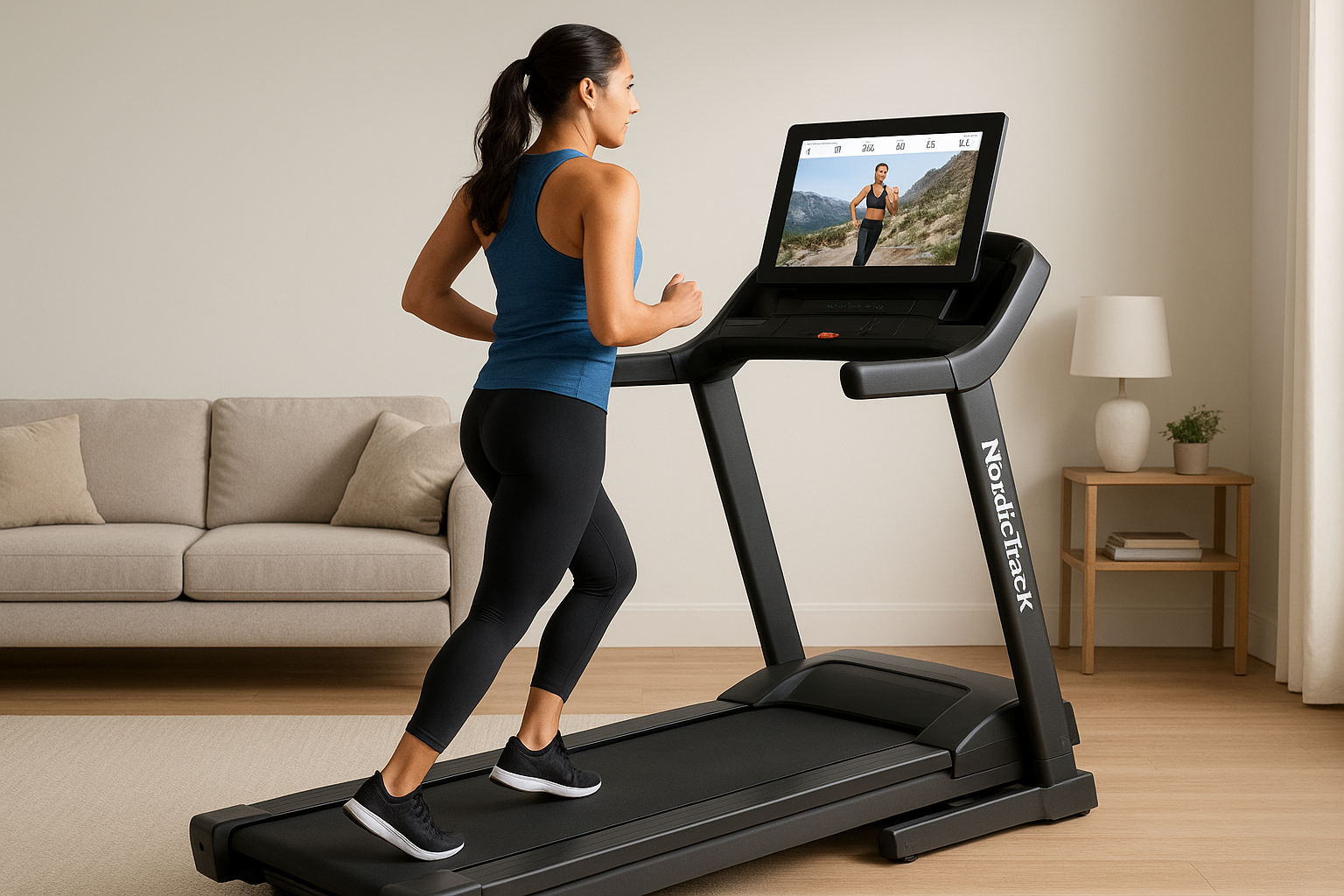
Screen-based training changes the equation entirely, and the NordicTrack T Series 10 is built around that idea. Instead of a basic LED display, this treadmill puts a 10-inch HD touchscreen front and center, streaming iFit workouts led by real trainers on real locations, from Icelandic trails to studio HIIT sessions. If you’ve been comparing a home mini treadmill against something that keeps you engaged mentally as well as physically, this is the model built for that exact itch.
Key features
Running that touchscreen experience is a 2.6 CHP motor paired with a 55" x 20" deck, shorter than the Sole F63 or Horizon 7.0 AT but still workable for most walkers and casual joggers. Incline automatically adjusts from -3 to 10 percent when you’re following an iFit trainer, since the console controls grade and speed in sync with the video without you touching a button. Speed tops out at 10 mph, and NordicTrack’s cushioning system softens landings compared to a flat, rigid deck. Bluetooth connectivity pairs with a wireless heart rate monitor and syncs workout data automatically, though the deepest features require an iFit subscription running around $39 a month.
An interactive touchscreen only pays off if you’ll actually use the subscription behind it, so weigh that recurring cost against a simpler console before you commit.
Who it’s for
Motivation-driven exercisers who stick with workouts better when a trainer is coaching them through a screen get the clearest benefit from the T Series 10. Households already invested in the iFit ecosystem, maybe through a NordicTrack bike or rower, also gain value since content and progress sync across machines. Skip this one if you’d rather avoid subscription fees altogether, since the touchscreen features shrink considerably without an active iFit plan.
Pros and cons
Weighing the subscription model against the simpler consoles on this list clarifies where the tradeoffs sit:
- Pro: Large touchscreen delivers genuinely engaging, trainer-led workouts
- Pro: Auto-adjusting incline and speed remove manual guesswork
- Pro: Data syncs automatically across compatible fitness gear
- Con: Full functionality depends on an ongoing iFit subscription
- Con: Deck length runs shorter than dedicated running treadmills
- Con: Folded unit is bulkier than slim walking pads
Price and specs
Expect to pay around $1,299 to $1,499 before factoring in the subscription cost.
| Spec | NordicTrack T Series 10 |
|---|---|
| Speed range | 0-10 mph |
| Incline | -3 to 10% |
| Folded dimensions | Roughly 39" x 35" x 66" |
| Weight capacity | 300 lbs |
| Motor | 2.6 CHP |
| Warranty | 10-year frame, 2-year parts, 1-year labor |
Factor the monthly subscription into your total cost of ownership before comparing this against machines that stream to your own tablet with no subscription fees.
6. Echelon Stride-6 for saving floor space
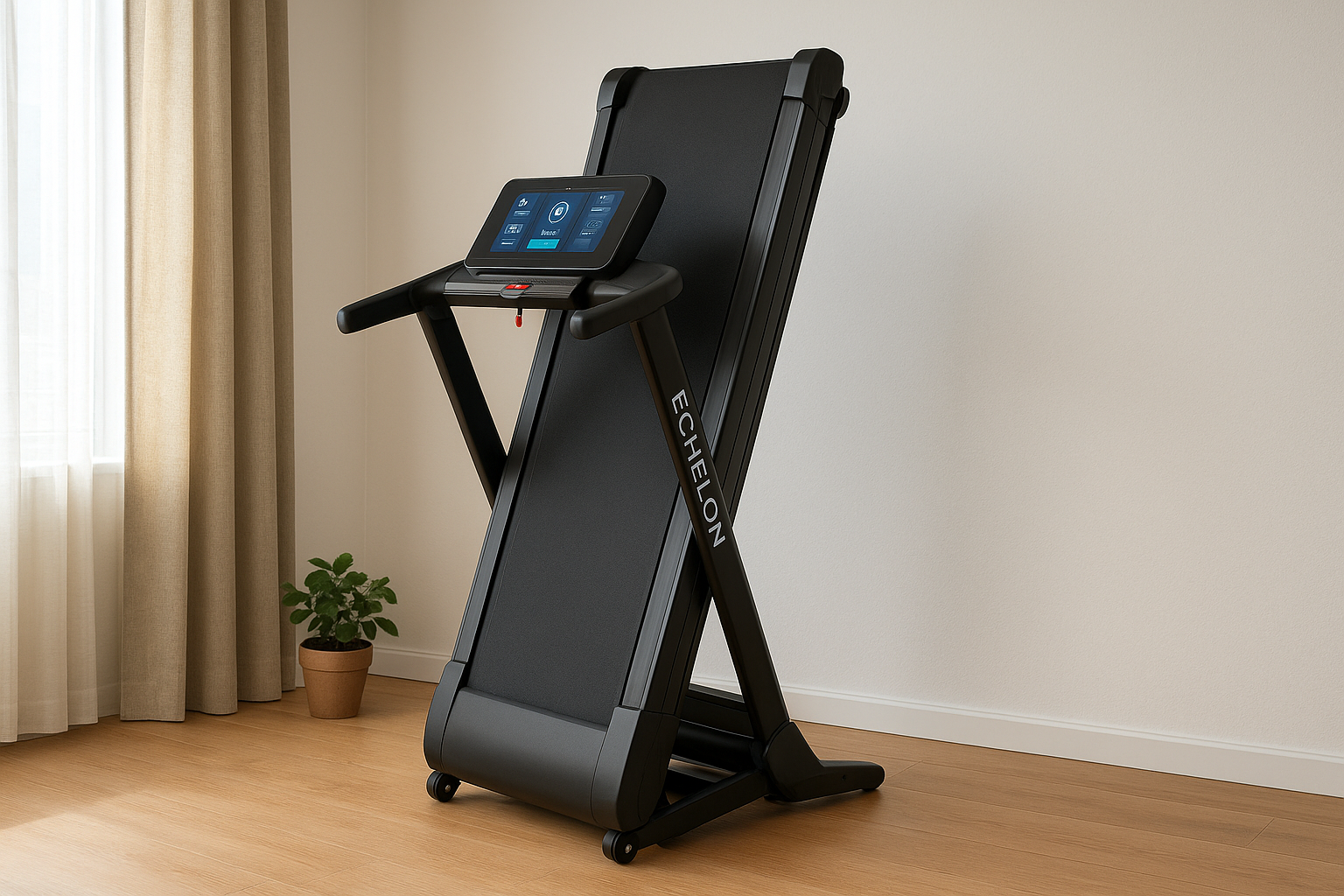
Compact folding treadmills usually force a tradeoff between deck size and storage size, but the Echelon Stride-6 tries to split that difference. It folds nearly vertical on built-in transport wheels, so the footprint standing upright is barely bigger than a bookshelf, yet it still runs on a real motor instead of the stripped-down units found on walking pads. If you’re hunting for one of those foldable treadmills for small spaces that stores upright in a closet or against a wall rather than sliding flat under furniture, this is the model built around that exact constraint.
Key features
Supporting that vertical fold is a 2.5 CHP motor paired with a 20" x 55" deck, enough room for jogging without the bulk of a full-length running treadmill. Speed ranges from 0.5 to 12 mph, and incline adjusts manually up to 10 percent, giving you hill work without an automated system to maintain. The 10-inch touchscreen streams Echelon’s on-demand classes through a subscription, similar to how NordicTrack ties its best features to iFit, though the treadmill still functions as a basic fitness equipment piece without an active plan. Bluetooth connectivity pairs with a heart rate strap and third-party apps, and the frame includes transport wheels so one person can tilt and roll it into a corner after a workout.
A treadmill that folds upright instead of flat saves wall space instead of floor space, which matters most in rooms where every square foot along the baseboards counts.
Who it’s for
Apartment dwellers with narrow rooms but a bit of wall clearance get the clearest benefit, since the Stride-6 trades floor footprint for vertical storage instead of eliminating bulk altogether. Subscription-friendly buyers who already enjoy Echelon’s other equipment, like their bikes or rowers, also find value in the shared class library. Anyone who wants a completely subscription-free experience should look at the Horizon 7.0 AT or Sole F63 instead, since Echelon’s touchscreen leans heavily on its paid content.
Pros and cons
Here’s how the Stride-6 compares against the flatter-folding treadmills earlier on this list:
- Pro: Vertical fold saves floor space better than flat-folding treadmills
- Pro: Real motor and deck handle jogging, not just walking
- Pro: Transport wheels make repositioning simple for one person
- Con: Best features require an Echelon membership
- Con: Incline adjusts manually rather than automatically
- Con: Touchscreen adds cost compared to basic LED consoles
Price and specs
Pricing typically runs between $1,000 and $1,300 before any subscription cost.
| Spec | Echelon Stride-6 |
|---|---|
| Speed range | 0.5-12 mph |
| Incline | 0-10% (manual) |
| Folded dimensions | Roughly 32" x 34" x 70" |
| Weight capacity | 300 lbs |
| Motor | 2.5 CHP |
| Warranty | 1-year parts and labor |
Weigh that shorter one-year warranty against the multi-year coverage on the Sole F63 or Horizon 7.0 AT if you plan to keep this treadmill for the long haul.
7. DeerRun 2-in-1 for women’s fitness needs
Marketed with a design that leans into how women actually use compact treadmills at home, the DeerRun 2-in-1 pairs a low-profile walking deck with a removable desk attachment built for laptops, tablets, or a cup of coffee. It skips the bulky console found on running-focused machines and instead prioritizes a quiet motor, light frame, and simple controls that don’t require a manual to figure out. If you’ve been searching for a home mini treadmill that fits a home office setup without towering over the room, this is the model that keeps showing up in that search.
Key features
Underneath the desk attachment sits a 2.25 HP motor running speeds from 0.6 to 3.8 mph, tuned specifically for walking rather than jogging or running. The removable desk surface attaches and detaches without tools, so you can switch between a standing walk-and-work setup and a clear floor space in seconds. A remote control adjusts speed without breaking stride, and the LED display tracks time, distance, speed, and calories burned. Bluetooth connectivity syncs step counts to a companion app, and the folding hinge lets the deck fold to roughly five inches thick for storage under a bed or couch.
A treadmill built around a desk attachment only works if the deck stays quiet enough for calls, and that’s the detail DeerRun gets right.
Who it’s for
Women working from home who want to log steps during calls or emails without a dedicated workout room fit this machine best, especially in smaller apartments or spare bedrooms doubling as offices. Buyers who value a lighter frame, around 48 pounds, that’s easier to lift and reposition solo also do well here compared to heavier folding treadmills elsewhere on this list. Skip the DeerRun if you want to run or need incline options, since the motor and deck are built strictly for slow, steady walking.
Pros and cons
Here’s how the DeerRun stacks up against other walking-focused machines on this list:
- Pro: Removable desk attachment doubles as a workstation
- Pro: Lightweight frame is easy for one person to move and store
- Pro: Quiet motor works well during video calls
- Con: No incline adjustment of any kind
- Con: Top speed caps out well below jogging pace
- Con: Desk surface has limited weight capacity for larger monitors
Price and specs
Pricing typically lands between $250 and $350, making it one of the more affordable options here.
| Spec | DeerRun 2-in-1 |
|---|---|
| Speed range | 0.6-3.8 mph |
| Folded dimensions | Roughly 41" x 23" x 5" |
| Weight capacity | 220 lbs |
| Motor | 2.25 HP |
| Connectivity | Bluetooth, companion app |
| Warranty | 1-year limited |
Expect this treadmill to handle walking duty well, but plan on a separate machine down the road if your goals ever shift toward jogging or incline training.
8. Sunny Health and Fitness for manual incline training
Closing out this list is the Sunny Health & Fitness SF-T7515, a budget-minded folding treadmill that adds something most cheap machines skip entirely: incline. Sunny has built its reputation on affordable home gym gear sold through big retailers, and this treadmill follows that formula by keeping the console simple while still giving you a way to add resistance beyond just cranking up speed. If you’ve compared every walking pad on this list and still want a home mini treadmill with a hill option, this is where that search usually ends.
Key features
Powering the SF-T7515 is a 2.5 HP motor paired with a 40" x 14" deck, noticeably narrower than the running-focused machines earlier on this list but adequate for walking and light jogging. Incline adjusts manually across three fixed positions, so you lift and lock the deck yourself rather than pressing a button, which keeps the mechanism simple and less prone to electronic failure. Speed tops out around 9 mph, and the LCD console tracks time, distance, speed, and calories without any app dependency. A space-saving hydraulic fold brings the deck upright for storage, and built-in wheels let one person roll it against a wall when the workout’s done.
Manual incline costs you convenience, but it also removes one more electronic system that can eventually break, and that tradeoff is exactly what keeps this treadmill affordable.
Who it’s for
Budget-conscious buyers who still want hill training without paying for an automated incline motor get the most out of this machine, and walking on an incline is where the extra effort pays off. It also suits anyone furnishing a first home gym who wants a treadmill that folds compactly but doesn’t feel as flimsy as a bare-bones walking pad. Skip it if you want the deck length or motor power to support serious distance running, since the narrower running surface limits stride room at higher speeds.
Pros and cons
Here’s how the manual incline design compares against the automated options elsewhere on this list:
- Pro: Adds incline training at a fraction of the cost of automated machines
- Pro: Simple mechanical design means fewer electronic parts to fail
- Con: Adjusting incline mid-workout means stopping to reset the position
- Con: Deck width feels tight for wider strides or larger frames
- Con: Warranty coverage trails the multi-year plans on pricier treadmills
Price and specs
Expect to pay between $550 and $700 depending on retailer promotions.
| Spec | Sunny Health & Fitness SF-T7515 |
|---|---|
| Speed range | 0.5-9 mph |
| Incline | 3 manual positions |
| Folded dimensions | Roughly 55" x 26" x 65" |
| Weight capacity | 220 lbs |
| Motor | 2.5 HP |
| Warranty | 5-year motor, 1-year parts, 90-day labor |
Weigh that shorter labor warranty against the multi-year coverage on the Sole F63 or Horizon 7.0 AT if you plan to log serious mileage rather than occasional walks.
Finding the right fit for your space
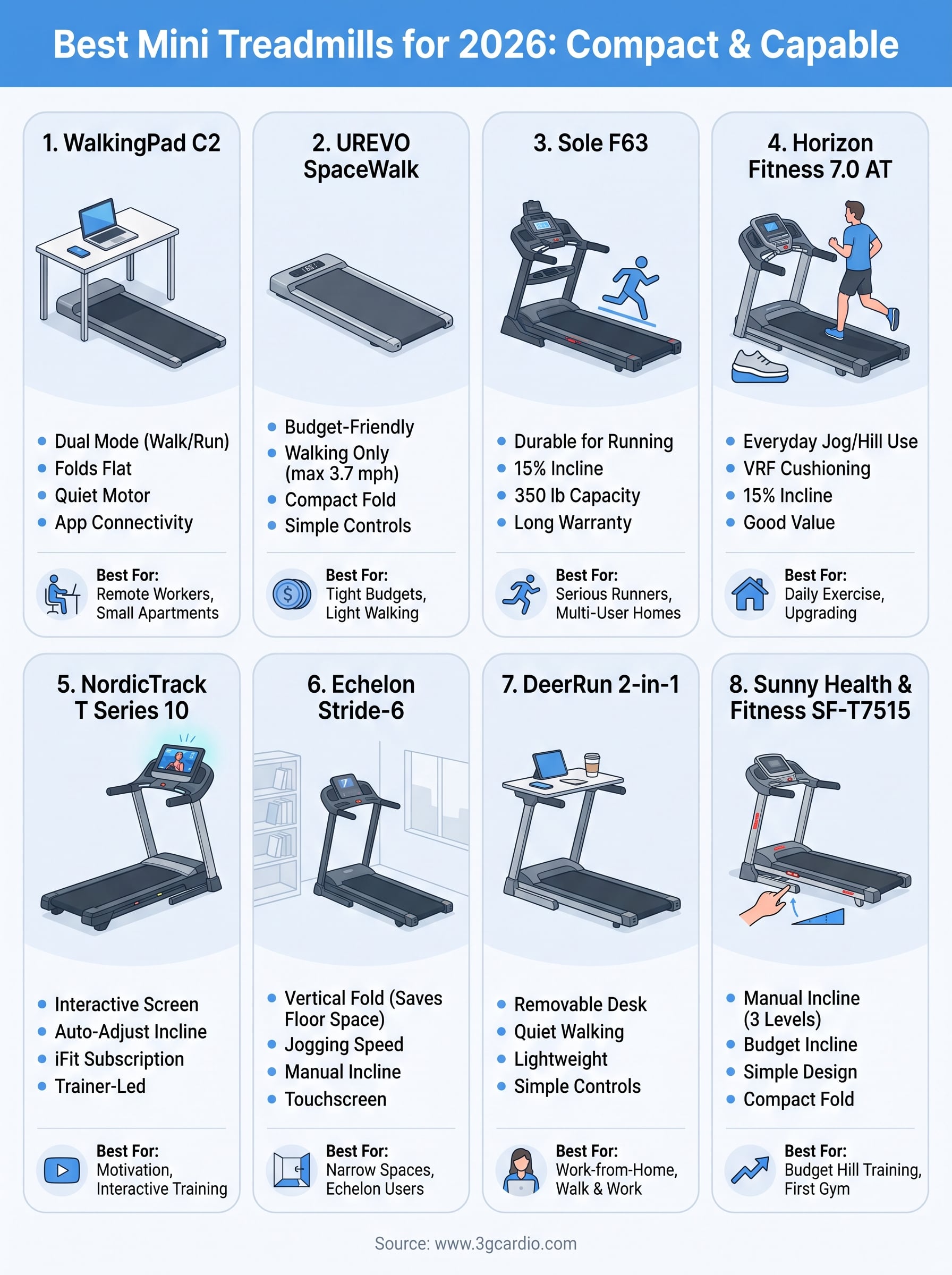
Picking the right home mini treadmill comes down to matching the machine to your actual habits, not the flashiest spec sheet. If you’re walking during work calls, a fold-flat pad like the C2 or DeerRun makes sense. If you’re logging real miles or training for a race, you need the motor, deck length, and warranty coverage that only a full-size folding treadmill like the Sole F63 or Horizon 7.0 AT can deliver.
That’s really the tradeoff running through this entire list: portability versus durability. Compact treadmills earn floor space back, but they rarely hold up to years of daily running the way a heavier, commercial-grade frame does. If durability and joint-friendly cushioning matter more to you than sliding a deck under the couch, look at a machine built with that long-term use in mind. Check out the space-saving folding treadmill built for serious running that still delivers commercial-grade construction without eating up your whole room.



No Comments