

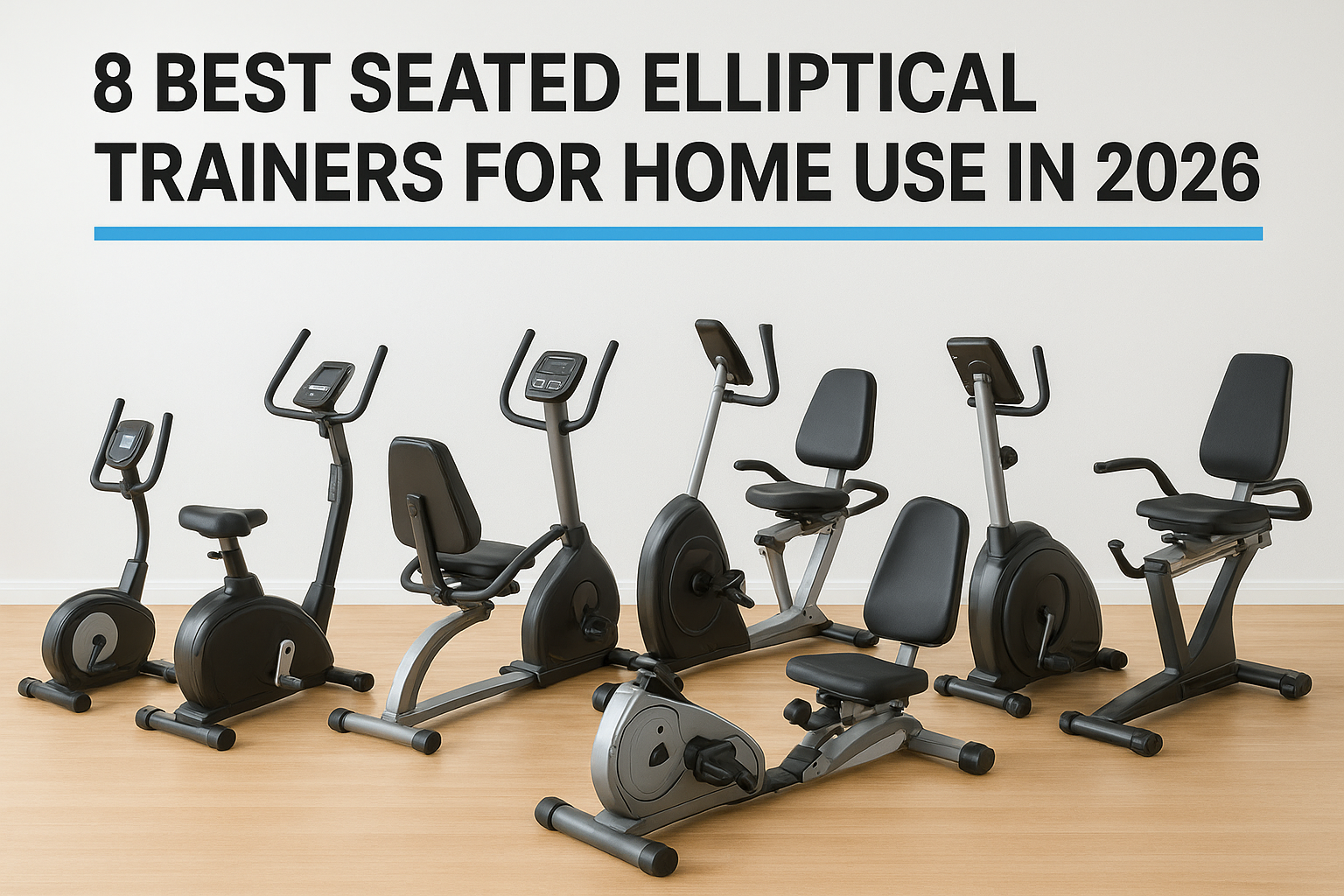
13 Aug 8 Best Seated Elliptical Trainers for Home Use in 2026
If your knees, hips, or back can’t handle pounding pavement or a bouncy home gym floor, a seated elliptical trainer solves the problem without forcing you to give up cardio altogether. These machines let you pedal from a stable, supported seat, which is why so many people recovering from injury, managing arthritis, or just wanting a gentler workout search for one before they buy.
This guide answers the real question behind that search: which sitting elliptical trainer is actually worth your money in 2026. We tested build quality, resistance range, stride comfort, and console features across the current market, then ranked eight models that hold up to daily use instead of wobbling apart after six months.
At 3G Cardio, we build commercial-grade cardio equipment for home use, so we know what separates a durable seated elliptical machine for home gyms from a flimsy import. You’ll find that experience reflected in how we evaluated each pick here, with straight talk about pricing, warranty coverage, and which models genuinely fit a home routine versus an office desk.
1. Cubii Go
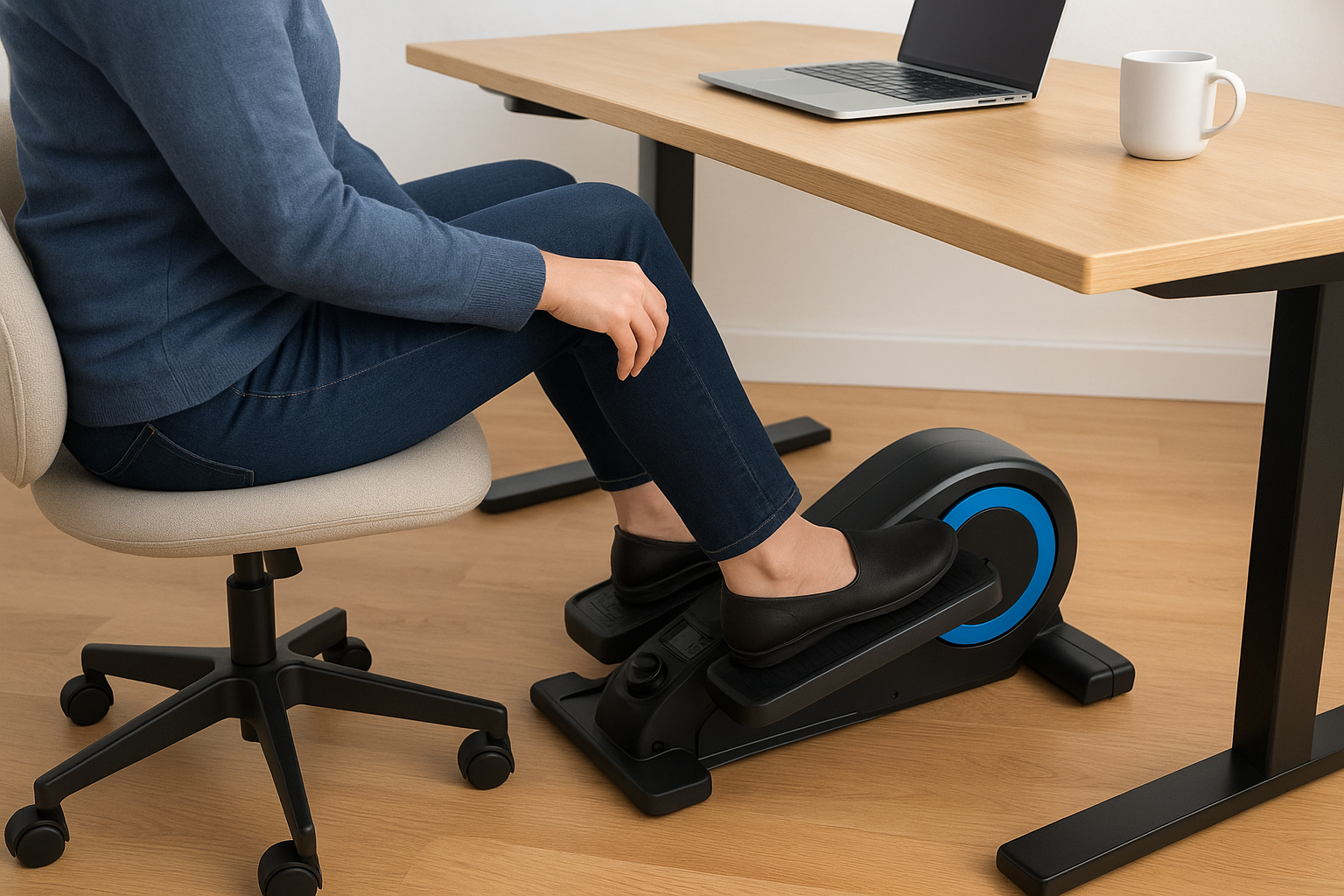
The Cubii Go is the machine most people picture when they type "seated elliptical trainer" into a search bar. It’s a compact, under-desk pedaler that slides beneath a chair, couch, or office desk, and it’s built by a brand that basically created this product category. If you want something you can use while answering emails rather than a standalone home gym piece, this is the benchmark against which every other model on this list gets measured.
Key features
Cubii built the Go around eight levels of magnetic resistance, a low-profile frame that clears most desk setups, and a companion app that tracks distance, calories, and steps over Bluetooth. The magnetic resistance system runs quieter than the friction-based resistance you’ll find on cheaper knockoffs, which matters if you’re pedaling during a video call. A small LCD display on the unit itself shows your stats without needing your phone open, and the whole thing weighs under 20 pounds, so moving it between rooms isn’t a chore.
- Eight resistance levels via a manual dial
- Bluetooth sync with the Cubii app (iOS and Android)
- Compact footprint: roughly 24" long by 14" wide
- Transport wheels for easy storage under a couch or bed
- Quiet magnetic flywheel, safe for shared walls and open offices
Who it’s best for
Office workers who sit for eight hours a day are the obvious fit here. The Cubii Go slides under most standard desks without hitting your knees on the frame, and the low resistance ceiling means you can pedal for an hour without breaking a sweat mid-meeting. Desk-bound professionals and anyone recovering from minor knee or hip procedures who just needs light, consistent movement will get real value out of it. It’s not going to satisfy someone chasing a serious cardio workout, though.
A seated elliptical like the Cubii Go earns its place at your desk, not in your home gym, and that distinction should drive your buying decision.
If your goal is burning a meaningful number of calories or building leg strength, you’ll hit the resistance ceiling within a few weeks and start looking for something with more headroom. That’s fine for light movement goals, but it’s worth knowing going in.
Pros and cons
Before you buy, weigh what the Cubii Go does well against where it falls short compared to a full-size seated elliptical machine for home use.
| Pros | Cons |
|---|---|
| Extremely quiet, safe for shared offices | Resistance tops out too low for serious training |
| Small enough to store under furniture | No adjustable stride length |
| Simple app tracks basic metrics | Plastic components feel less durable long-term |
| Lightweight and easy to move between rooms | No handlebars or upper-body engagement |
| Backed by a well-known, established brand | Not designed for standing or high-intensity use |
The biggest limiting factor is resistance range. Eight levels sounds like plenty until you realize level eight still feels like a warm-up compared to a commercial-grade elliptical. Build materials also skew toward plastic housing rather than the steel frames you’d find on equipment designed for daily home gym use, so expect it to show wear faster if you’re pedaling for hours every day rather than in short desk sessions.
Price
Cubii sells the Go directly through its website, typically in the $259 to $299 range depending on current promotions and bundle offers. That price point sits at the low end of the seated elliptical market, which makes sense given the plastic construction and limited resistance range. You won’t find much in the way of extended warranty coverage either, usually just a standard one-year limited warranty on parts.
For comparison, that’s roughly a tenth of what you’d pay for a full-featured recumbent bike or elliptical built for daily home workouts, like the ones in our own Elite RB X recumbent bike lineup. The Cubii Go isn’t trying to compete in that category, and it shouldn’t be judged against it. Think of the price as buying convenience and light movement, not a substitute for a real cardio machine.
2. Stamina InMotion E1000 Compact Strider
The Stamina InMotion E1000 takes the same under-desk concept as the Cubii Go and adds a bit more resistance headroom and a sturdier frame. Stamina has been making compact fitness gear for decades, and this strider reflects that experience: it’s not flashy, but it holds up to daily use better than most budget competitors. If the Cubii feels too light-duty for your needs but you’re not ready to commit to a full-size machine, this is the logical next step up.
Key features
This compact strider runs on a bidirectional pedal motion, meaning you can pedal forward or backward to work slightly different muscle groups, something the Cubii Go doesn’t offer. It includes a built-in LCD monitor that tracks time, distance, calories, and strides per minute without needing a phone or app connection at all.
- Bidirectional pedaling for forward and reverse motion
- Built-in monitor, no app or Bluetooth required
- Non-slip pedals with adjustable straps for different foot sizes
- Compact frame with transport wheels
- Whisper-quiet magnetic resistance
Who it’s best for
This machine suits people who want a seated elliptical machine for home use but don’t want to fuss with apps, Bluetooth pairing, or a phone propped up while they pedal. The standalone display covers the basics, and the bidirectional motion gives you a little more variety than a strictly forward-pedaling machine. Retirees and casual exercisers who value simplicity over data tracking will appreciate not needing a smartphone to see their stats.
Skip the app entirely and you skip a common failure point on cheap seated ellipticals: dead batteries and dropped Bluetooth connections mid-workout.
It’s not the right pick if you’re motivated by tracking trends over time or syncing with a fitness app like Kinomap, since there’s no data export or history beyond what’s on screen during your session.
Pros and cons
Here’s how the InMotion E1000 stacks up once you get past the marketing copy and into daily use.
| Pros | Cons |
|---|---|
| No app required, works right out of the box | No Bluetooth or app connectivity at all |
| Bidirectional pedaling adds variety | Resistance ceiling still modest for serious training |
| Sturdier build than most under-desk models | Monitor resets between sessions, no history saved |
| Simple, reliable LCD display | Straps wear out faster than the frame does |
| Good value for the price point | No handlebars for upper-body work |
The monitor’s lack of memory is the most common complaint. If you care about tracking progress week over week, you’ll need to jot numbers down yourself or start a workout log, since the machine won’t do it for you.
Price
Stamina prices the InMotion E1000 in the $130 to $160 range, which undercuts the Cubii Go while offering comparable build quality. You’ll typically find it through major retailers and Stamina’s own site, often with a one-year limited warranty on parts. That price makes it an easy low-risk entry point if you’re testing whether a seated elliptical trainer even fits your routine before spending more on a machine designed for full home gym use.
3. Sunny Health & Fitness SF-E3872 Under-Desk Elliptical
Sunny Health & Fitness built a reputation on affordable, no-frills equipment, and the SF-E3872 fits that mold exactly. It’s a budget-friendly under-desk elliptical that trades some of the polish you’d find on the Cubii Go for a lower price tag and a wider resistance range. Shoppers comparing every option in the seated elliptical trainer category often land on this one simply because it undercuts the competition while still covering the basics.
Key features
Unlike the two previous entries, the SF-E3872 uses a manual tension knob instead of preset resistance levels, giving you infinite adjustment between light and challenging pedaling rather than fixed steps. It includes a basic LCD monitor that displays time, speed, distance, and calories, plus a set of adjustable straps that fit a wider range of shoe sizes than most competitors.
- Manual tension knob for infinite resistance adjustment
- Basic LCD monitor, no app or Bluetooth
- Adjustable foot straps sized for most shoe types
- Compact steel frame with non-skid pads
- Lightweight design under 20 pounds
Who it’s best for
Budget-conscious buyers who want a sitting elliptical trainer without paying for app connectivity or a fancy display will get the most out of this machine. It also suits people who prefer turning a knob to dial in exact resistance rather than clicking through preset levels that don’t quite match what they want. Older adults easing back into movement after time off appreciate the low learning curve here.
The SF-E3872 proves you don’t need Bluetooth or an app to get a functional seated elliptical, just a solid knob and a sturdy frame.
Someone chasing detailed workout data or app integration should look elsewhere on this list, since the monitor here resets between sessions and offers no export options.
Pros and cons
Weigh these tradeoffs before you decide if this budget pick covers what you need.
| Pros | Cons |
|---|---|
| Very low price point | Monitor feels basic and dated |
| Infinite manual resistance adjustment | No Bluetooth or app tracking |
| Steel frame holds up reasonably well | Foot straps loosen over long sessions |
| Straps fit wider range of shoe sizes | Pedal motion feels less smooth than pricier models |
| Lightweight and easy to store | Limited warranty coverage |
The pedal motion is the main complaint we heard repeatedly. It works fine for light movement, but it lacks the smoothness of machines with better-balanced flywheels, so expect a slightly choppier stride the longer you pedal.
Price
Sunny prices the SF-E3872 aggressively, usually between $90 and $120 depending on the retailer. That makes it one of the cheapest options in this entire roundup, and it typically ships with a 90-day to one-year limited warranty depending on where you buy it. If you’re testing whether a seated elliptical machine for home desk setup even works for your schedule before investing more, this price removes most of the risk. For anyone who later wants a full-size machine with real resistance headroom, our Elite EM X elliptical trainer shows what commercial-grade construction looks like once you’re ready to upgrade.
4. FitDesk Under-Desk Elliptical
FitDesk built its name on compact desk bikes before expanding into ellipticals, and this under-desk elliptical carries over the same emphasis on smooth, low-noise pedaling. It sits closer to the Cubii Go in size and intent, but FitDesk leans harder into a wider, more stable stance that keeps your feet from drifting sideways during longer sessions. If you’ve tried a cheaper seated elliptical trainer and found the pedal path wobbly or narrow, this model addresses that specific complaint.
Key features
FitDesk uses a whisper-quiet belt drive rather than a direct-gear mechanism, which cuts down on the clicking noise that plagues some budget under-desk units. The pedals sit on a wider track than the Cubii Go’s, giving your feet more natural spacing while you pedal, and the resistance dial offers smooth, stepless adjustment instead of preset click levels.
- Belt-drive system for quieter, smoother pedaling
- Wide-set pedal track for natural foot spacing
- Stepless manual resistance dial
- Non-slip base pads to prevent sliding on hard floors
- Compact, low-profile frame that clears most desks
Who it’s best for
People who’ve already tried a cheaper unit and found the pedal motion jerky or the footprint too narrow will notice the difference immediately here. FitDesk’s wider stance suits taller users or anyone with wider hips who felt cramped on the Cubii Go’s tighter frame. This machine also works well for home office workers who want quieter operation than most budget competitors, since the belt drive genuinely runs smoother once you’re a few minutes into a session.
A wider pedal track sounds like a small detail until you’re twenty minutes into a workout and your feet aren’t fighting the frame.
Someone shopping strictly on price should look at the Sunny Health & Fitness pick instead, since FitDesk charges a premium for that smoother, quieter mechanism.
Pros and cons
Here’s how the FitDesk stacks up against the other under-desk options on this list.
| Pros | Cons |
|---|---|
| Quiet belt-drive mechanism | Costs more than comparable under-desk models |
| Wider pedal stance improves comfort | No Bluetooth or app connectivity |
| Stepless resistance dial | Basic LCD monitor, no memory between sessions |
| Stable base resists sliding | Resistance ceiling still modest for serious training |
| Compact enough for most desk setups | No handlebars for upper-body engagement |
The lack of app connectivity stands out as the biggest gap given the price. You’re paying for mechanical smoothness and stability rather than digital features, so if tracking data matters to you, factor that into the decision before you buy.
Price
FitDesk typically prices this under-desk elliptical between $150 and $190, depending on the retailer and current promotions. That puts it above the Sunny Health & Fitness SF-E3872 and the Stamina InMotion E1000, but below the Cubii Go’s typical retail price. Warranty coverage usually runs one year on parts, standard for this category. If you eventually outgrow the resistance ceiling here and want a seated elliptical machine for home workouts with real training range, our Elite EM X elliptical trainer offers the commercial-grade construction and adjustable stride that under-desk units simply can’t match.
5. DeskCycle Ellipse
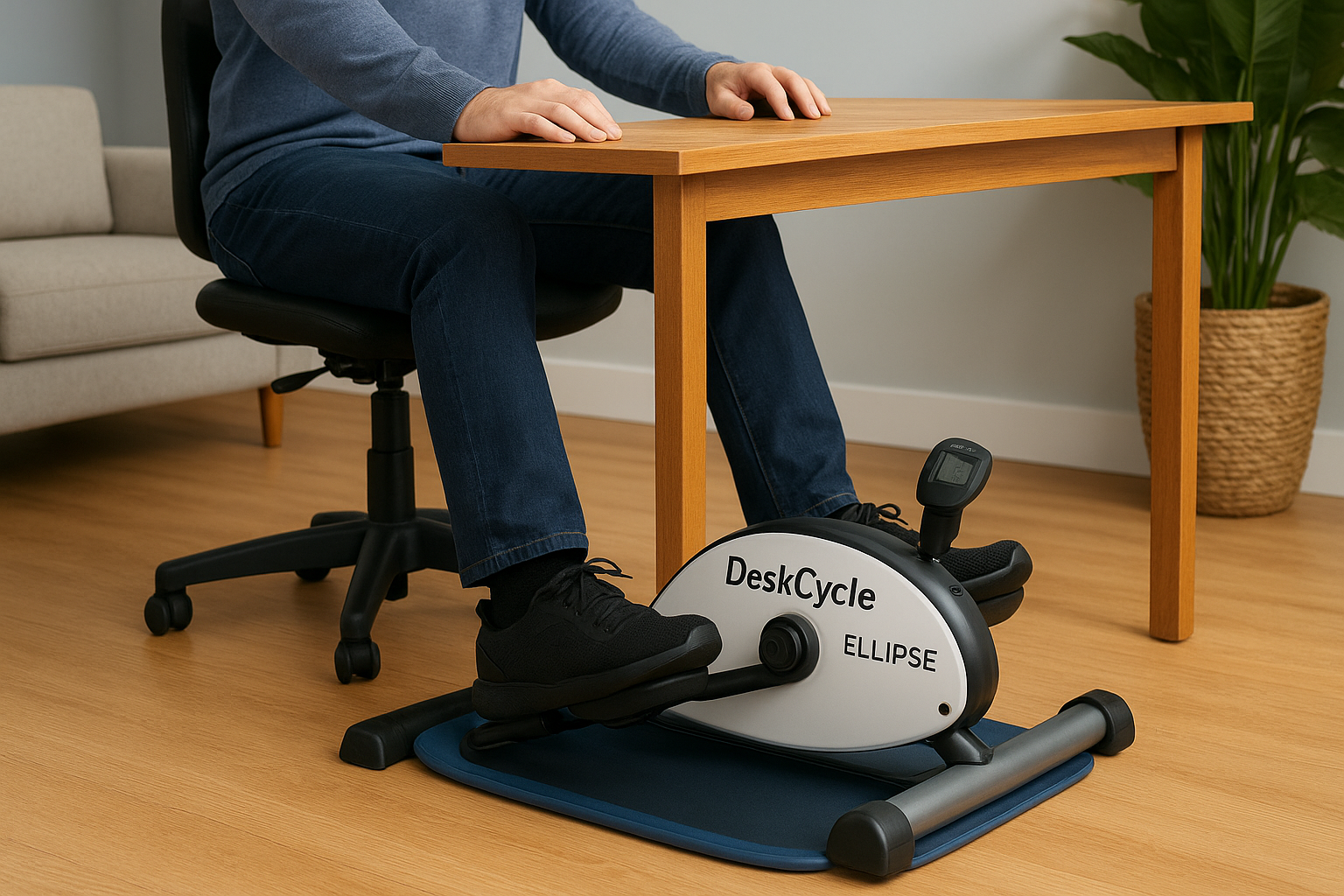
DeskCycle built its reputation on the original desk pedal exerciser, and the Ellipse is the company’s take on the seated elliptical trainer category. It swaps the simple circular pedal motion of the classic DeskCycle for a true elliptical path, which puts less strain on the knees than a straight up-and-down pedal stroke. Shoppers who already own a DeskCycle bike and want to upgrade to elliptical motion tend to land on this model first, since the brand carries a following among people who’ve used its products for years without issue.
Key features
The Ellipse runs on a magnetic resistance system with eight adjustable levels, controlled by a dial on the front of the unit rather than a phone app. Its extended pedal arms create a longer stride than most under-desk competitors, which matters if you’re taller than average and have felt cramped on smaller machines. DeskCycle also added a raised lip around the base to catch stray socks or loose clothing before they get near the moving parts, a small touch that longtime desk-exerciser users specifically requested.
- Eight-level magnetic resistance with a manual dial
- Longer pedal arms for an extended, natural stride
- Raised safety lip around the base
- Built-in LCD console tracking time, distance, and calories
- Compact enough to store under a couch or bed
Who it’s best for
Taller users who’ve tried a compact seated elliptical trainer and found the stride too short will notice the difference here right away. The extended pedal arms give your legs more room to move through a full range of motion, which reduces the cramped feeling that shows up on smaller under-desk units after twenty minutes. DeskCycle loyalists who already trust the brand from its original pedal exerciser will also appreciate the familiar build quality and simple dial-based controls.
A longer stride matters more than another resistance level once your knees start hitting the frame on a shorter machine.
Anyone shorter than average or working with a tight footwell under their desk should measure carefully first, since the extended arms take up more floor space than the Cubii Go or Sunny Health & Fitness pick.
Pros and cons
Here’s where the Ellipse earns its keep and where it falls short compared to shorter-stride competitors.
| Pros | Cons |
|---|---|
| Longer stride suits taller users | Takes up more floor space than compact rivals |
| Safety lip prevents clothing snags | No Bluetooth or app connectivity |
| Reliable brand with a long track record | Resistance ceiling still light for serious training |
| Smooth magnetic resistance, minimal noise | Console lacks memory between sessions |
| Sturdy frame for the price point | Straps wear faster than the frame itself |
The extended footprint is the tradeoff most buyers weigh before ordering. If your desk setup is tight, that longer stride works against you rather than for you.
Price
DeskCycle typically prices the Ellipse between $170 and $210, sitting in the middle of this list alongside the FitDesk model. It ships with a one-year warranty on parts, standard for the category, and DeskCycle sells it directly through its own site rather than relying heavily on third-party retailers. That direct relationship mirrors what we value at 3G Cardio: a manufacturer standing behind its own equipment instead of disappearing after the sale.
6. LifePro FlexStride Plus
LifePro built a name in massage guns and vibration platforms before entering the seated elliptical trainer market, and the FlexStride Plus shows that crossover experience in its focus on smooth, low-vibration operation. It targets buyers who want more resistance range than a basic under-desk unit but aren’t ready to invest in a full-size machine. Compared to the DeskCycle Ellipse, LifePro pushes harder on digital features, adding app connectivity that several cheaper competitors on this list skip entirely.
Key features
The FlexStride Plus runs on sixteen levels of magnetic resistance, double what you’ll find on the Cubii Go or DeskCycle Ellipse, giving you real room to progress as your fitness improves rather than plateauing within a month. It pairs with a companion app over Bluetooth that logs workout history across sessions, something the Stamina and Sunny picks on this list can’t do. The frame also includes a slightly reclined seat option for users who prefer to pair the machine with a chair rather than a standard desk setup.
- Sixteen levels of magnetic resistance
- Bluetooth app connectivity with saved workout history
- Reinforced steel frame rated for heavier users
- Non-slip pedal straps with quick-release buckles
- Transport wheels for moving between rooms
Who it’s best for
Buyers who’ve outgrown a basic Cubii-style machine but still want a seated elliptical machine for home desk use, rather than a standalone gym piece, land well here. The sixteen-level resistance range gives you months of progression before you hit a ceiling, which matters if you’re using this daily rather than occasionally. Heavier users also benefit from the reinforced frame, since LifePro rates the FlexStride Plus for a higher weight capacity than most under-desk competitors on this list.
Sixteen resistance levels sound excessive until you realize it’s the difference between a machine you outgrow in a month and one that lasts a year.
Someone who wants zero digital fuss and just wants to pedal without opening an app should look at the Stamina InMotion E1000 instead, since the FlexStride Plus leans into its connected features as a selling point.
Pros and cons
Here’s how the tradeoffs shake out once you’ve used the FlexStride Plus for a few weeks rather than just unboxed it.
| Pros | Cons |
|---|---|
| Sixteen resistance levels, best range in this price tier | App occasionally drops Bluetooth connection |
| Reinforced frame supports heavier users | Heavier overall unit, less portable than the Cubii Go |
| Saved workout history through the app | Setup instructions are thinner than they should be |
| Quick-release pedal straps | Louder than magnetic-only competitors at top resistance |
| Reclined seat compatibility | Higher price than most under-desk rivals |
The Bluetooth reliability issue comes up often enough in owner feedback to mention directly. It’s not a dealbreaker, but don’t expect flawless syncing every single session.
Price
LifePro prices the FlexStride Plus between $200 and $250 depending on current bundle offers, positioning it above the DeskCycle Ellipse but below full-size machines. It typically ships with a one-year warranty on parts and a shorter frame warranty than what you’d get from a manufacturer built around commercial-grade equipment. If the resistance ceiling here still feels limiting once you’ve built up strength, our Elite RB X recumbent bike offers a genuine step up in both resistance range and seat support.
7. Teeter FreeStep LT3 Recumbent Cross Trainer
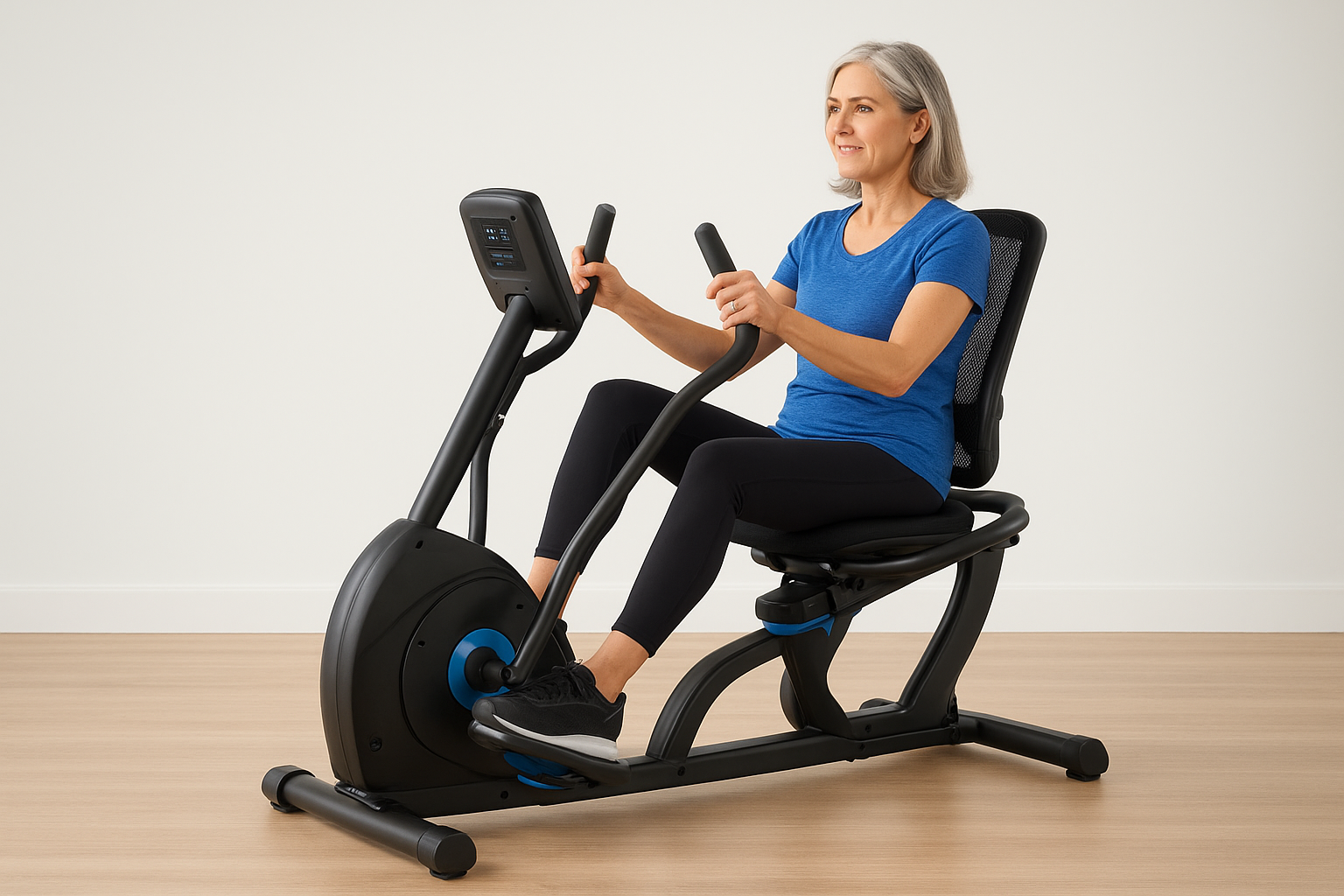
Teeter made its name with inversion tables before branching into low-impact cardio, and the FreeStep LT3 is where that joint-friendly engineering shows up most clearly. This is a full-size recumbent cross trainer, not an under-desk unit, and it marks a real jump in scale from everything else on this list. If you’ve been shopping the compact category and realized you actually want a standalone seated elliptical trainer built for a real workout rather than light movement at your desk, this is the model that bridges that gap.
Key features
Teeter engineered the FreeStep around a patented Stride Path that keeps your feet moving in a naturally elliptical arc while your back stays supported in a reclined seat, which takes pressure off the knees and lower back compared to standing elliptical trainers. The LT3 adds moving handlebars for upper-body engagement, something none of the under-desk models on this list offer, along with a swivel seat that makes mounting and dismounting easier for users with limited mobility.
- Patented Stride Path for a low-impact elliptical motion
- Reclined, cushioned seat with 360-degree swivel for easy entry
- Moving handlebars for combined upper and lower body work
- 20 levels of magnetic resistance
- Console with heart rate monitoring and multiple workout programs
Who it’s best for
This machine suits people managing arthritis, recovering from joint surgery, or dealing with chronic back pain who need genuine cardio volume without the impact of a standing elliptical or treadmill. Physical therapy patients and older adults who want a full workout session rather than fifteen minutes of desk pedaling will get real value here, since the resistance range and handlebar engagement let you build a legitimate cardio and strength routine over months, not weeks.
When your joints can’t tolerate impact but your cardio goals haven’t changed, a recumbent cross trainer like the FreeStep LT3 does the work a treadmill can’t.
Someone who only wants a compact machine to tuck under a desk during work hours should skip this pick entirely, since the FreeStep needs its own floor space and isn’t designed to move around a home office.
Pros and cons
Here’s how the tradeoffs land once you compare the FreeStep against the smaller machines earlier on this list.
| Pros | Cons |
|---|---|
| Genuinely low-impact motion backed by patented design | Large footprint, not suited for desk use |
| Handlebars add upper-body engagement | Heavier and harder to move between rooms |
| Swivel seat eases entry for limited mobility | Higher price than every compact option here |
| 20 resistance levels support real progression | Assembly takes longer than smaller units |
| Supportive seat reduces back strain during longer sessions | Console feels dated compared to app-connected rivals |
The footprint is the main tradeoff. You’re trading portability for a machine that can actually replace a gym visit, and that’s a fair exchange if joint pain has been limiting your options.
Price
Teeter prices the FreeStep LT3 in the $1,200 to $1,400 range, a significant step up from every model earlier on this list but still well below full commercial-grade equipment. It typically ships with a limited warranty covering the frame and parts for several years, though labor coverage runs shorter. If you’re weighing this against a purpose-built recumbent bike instead, our Elite RB X recumbent bike offers a comparable low-impact seated position with commercial-grade construction at a similar investment level.
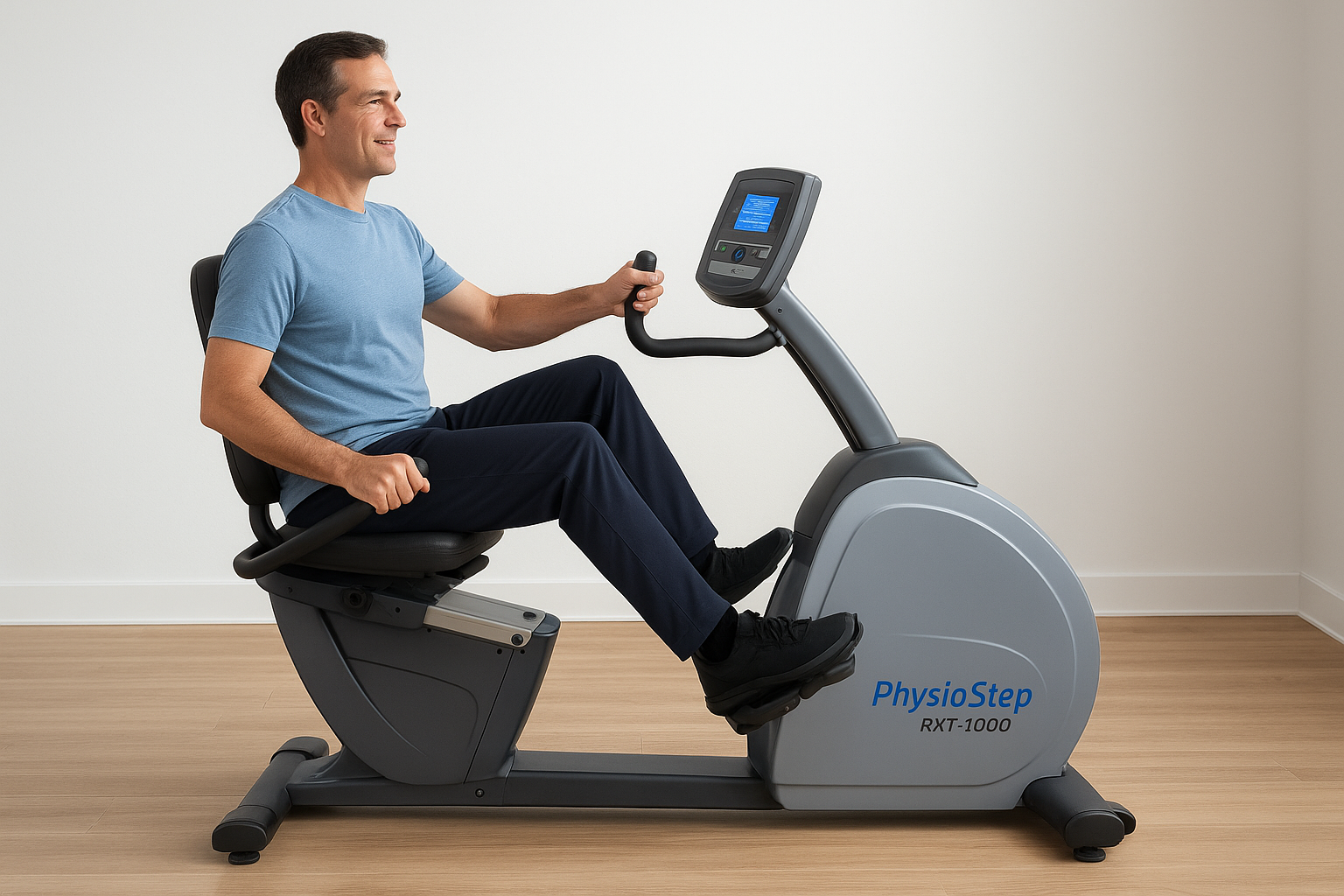
8. HCI Fitness PhysioStep RXT-1000 Recumbent Elliptical
HCI Fitness built its reputation supplying rehab clinics and physical therapy offices, and the PhysioStep RXT-1000 carries that clinical pedigree into the home. This is the most expensive machine on this list, and it earns that price through a recumbent design that puts almost zero pressure on the spine while still delivering a full elliptical stride. If you’ve already ruled out under-desk units because you need real cardio volume, and the Teeter FreeStep LT3 still feels like it’s asking too much of your knees, this model sits at the top of the seated elliptical trainer category for a reason.
Key features
HCI engineered the RXT-1000 around a recumbent seat position that reclines further back than the Teeter, spreading your body weight across the seat and backrest rather than your legs and lower back. The step-through design means you don’t swing a leg over a high frame to get on, which matters if balance or hip mobility is a concern. A self-generating power system runs the console off your own pedaling motion, so you never need to plug it in or replace batteries.
- Recumbent seat with adjustable recline for spine support
- Step-through frame, no high leg-swing needed to mount
- Self-powered console, no outlet or batteries required
- Bidirectional pedaling with adjustable magnetic resistance
- Oversized pedals with heel support for stability
Who it’s best for
This machine suits people managing serious mobility limitations, post-surgical patients following a physical therapist’s home exercise plan, and older adults who need the most supported seated position available in this category. Rehab patients transitioning out of clinical settings often buy this exact model because their therapist recommended it, and the step-through design removes the mounting struggle that stops many people from using other machines consistently.
The lower you can recline without losing pedal power, the more people with real mobility limits will actually use the machine every day.
Someone shopping on a budget, or anyone who just wants light desk pedaling, should look elsewhere on this list, since this machine is overbuilt for casual use.
Pros and cons
| Pros | Cons |
|---|---|
| Most supportive recline in this category | Highest price on this entire list |
| Step-through frame eases mounting | Large footprint, needs dedicated floor space |
| Self-powered console, no outlet needed | Console lacks app or Bluetooth connectivity |
| Trusted in clinical and rehab settings | Heavier, harder to relocate than smaller units |
| Sturdy build rated for daily therapeutic use | Assembly often requires two people |
The price is the real barrier here. You’re paying for a design proven in clinics, not consumer marketing.
Price
HCI Fitness prices the PhysioStep RXT-1000 between $2,400 and $2,700, depending on retailer promotions, with a multi-year frame warranty and shorter parts and labor coverage. That places it above the Teeter FreeStep LT3 and close to entry-level full-size home cardio equipment. If that price has you considering a standard recumbent bike instead, our Elite RB X recumbent bike delivers comparable seated support and commercial-grade construction at a lower entry point.
Picking the seated elliptical that fits your day
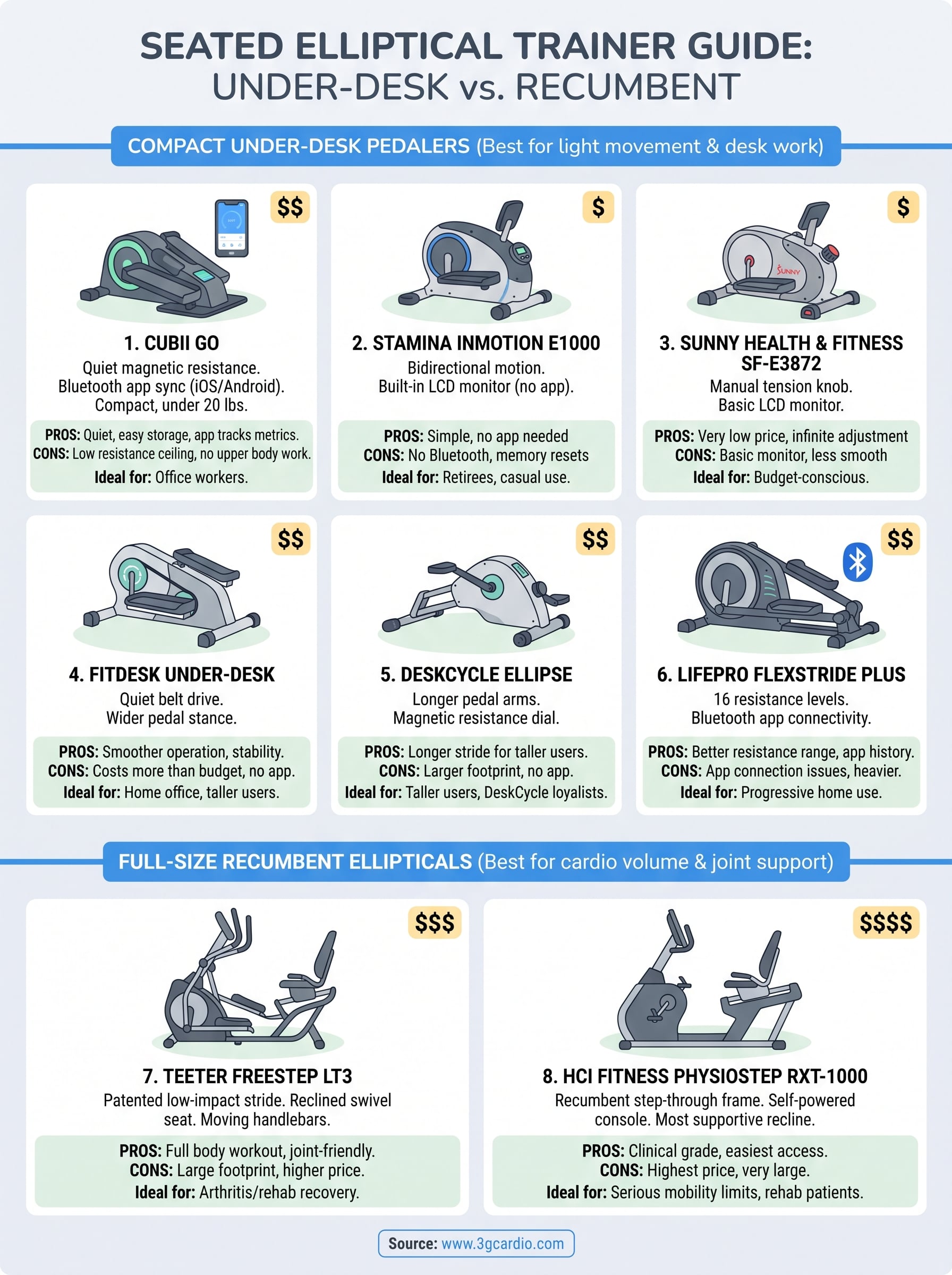
Your choice here really comes down to where you’ll use the machine and how much resistance your body actually needs. A desk-bound worker looking for light movement during calls is better served by the Cubii Go or Sunny Health & Fitness pick than by anything with a full seat and handlebars. Someone managing joint pain or rehab needs, on the other hand, will outgrow every under-desk unit on this list within weeks and end up wishing they’d bought the Teeter or HCI Fitness model from the start.
Before you buy anything compact, be honest about whether you want a seated elliptical machine for home cardio sessions or just fidget-level movement at your desk. If it’s the former, skip straight to equipment built for daily training. Browse our Elite EM X elliptical trainer for commercial-grade construction that won’t leave you shopping again in six months.




Sorry, the comment form is closed at this time.