
14 Aug What Muscles Does an Elliptical Trainer Work?
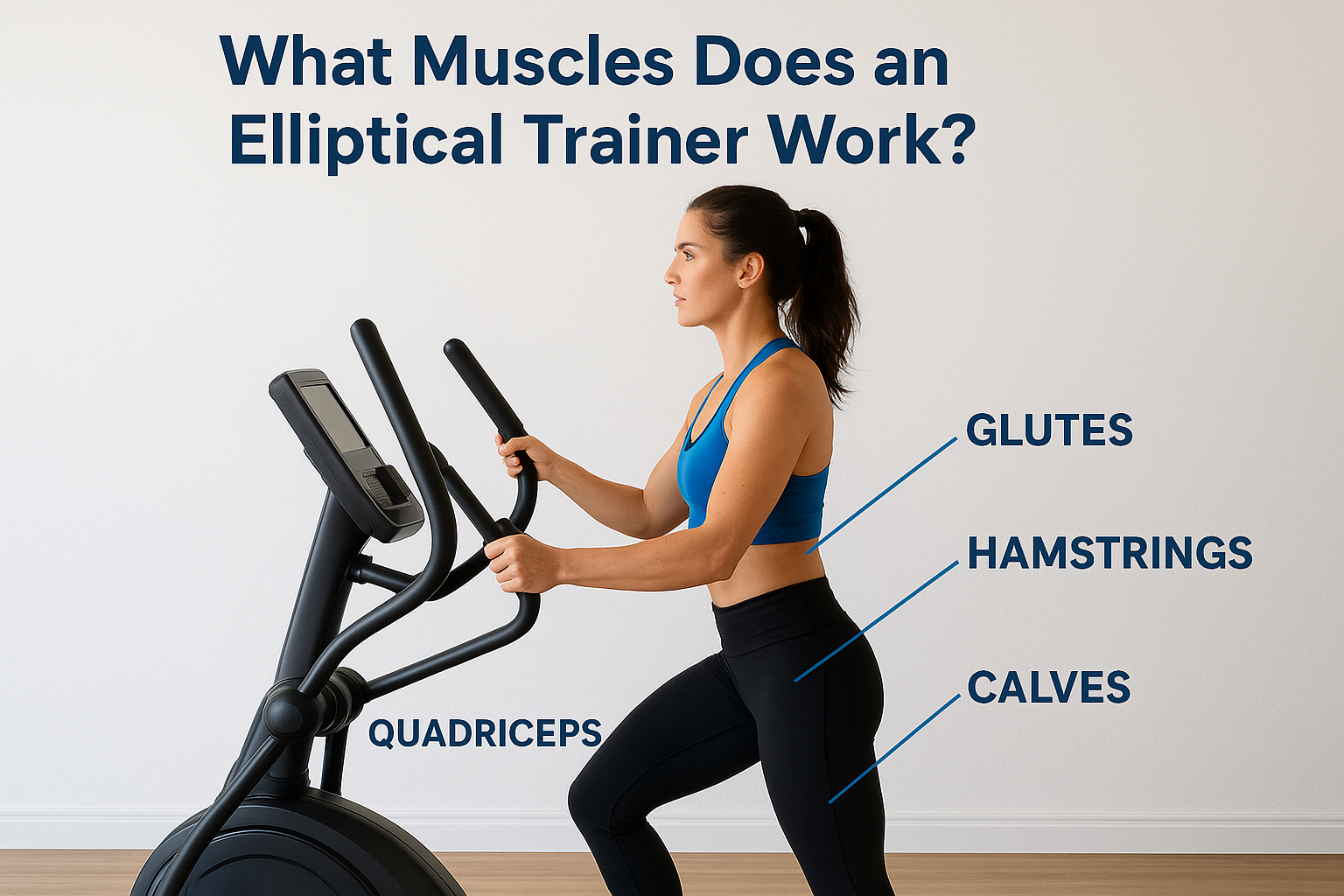
You step onto an elliptical expecting a solid workout, but you probably can’t name exactly which muscles you’re training. What muscles does an elliptical trainer work isn’t a trivial question if you’re trying to build a balanced routine instead of just burning time. The short answer: an elliptical hits far more of your body than a treadmill or stationary bike, and that’s exactly why so many home gym owners choose one.
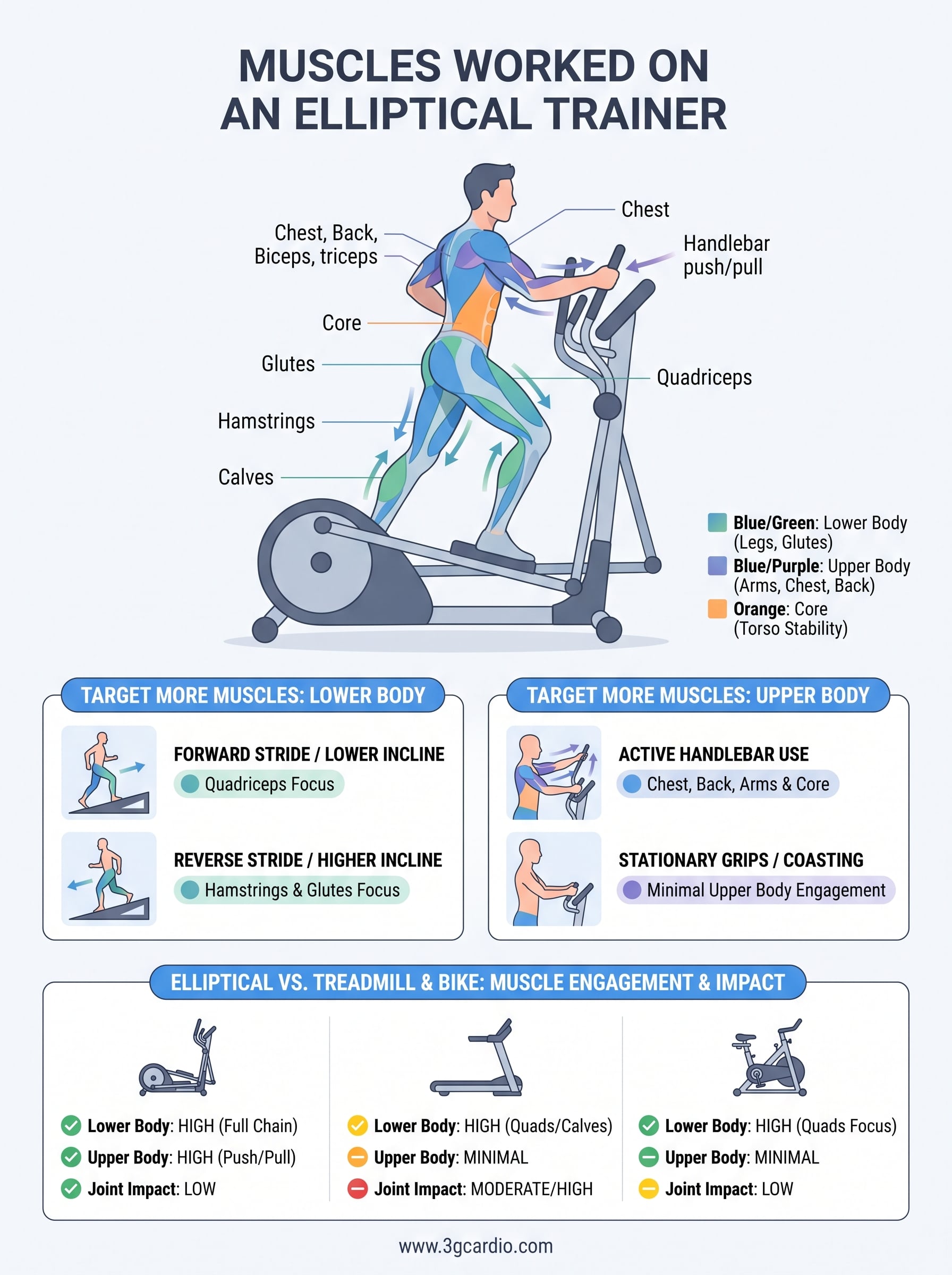
Used correctly, an elliptical engages your quads, hamstrings, and glutes with every stride, while the moving handlebars pull in your chest, back, biceps, and triceps at the same time. Adjust the incline or resistance and you shift the emphasis toward your calves or your posterior chain. That full-body engagement, combined with low impact on your joints, is why the elliptical shows up so often in physical therapy plans and long-term fitness programs.
In this article, we break down exactly which muscle groups activate during elliptical training, how stride direction and resistance level change the demand on your body, and what that means if you’re shopping for a machine built to actually deliver that workout, like our Elite EM X elliptical trainer, designed with adjustable stride and commercial-grade resistance to target these muscles properly.
Why it matters which muscles the elliptical works
Most people buy cardio equipment for calorie burn and never think past that. But understanding which muscles an elliptical works changes how you train. If you know your glutes and hamstrings dominate the backward stride, you can program around leg day instead of accidentally overtraining the same muscles twice in one week. If you know the upper body only activates when you actually push and pull the handlebars, you stop coasting with your arms resting on the rails and start getting the full-body payoff you’re paying for.
The lower body does the heavy lifting
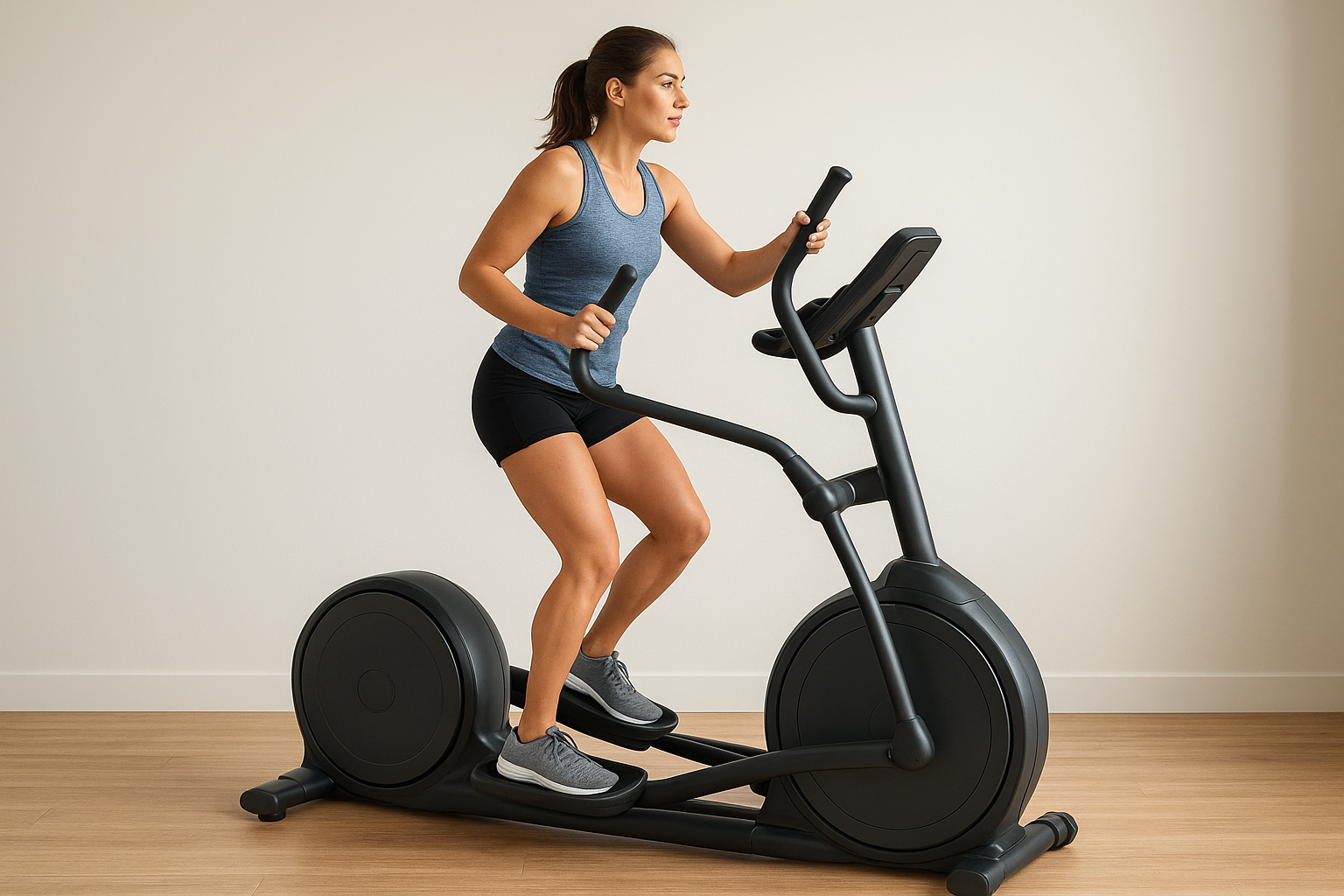
Every elliptical stride runs through the same chain: your quadriceps drive the forward push, your hamstrings and glutes take over on the pull-back, and your calves stabilize your ankle through the whole motion. Steepen the incline on a machine like the Elite EM X and you shift more load onto the glutes and hamstrings, closer to what a hill climb or the muscles a stair stepper works demands. Flatten it out and the quads do more of the work, similar to a fast walk or light jog.
| Muscle Group | Primary Role on the Elliptical | How to Increase Engagement |
|---|---|---|
| Quadriceps | Drives the forward phase of each stride | Lower incline, faster cadence |
| Hamstrings | Powers the backward pull of the pedal | Higher incline, reverse stride |
| Glutes | Stabilizes hips, extends the leg | Higher resistance, reverse stride |
| Calves | Stabilizes ankle through the stride | Toe-focused pedal pressure |
| Chest & Back | Push/pull on the moving handlebars | Full-arm extension, higher resistance |
| Biceps & Triceps | Assist the handlebar push/pull | Firm grip, deliberate arm drive |
| Core | Stabilizes the torso throughout | Upright posture, no leaning on rails |
Your upper body isn’t just along for the ride
Stationary handlebars turn an elliptical into a leg-only machine, but moving handlebars, the kind found on most quality home ellipticals, pull your chest, back, and arms into real work. Pushing forward engages your triceps and chest, while pulling back recruits your biceps and upper back. Your core stays active the entire time, bracing against the rotational forces generated by your arms and legs moving in opposition. Skip the handlebars and rest your hands on the stationary grips instead, and you’ve just turned a full-body machine into a glorified stair stepper for your legs alone.
An elliptical only delivers a full-body workout if you actually use the handlebars instead of resting on them.
Balanced muscle engagement protects your joints
Because the elliptical distributes work across so many muscle groups instead of concentrating impact on your knees and hips, it shows up constantly in physical therapy and post-injury rehab programs, right alongside the other joint-friendly cardio machines worth considering. Compare that to running, where your quads and calves absorb repeated ground-impact forces with every step, or straight leg extensions on a bike, which barely touch your upper body at all. Distributing load this way also reduces your odds of the overuse injuries that come from hammering the same joint angle for thirty minutes straight, which is exactly why the CDC lists elliptical training among the recommended low-impact aerobic activities for adults managing joint pain or recovering from injury (cdc.gov). Getting the muscle balance right isn’t a bonus feature, it’s the reason the machine works as well as it does.
How to target more muscle groups on the elliptical
Most riders default to the same stride length, resistance level, and incline every single session, then wonder why their results plateau. Small adjustments to stride direction and resistance level force different muscle groups to do the work, turning a passive cardio session into a genuine strength-building routine, which is the core of how to maximize an elliptical workout. The Elite EM X’s adjustable stride and resistance dial make these tweaks a matter of one push of a button, not a full machine swap.
Switch your stride direction
Pedaling backward shifts the workload from your quads to your hamstrings and glutes, essentially reversing the muscle emphasis of a forward stride. Alternating direction every five minutes during a session builds balanced leg strength instead of overdeveloping the front of your thighs while neglecting your posterior chain. This single change is often the fastest way to feel a totally different set of muscles working by the end of your workout.
Raise the incline and resistance together
Increasing incline recruits more glute and hamstring fibers, while dialing up resistance forces every muscle in the chain, quads included, to generate more force per stride. Combining both gives you a workout that resembles hill sprints more than a flat jog, without the joint pounding a real hill would demand. Ellipticals with a wider resistance range, like commercial-grade machines, let you push this further than budget models that top out too quickly to challenge experienced users.
Commit your upper body to every rep
Gripping the handlebars loosely and letting your arms swing passively wastes half the machine’s potential. Using proper elliptical cross trainer technique and extending your arms fully on the push, then pulling them completely back on the return, recruits your chest, back, and arms at nearly the same intensity as a light resistance-training session.
If you’re not actively pushing and pulling the handlebars, you’re only getting half the workout the machine is built to deliver.
Pairing a firm grip with an upright posture keeps your core engaged the entire session instead of relaxing the moment your legs take over.
Sample workouts to engage your whole body
Knowing which muscles the elliptical works only helps if you actually structure a session around it. Random pedaling with no plan for stride direction, resistance, or incline wastes the machine’s biggest advantage over a treadmill or bike, and there are elliptical exercises for every fitness level that give the session a structure. Below are two workouts you can run on the Elite EM X or any elliptical with adjustable resistance and moving handlebars, one built for full-body intensity and one for steady, joint-friendly conditioning.
A 20-minute total-body interval session
Building real muscle engagement means changing something, direction, resistance, or arm effort, every few minutes instead of settling into autopilot. This interval structure forces your quads, hamstrings, glutes, and upper body to trade off doing the heavy work, so nothing coasts for the full 20 minutes.
0-3 min: Warm up, moderate pace, light resistance, arms relaxed
3-6 min: Forward stride, high resistance, full arm push/pull
6-9 min: Reverse stride, moderate resistance, focus on glutes/hamstrings
9-12 min: Forward stride, incline raised, fast cadence
12-15 min: Reverse stride, incline raised, slow deliberate strides
15-18 min: Forward stride, high resistance, arms driving hard
18-20 min: Cool down, low resistance, easy pace
A workout that never changes direction or resistance never asks your whole body to show up.
A steady endurance ride for joint-friendly training
Going longer at a lower intensity still works every major muscle group, just with less peak force per stride, which makes this option a solid fit if you’re recovering from injury or new to cardio equipment. Keep resistance moderate, hold an upright posture, and commit to the handlebars for the entire session instead of letting your arms rest once fatigue sets in.
- Minutes 0-5: Easy pace, light resistance, full range of motion
- Minutes 5-25: Steady moderate resistance, alternate forward and reverse stride every 5 minutes
- Minutes 25-30: Gradual cool down, resistance reduced, focus on posture
Hitting either workout twice a week alongside your regular routine, or rotating in other elliptical cardio workouts that burn calories, gives your lower body, upper body, and core a consistent reason to adapt instead of stalling out on the same settings session after session.
Elliptical vs treadmill and bike for muscle engagement
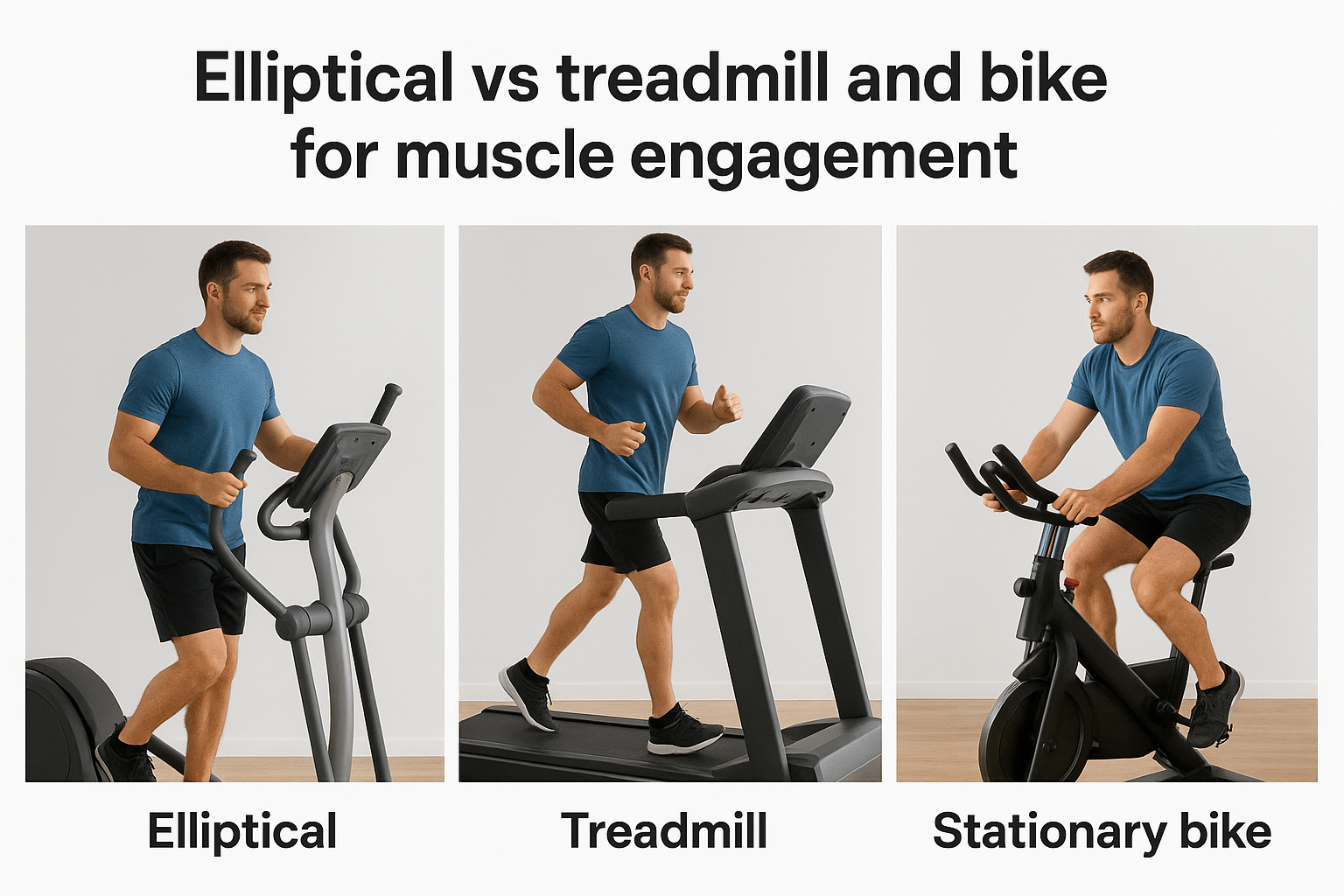
Comparing cardio machines by muscle groups worked makes the elliptical’s advantage obvious fast. In an elliptical vs treadmill comparison, the treadmill trains your legs the way running does, hard on the quads and calves, easy on everything above the waist. A stationary bike isolates the quads and hamstrings even further, since your upper body barely moves beyond gripping the handlebars for balance. The elliptical is the only one of the three that asks your chest, back, and arms to generate real force while your legs do their share.
Treadmills concentrate the work in your legs
Running or walking on a treadmill builds strong quads and calves, but your hamstrings and glutes get far less attention unless you’re sprinting or running on an incline. Your upper body does almost nothing except swing your arms for momentum. That’s fine if leg strength and running performance are your only goals, but it leaves your posterior chain and upper body undertrained compared to a machine built for full-body recruitment.
Stationary bikes go even narrower
A bike isolates the quads more than either the treadmill or elliptical, with hamstrings and glutes contributing less unless you’re standing and mashing the pedals. Your arms and core stay almost entirely passive, since you’re seated and stable. If you want a serious upper-body contribution from your cardio machine, a bike simply isn’t built to deliver it.
If your cardio machine only trains your legs, you’re leaving half your body’s workout on the table.
| Machine | Lower Body Engagement | Upper Body Engagement | Joint Impact |
|—|—|—|
| Treadmill | High (quads, calves) | Minimal | Moderate to high |
| Stationary Bike | High (quads) | Minimal | Low |
| Elliptical | High (full leg chain) | Moderate to high | Low |
Given that spread, an elliptical with moving handlebars, like the Elite EM X, closes a gap that neither a treadmill nor a bike can. You get comparable calorie burn to running, low-impact mechanics closer to a bike, and an upper-body contribution neither machine offers at all. For anyone building one piece of home cardio equipment to do the most work, that combination is hard to match, and it’s what separates the best ellipticals for home use from the rest.
Getting the most from every stride
Knowing what muscles an elliptical trainer works only pays off once you apply it. Legs drive most of the calorie burn, but your chest, back, and arms turn a leg-only machine into a genuine full-body session, and your core ties the whole motion together. Skip the handlebars or stick to one stride direction, and you’re leaving real strength gains on the table every single workout.
Vary your resistance, alternate stride direction, and commit to the handlebars, and the elliptical delivers more balanced muscle engagement than a treadmill or bike ever will, without the joint pounding either one demands. The machine only works as hard as you make it.
If your current equipment can’t adjust stride length or resistance enough to challenge you, that’s a machine problem, not a you problem. See the Elite EM X commercial-grade elliptical with 3-level adjustable stride and get a machine built to actually deliver on every stride.




Sorry, the comment form is closed at this time.