

01 Sep Treadmill vs Elliptical for Weight Loss: Which Wins?
You want to lose weight, and you’re staring at two machines wondering which one actually gets you there faster. The treadmill vs elliptical for weight loss debate isn’t just gym small talk. It affects how many calories you burn per session, how your joints feel the next day, and whether you’ll actually stick with your routine six months from now.
Here’s the short answer: treadmills typically burn more calories per session because running and walking recruit your full body weight against gravity, but ellipticals deliver a lower-impact workout that lets you train longer and more often without wrecking your knees. The right choice depends on your current fitness level, any joint issues, and how much intensity you can realistically sustain week after week.
In this article, we’ll break down the real calorie burn numbers for both machines, compare joint impact side by side, and look at which one holds up better for long-term consistency. We’ll also cover how equipment quality, like adjustable resistance and stride length, changes the math on both machines, so you can pick the one that fits your body and your goals, not just the one everyone else recommends.
Why treadmill and elliptical results differ for weight loss
The gap between these two machines comes down to basic physics, not marketing. Every time your foot strikes the belt on a treadmill, you’re lifting and lowering your entire body weight against gravity, which is exactly why walking or running burns more calories than gliding on an elliptical at a similar perceived effort. The elliptical’s fixed foot pedals keep your feet in constant contact with the machine, so you skip the impact phase and the extra energy cost that comes with it. That difference in calorie burn matters if your only goal is maximum deficit per minute, but it’s not the whole story.
Calorie burn by the numbers
Research from the American Council on Exercise and similar lab studies consistently shows treadmills edging out ellipticals when intensity and duration are matched. Here’s how a 160-pound person typically compares across 30-minute sessions:
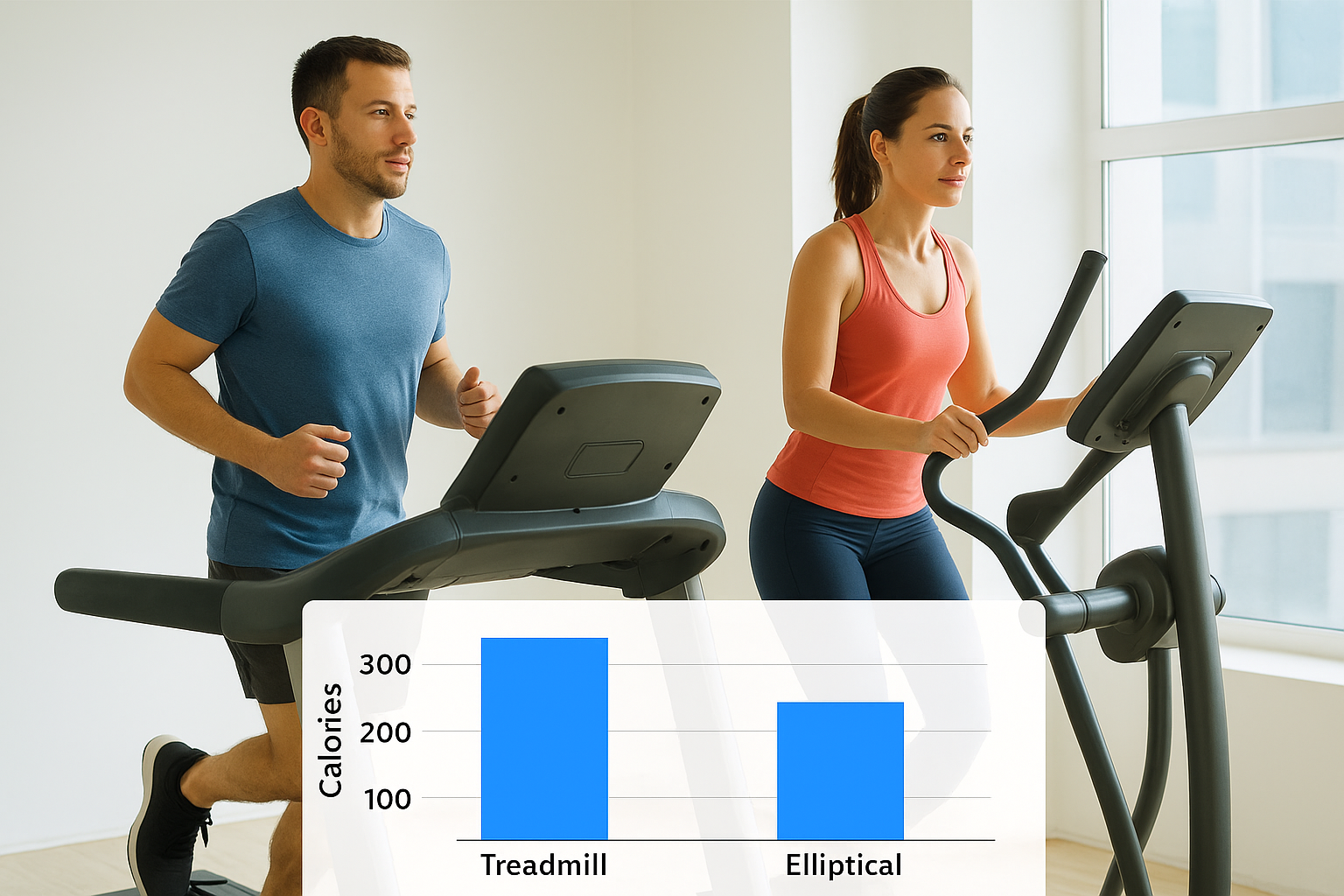
| Activity | Machine | Calories Burned (30 min) |
|---|---|---|
| Brisk walk (3.5 mph, flat) | Treadmill | 150-170 |
| Incline walk (3.5 mph, 8% grade) | Treadmill | 220-250 |
| Jog (5 mph) | Treadmill | 300-330 |
| Moderate resistance | Elliptical | 250-290 |
| High resistance, arms engaged | Elliptical | 300-320 |
Notice that a hard elliptical session can actually match a moderate treadmill jog, even though the elliptical console often reads lower than the calories you actually burned. The gap closes fast once you crank up resistance and use the moving handlebars instead of resting your arms on the rails.
Joint impact and injury risk
This is where the elliptical earns its reputation. A treadmill generates ground reaction forces of roughly 1.5 to 3 times your body weight with every step, concentrated through your ankles, knees, and hips. An elliptical trainer keeps that same lower body moving through a smooth, fixed path with almost no jarring, which is why physical therapists so often recommend it for clients recovering from knee or hip issues.
A workout you can repeat five days a week without pain beats one you can only manage twice.
That single fact explains why so many people who start on a treadmill eventually migrate to an elliptical, not because the elliptical is objectively better, but because their joints demanded it. If you’ve got healthy knees and no history of impact injuries, this trade-off matters less to you than it does to someone managing arthritis or an old running injury.
Muscle engagement and metabolic afterburn
Beyond calories burned during the session itself, treadmill running triggers a larger excess post-exercise oxygen consumption (EPOC) effect, meaning your metabolism stays elevated longer afterward compared to steady elliptical work at the same heart rate. Sprint intervals or incline walking on a treadmill recruit your glutes, hamstrings, and calves harder than most elliptical settings do, unless you’re actively pushing and pulling the handlebars to work your upper body too. That upper body engagement is actually the elliptical’s quiet advantage: a treadmill only works your legs, while the muscles an elliptical trainer works add up to close to a full-body session.
Consistency beats raw intensity
Ultimately, the machine that burns more calories on paper isn’t automatically the one that produces more weight loss over three months. Adherence data from exercise science research points to one consistent pattern: people lose more weight on whatever machine they actually use four or five times a week without dreading it. If treadmill impact leaves your knees sore enough that you skip two sessions, the elliptical’s lower calorie burn per minute still wins on a monthly total. Sustainability, not the spreadsheet math of a single workout, decides the outcome for most people trying to lose weight long-term.
How to choose the right machine for your weight loss goals
Picking between these two machines isn’t about finding the objectively "better" one, it’s about matching the equipment to your body, your schedule, and your history. Weight loss equipment only works if you actually use it, so the right choice is the one that fits your life instead of someone else’s Instagram routine.
Start with your joints and injury history
Your knees and hips should have the loudest vote in this decision. If you’ve dealt with runner’s knee, plantar fasciitis, or hip arthritis, the elliptical and other low-impact machines for sore knees and hips almost always win because they let you rack up minutes without the pounding. Runners with clean joint histories and a background in impact sports usually adapt fine to a treadmill and can push harder intensity without setback. Someone starting from scratch after years of inactivity should lean elliptical first, build a fitness base, then add treadmill walking or light jogging once their joints and cardiovascular system catch up.
Factor in your available time and intensity tolerance
Time matters as much as joint health here. A treadmill rewards shorter, harder sessions since incline walking or jogging burns more per minute, which suits people squeezing in 20 to 30 minutes before work. An elliptical suits longer, steady sessions of 40 to 60 minutes at moderate resistance, which fits people who prefer a slower burn while watching TV or listening to a podcast. Neither approach is wrong; the math evens out over a week if you’re consistent.
The best cardio machine is the one still running your workout six months from now, not the one that burns the most calories on day one.
Use this quick decision checklist
- Bad knees, hips, or lower back? Choose an elliptical first.
- Training for a race or event? Choose a treadmill for specificity.
- Short on time most days? Choose a treadmill for higher calorie burn per minute.
- Want a full-body workout? Choose an elliptical and actively push the handlebars.
- New to structured exercise? Start on an elliptical, then graduate to treadmill intervals.
- Live with someone who has different needs? Consider owning both, since space and budget allow.
Test drive before you commit
Before buying, stand on the machine in a showroom or ask about a home trial period, since belt cushioning and how much stride length really matters vary a lot between brands. A treadmill with a short deck feels cramped if you have long legs, and an elliptical with a fixed stride can strain your hips if it doesn’t match your natural gait. 3G Cardio’s Elite Runner X treadmill and the Elite EM X elliptical with an 18", 20", and 23" adjustable stride both offer adjustable settings specifically because one-size-fits-all rarely fits anyone well.
Sample treadmill and elliptical workouts for weight loss
Theory only gets you so far, so let’s put these numbers into an actual routine you can start this week. Both workouts below run 30 minutes and use interval structure, because alternating hard and easy segments burns more total calories than plodding at one steady pace for the same amount of time.
A 30-minute treadmill interval workout
Build this around your current fitness level and adjust incline before speed if your knees are sensitive:
- Minutes 0-5: Warm up at 3.0 mph, 0% incline
- Minutes 5-10: Walk at 3.5 mph, 6% incline
- Minutes 10-15: Jog at 5.0 mph, 1% incline
- Minutes 15-20: Walk at 3.5 mph, 8% incline
- Minutes 20-25: Jog at 5.5 mph, 1% incline
- Minutes 25-30: Cool down at 3.0 mph, 0% incline
This pattern keeps your heart rate bouncing between moderate and vigorous zones, which is exactly the stimulus that drives the strongest calorie burn per session on any treadmill, and it’s the same idea behind interval training on an Elite Runner treadmill.
A 30-minute elliptical interval workout
The elliptical version leans on resistance changes instead of incline, and it works best when you commit to pushing and pulling the handlebars rather than resting your arms:
- Minutes 0-5: Warm up at low resistance, easy pace
- Minutes 5-10: Moderate resistance, steady cadence, arms working
- Minutes 10-15: High resistance, slower strides, focus on power
- Minutes 15-20: Moderate resistance, faster cadence
- Minutes 20-25: High resistance, reverse direction to hit different muscles
- Minutes 25-30: Cool down at low resistance
Intervals beat steady pace on either machine because your body burns more calories recovering from hard effort than it does cruising through the whole session at one speed.
Progressing without burning out
Stick with either workout twice a week for the first two weeks before adding a third session, since how many cardio days per week you need matters more than jumping straight to daily high-intensity work, the fastest way to end up sidelined with sore joints or shin splints. Once your body adapts, extend the hard intervals by a minute or two every week rather than adding more sessions, which keeps your weight loss for treadmill vs elliptical progress steady without overtraining. A console that tracks heart rate, like the FreeSync FTMS Bluetooth displays on 3G Cardio’s Elite Runner X and Elite EM X, makes it easy to confirm you’re actually hitting those harder zones instead of guessing based on how tired you feel.
How to combine both machines for faster results
You don’t have to pick a permanent side when choosing between an elliptical cross trainer and a treadmill for weight loss. Cross-training between the two machines lets you stack the treadmill’s higher calorie burn with the elliptical’s joint-friendly recovery, so you can train more days per week without breaking down. Most people who plateau on a single machine start losing again the moment they add variety, simply because their body stops adapting to the same repetitive movement pattern.
Why alternating machines accelerates fat loss
Switching between a treadmill and an elliptical trainer forces your muscles and cardiovascular system to work through slightly different movement patterns, which keeps your body from settling into an efficient, calorie-sparing groove. Running conditions your legs for impact and power, while the elliptical builds muscular endurance and gives your joints a break to recover between harder sessions. That recovery matters more than most people realize.
The fastest weight loss usually comes from the person who trains five days a week on two machines, not the one who grinds one machine into the ground three days a week.
A sample weekly split
Here’s a simple four-week starting structure that blends both machines without overloading your joints:
- Monday: Treadmill intervals, 30 minutes
- Tuesday: Elliptical, steady moderate resistance, 40 minutes
- Wednesday: Rest or light walk
- Thursday: Treadmill incline walk, 30 minutes
- Friday: Elliptical intervals, 30 minutes
- Saturday: Longer elliptical session, 45-60 minutes, low intensity
- Sunday: Rest
This split gives you two harder treadmill days, two elliptical days that double as active recovery, and one longer steady-state session that adds extra calorie burn without extra joint stress.
Avoiding overtraining when you combine machines
Overlapping two forms of cardio can backfire if you chase intensity every single day, so treat at least one weekly session on each machine as genuinely easy. Track how your knees, shins, and hips feel each morning; soreness that doesn’t fade by the next session is your body asking for another elliptical day instead of another treadmill run. Rotating machines also solves a practical problem for households: two people with different joint tolerances can each get their preferred workout for weight loss without fighting over one piece of equipment.
Owning both machines makes this rotation far easier to stick with than trying to schedule gym time around someone else’s equipment. 3G Cardio’s Elite Runner X treadmill and the Elite RB X recumbent bike with its cushioned reclining seat both connect through the same FreeSync FTMS Bluetooth console, so you can log every session, treadmill or elliptical, in one fitness app and actually see the combined effect on your weekly calorie totals.
What to look for in a treadmill or elliptical for home use
Buying either machine for weight loss only pays off if the equipment holds up to daily use, so specs matter more here than they do for occasional gym visitors. A home treadmill or elliptical that wobbles, maxes out your weight limit, or breaks down after eight months won’t help you lose a single pound, no matter how good the workout plan looks on paper, which is why it pays to compare cardio machines that hold up for weight loss at home.
Motor power and stride quality
Continuous horsepower, not peak horsepower, tells you whether a treadmill motor can handle daily jogging without overheating, and the motor specs worth comparing before you buy start at 2.5 to 3.0 CHP if you plan to run rather than just walk. Elliptical shoppers should check stride length instead, since a fixed 18-inch stride feels cramped for anyone over 5’9", while an adjustable stride between 18 and 20 inches accommodates a wider range of leg lengths and joint angles without straining your hips, something worth verifying across elliptical trainers tested for home use.
Weight capacity and frame durability
Commercial-grade frames typically support 300 to 400 pounds and use heavier-gauge steel than big-box store models rated for 250 pounds, which matters even if you weigh less, because a sturdier frame simply flexes less and lasts longer under repeated impact.
A machine built to commercial specs at a residential price beats a flimsy frame dressed up with flashy screens every time.
Connectivity without the subscription trap
Many newer consoles lock basic features behind monthly app fees, which adds up fast if you’re already paying for a machine. Look instead for Bluetooth-enabled consoles that connect to fitness apps you already use, like Kinomap or Zwift, without forcing a subscription just to see your heart rate or track workouts. 3G Cardio builds FreeSync FTMS Bluetooth connectivity into the Elite Runner X, a club-quality treadmill with a 4.0 HP motor and 400 lb capacity, the Elite EM X elliptical, and the Elite VS X vertical stair stepper, so your own tablet or phone becomes the screen instead of paying extra for one built in.
Warranty and delivery support
Warranty terms reveal a lot about how confident a manufacturer is in its own build quality. Check for these before you buy:
- Frame warranty: Lifetime coverage signals real confidence in the welds and steel.
- Parts warranty: Look for 5 to 7 years minimum on motors, belts, and resistance systems.
- Labor warranty: At least one year of covered labor saves you from paying a technician for a manufacturer defect.
- Delivery options: Free curbside delivery works for handy owners, while White Glove delivery and installation matters if you’d rather not assemble a 250-pound treadmill alone.
Owners who compare treadmill warranty fine print before buying online rarely regret it once year three rolls around and something finally needs a replacement part.
The machine that fits your routine wins
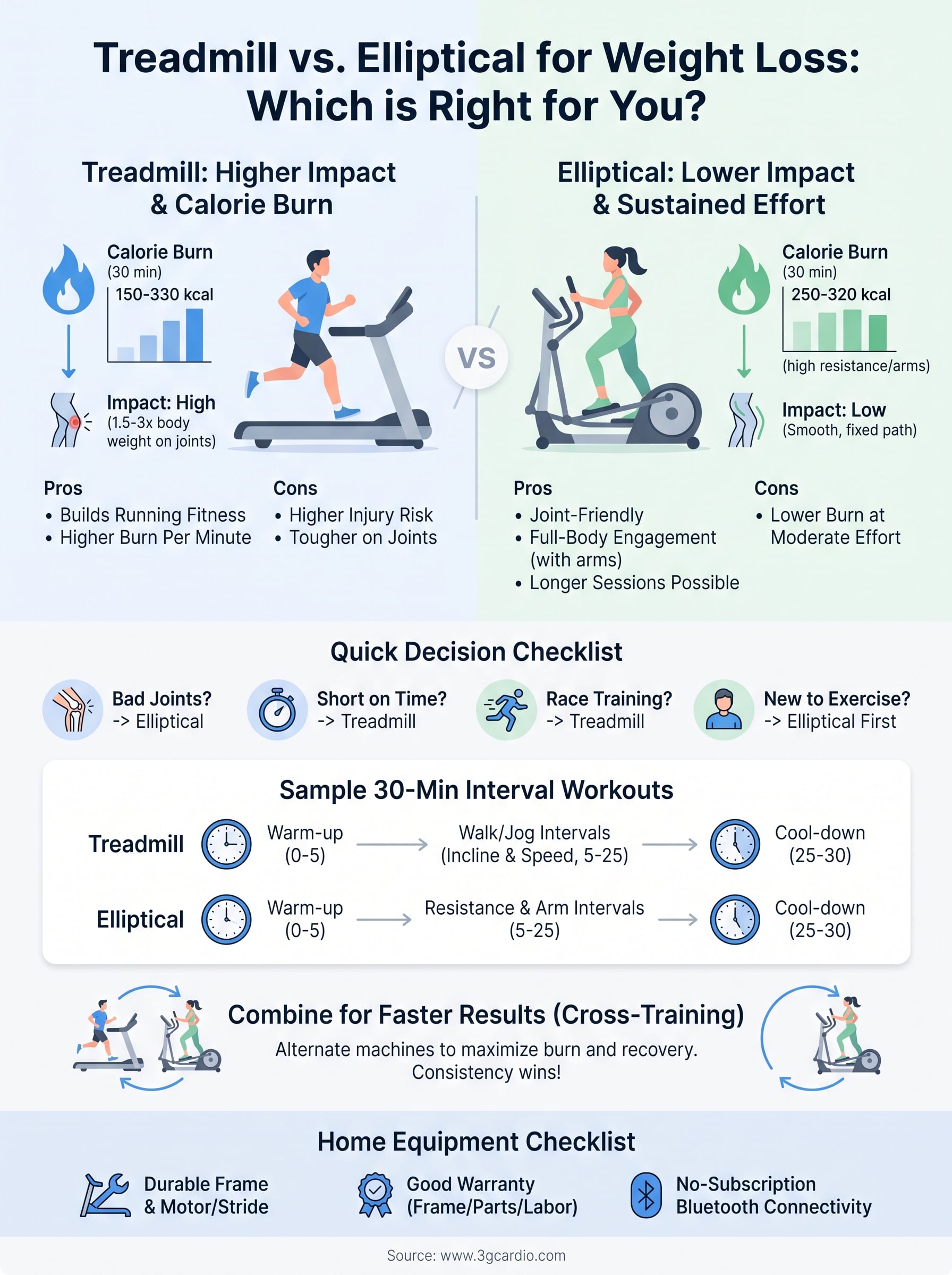
So which side wins the treadmill vs elliptical for weight loss debate? Neither, if you’re asking which machine is objectively superior. Treadmills burn more calories per minute and build real running fitness. Ellipticals protect your joints and let you rack up more weekly minutes without breaking down. The machine that actually moves the needle on your scale is whichever one you’ll use four or five days a week, month after month, without dreading it.
Stop overthinking the spreadsheet math and start with your body. Bad knees point toward an elliptical. Clean joints and race goals point toward a treadmill. Most people do best owning both and rotating between them, which is exactly why 3G Cardio builds both machines with the same FreeSync FTMS Bluetooth connectivity. Browse the FreeSync-enabled treadmills, ellipticals, and bikes and pick the setup that matches how you actually want to train.




Sorry, the comment form is closed at this time.