

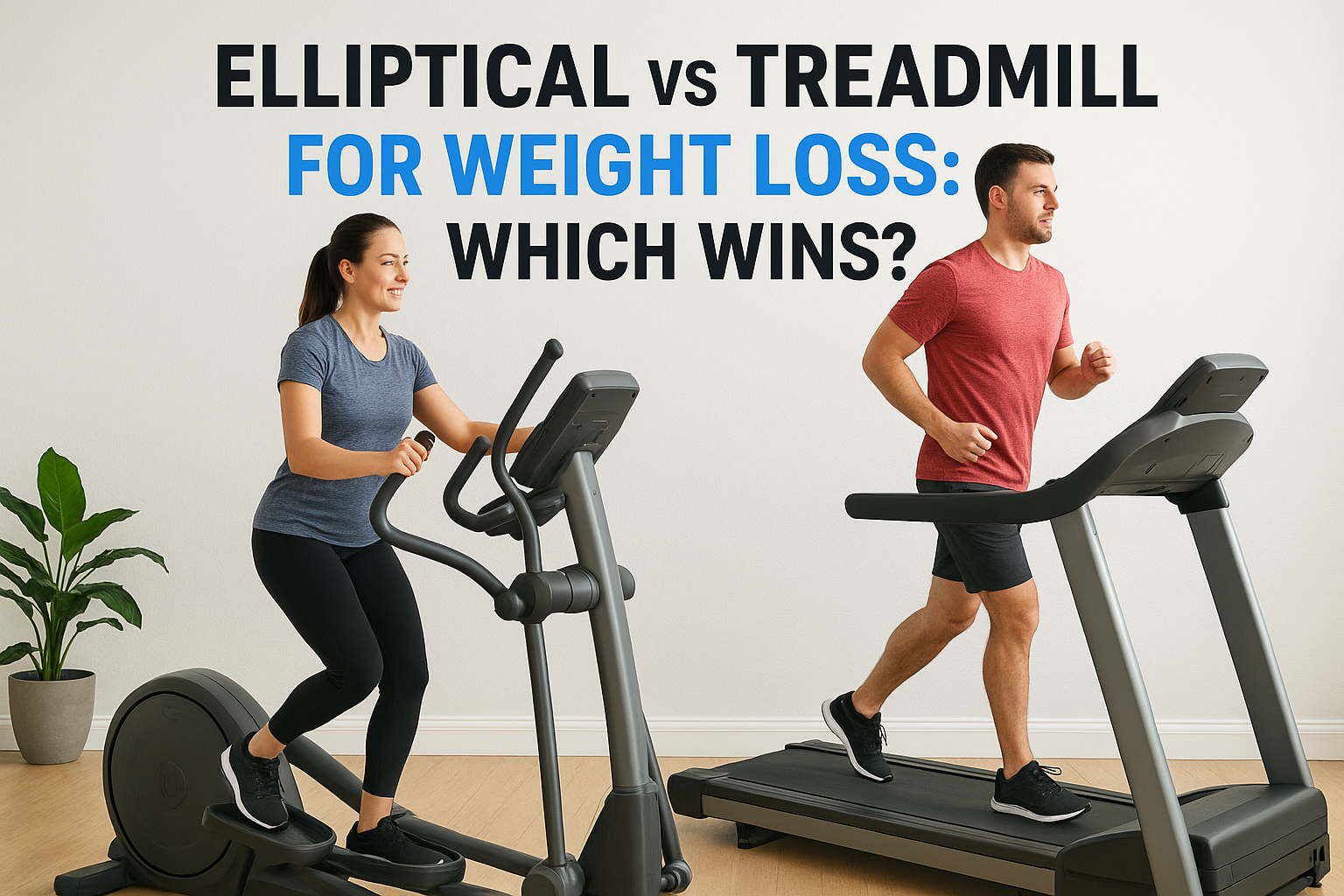
15 Sep Elliptical vs Treadmill for Weight Loss: Which Wins?
You want to lose weight and you’re staring down two machines at the gym, or trying to decide which one to buy for your home. The elliptical vs treadmill for weight loss debate comes up constantly, and the honest answer is more nuanced than either side wants to admit. Both burn calories. Both can help you drop pounds. But how they do it, and how well they fit your body and your habits, makes all the difference.
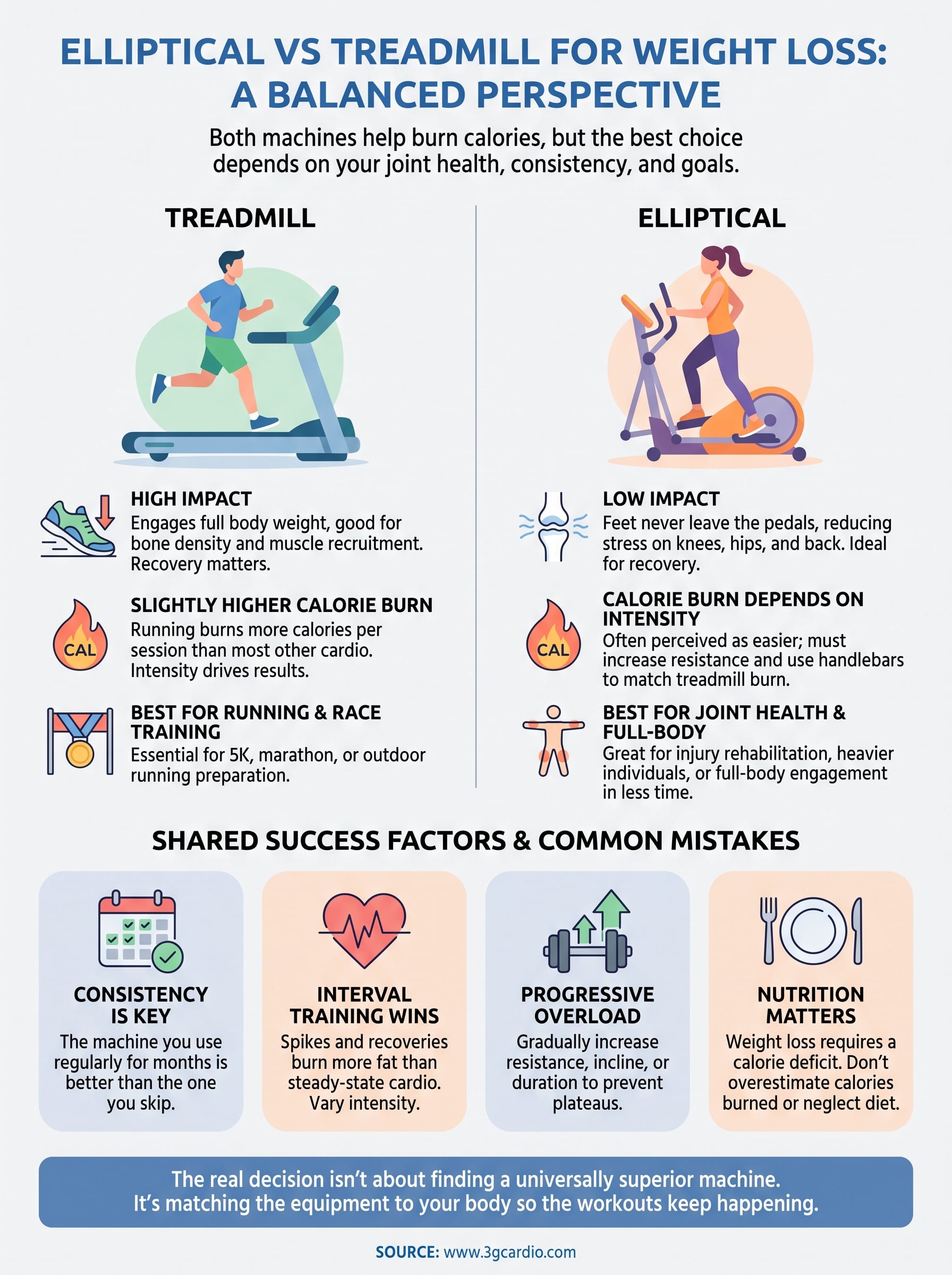
Here’s the short version: treadmills typically burn slightly more calories per session because running and walking engage your full body weight against gravity, while ellipticals offer a low-impact option that’s easier on your joints and lets many people push harder for longer. The machine that wins for you depends on your joint health, your consistency, and whether you’ll actually use it week after week.
In this article, we’ll break down the calorie-burning data, compare how each machine affects your joints and muscles, and help you figure out which one matches your fitness level and goals. We’ll also cover what to look for if you’re shopping for either type of equipment for home use.
Why your choice of cardio machine matters for weight loss
Weight loss comes down to a calorie deficit, but the machine you choose determines whether you’ll actually create and sustain that deficit over months, not just one workout. A treadmill session might torch 400 calories in 30 minutes, but if your knees ache the next day and you skip the gym for a week, that number means nothing. The right machine is the one that lets you show up consistently, because consistency beats intensity when you’re talking about long-term fat loss.
The best cardio machine for weight loss isn’t the one that burns the most calories in a single session, it’s the one you’ll still be using six months from now.
Impact levels change how your body recovers
Running on a treadmill is a high-impact activity. Each stride sends a force through your knees, hips, and lower back equal to roughly 2 to 3 times your body weight. That impact builds bone density and recruits more muscle, but it also means recovery time matters more. Ellipticals eliminate the impact almost entirely because your feet never leave the pedals, which is why physical therapists often recommend them for people rebuilding fitness after an injury or carrying extra weight that puts stress on their joints.
Muscle recruitment affects your metabolic rate
Treadmills mostly work your lower body: calves, quads, hamstrings, and glutes. Ellipticals with moving handlebars bring your arms, chest, and back into the movement too, and the muscles an elliptical works spread the workload across more muscle groups in a single session. More muscle recruitment during exercise translates to a slightly higher afterburn effect, the extra calories your body burns during recovery. This difference is small compared to what you eat, but it adds up over dozens of workouts.
Your history and goals point you toward one machine
Someone training for a 5K needs treadmill mileage no elliptical can replace. Someone with arthritic knees or 40+ pounds to lose often does better easing in on one of the machines built for joint-friendly training like an elliptical, then adding treadmill work later once their joints adapt. Here’s a quick way to think about it:
- Choose a treadmill like the Elite Runner X, built for real training miles if you have healthy joints, want to train for running events, or prefer the mental simplicity of walking or jogging.
- Choose an elliptical if you have joint pain, are returning from injury, are significantly overweight, or want a full-body workout in less time.
- Choose both if you have access to a gym or the space and budget for two machines, alternating them to reduce repetitive strain.
Models like the 3G Cardio Elite EM X elliptical are built specifically to bridge that gap, giving people who need low-impact training the resistance and stride adjustability to still get a demanding workout. The point isn’t finding a universally superior machine. It’s matching the equipment to your body so the workouts keep happening.
How to pick the right machine for your weight-loss goals
Picking between an elliptical and a treadmill, or any of the other home cardio machines that support fat loss, isn’t about which one science says burns more calories. It’s about which one fits your body, your schedule, and your living space well enough that you’ll actually stick with it. Ask yourself three questions before you buy or commit to a routine, alongside the specs worth checking on any treadmill: how do your joints handle impact, how much time can you realistically give this each week, and where will the machine live. Answering these honestly does more for your weight-loss results than any spec sheet.
Start with a joint and injury check
Your knees, hips, and lower back tell you almost everything you need to know. If you’ve had joint pain, a past ACL tear, or you’re carrying significant extra weight, a low-impact elliptical removes the pounding that a treadmill delivers with every stride. If your joints are healthy and pain-free, impact isn’t a dealbreaker, and you can consider either machine based on preference alone.
Choose the machine your joints can handle for years, not just the one that feels hardest today.
Match the machine to your schedule
Consistency depends on realistic time commitments, so it helps to know how long a cardio session should be for your goal. Someone squeezing in 20 minutes before work benefits from the elliptical’s full-body engagement, since it recruits your arms and core along with your legs, giving you more work in less time. Someone with 45 minutes to an hour, especially anyone training for a race, gets more specific benefit from treadmill mileage.
Think about where you’ll actually work out
Space and noise matter more than most buyers admit until after delivery. Treadmills need floor space for the belt and usually benefit from a mat to reduce vibration through the floor. Ellipticals take up a similar footprint but run quieter, which matters if you’re working out in an apartment or near a bedroom.
| Factor | Elliptical fits better | Treadmill fits better |
|---|---|---|
| Joint pain or injury history | Yes | Not ideal |
| Training for a run or race | No | Yes |
| Limited workout time | Yes | Depends |
| Noise-sensitive household | Yes | Less ideal |
Weigh these factors together rather than picking based on one alone, since the machine that checks the most boxes for your actual life is the one that supports lasting weight loss.
Elliptical vs treadmill: what the calorie-burn data shows
Numbers help settle arguments, so let’s look at what actual research and equipment data show. A 155-pound person burns roughly 335 calories in 30 minutes of moderate treadmill jogging (5 mph), compared to about 300 calories on an elliptical at a similar perceived effort, according to figures compiled by Harvard Health Publishing. Bump the treadmill up to a 6 mph run and that number climbs past 370 calories, a gap that widens as intensity increases. On paper, the treadmill wins the raw calorie count, but the story doesn’t end there.
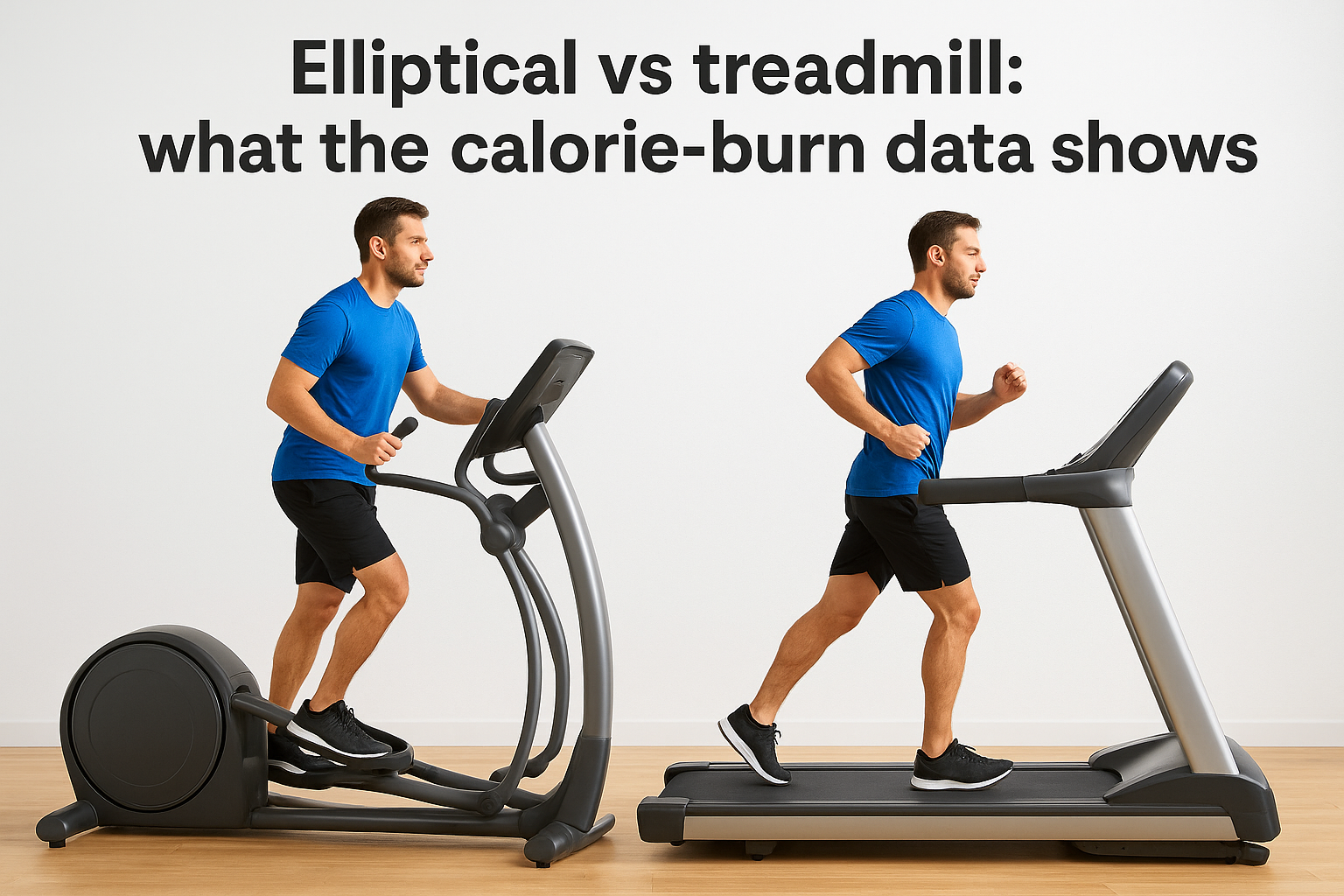
Raw calorie counts favor the treadmill, but the machine you can push hardest without pain often burns more calories over a real week of workouts.
Why perceived effort skews the comparison
Ellipticals feel easier at the same heart rate because the machine supports part of your body weight and eliminates the jarring impact of foot strikes. That means many people underestimate how hard they’re actually working on an elliptical, which is also why the calorie readout can look lower than the effort felt, and they hold back when they could push the resistance higher. Increase the resistance and incline settings on an elliptical, and you can match or exceed treadmill calorie burn while keeping the same low joint impact. This is where a lot of home buyers leave results on the table: they set the elliptical to an easy level and coast, instead of dialing up resistance the way they’d increase treadmill speed or incline.
Comparing calorie burn at moderate intensity
| Machine | Intensity | Calories burned (30 min, 155 lb person) |
|---|---|---|
| Treadmill (walking, 3.5 mph) | Light | 149 |
| Elliptical | Moderate | 300 |
| Treadmill (jogging, 5 mph) | Moderate | 335 |
| Treadmill (running, 6 mph) | Vigorous | 372 |
| Elliptical (high resistance) | Vigorous | 355 |
Source figures adapted from Harvard Health Publishing calorie-burn charts.
Notice how a vigorous elliptical session closes most of the gap with treadmill running. The takeaway isn’t that one machine is objectively better for burning calories. It’s that intensity settings, not the machine itself, drive most of the difference. If you’re comparing options for home use, look at how easily a machine lets you increase resistance or incline, since that adjustability determines whether you’ll actually reach the intensity these numbers assume.
Sample workouts that maximize fat burn on each machine
A good workout structure matters more than the machine badge on the console. Interval training beats steady-state cardio for fat loss on either machine because it spikes your heart rate, then lets it recover, which trains your body to burn calories more efficiently even after you’ve stepped off. Below are two workouts you can start using this week, one built for treadmills and one for ellipticals, both designed around the same interval principle.
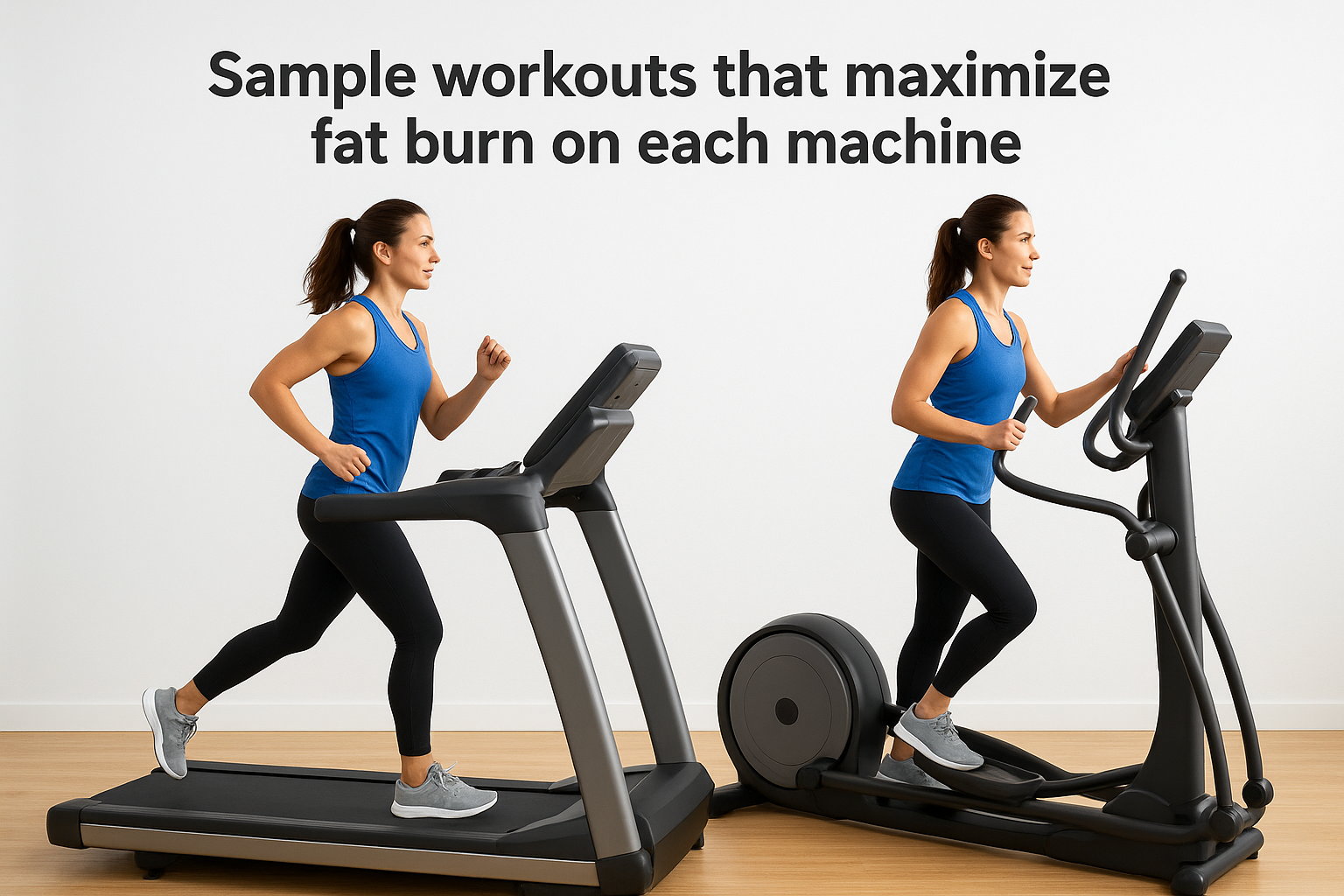
Structured intervals burn more fat in 25 minutes than an hour of coasting at the same easy pace.
A treadmill interval workout for fat loss
This workout takes 28 minutes and works for most fitness levels because you control the sprint intensity based on your own pace, and it slots neatly into a 4-week treadmill plan for weight loss.
- 5-minute walk warm-up at 3.0 mph
- 1-minute run at a pace that feels like a 7 out of 10 effort
- 2-minute walk recovery at 3.0 mph
- Repeat the run/walk cycle 6 times
- 5-minute cool-down walk, gradually slowing your pace
Bump the incline to 2 or 3 percent during the run intervals once this feels manageable. That small change recruits your glutes and hamstrings harder without adding joint stress the way speed increases do.
An elliptical interval workout for fat loss
Ellipticals let you adjust resistance instead of speed, which is the lever you should pull to raise your calorie burn without adding impact, and it anchors most elliptical sessions designed to burn calories.
- 5-minute warm-up at low resistance, moderate pace
- 90 seconds at high resistance, pushing hard through the handlebars
- 2-minute recovery at low resistance
- Repeat 6 times
- 5-minute cool-down at low resistance
On most 3G Cardio ellipticals, resistance adjusts in seconds right from the console, so you can move between intervals without breaking stride.
Why intervals outperform steady cardio for both machines
Steady, moderate cardio still burns calories, and it’s a fine option on rest days or when you’re short on time. But intervals create a bigger gap between your effort and your recovery, and that gap is where fat-burning gains come from. Whichever machine you choose, build your weekly routine around two or three interval sessions and one longer, easier session to balance intensity with recovery, and check how many cardio days a week fat loss really takes.
Common mistakes that slow your weight-loss progress
Most people who stall out on an elliptical or treadmill aren’t picking the wrong machine, they’re making avoidable errors that quietly cap their results. These mistakes show up on both machines, and fixing them matters more than which one you own.
The machine rarely fails you. The habits around it usually do.
Coasting at the same intensity every session
Setting the same speed or resistance level week after week is the single biggest reason people plateau. Your body adapts fast, often within two to three weeks, so a workout that once burned 350 calories starts burning less as your cardiovascular fitness improves. Progressive overload, meaning small increases in resistance, incline, or duration every couple of weeks, keeps your body working instead of gliding through a routine it has already mastered.
Ignoring what you eat after exercising
Overestimating calories burned is another common trap. A 30-minute session doesn’t earn you a 600-calorie snack, and this mismatch is why so many people work out consistently but never see the scale move. According to the CDC, sustainable weight loss depends far more on total daily calorie balance than on any single workout, so track your intake honestly rather than treating exercise as a free pass.
Skipping strength training entirely
Relying only on cardio, whether elliptical or treadmill, leaves muscle mass on the table, and weighing cardio against strength training shows muscle is what keeps your metabolism running higher at rest. Two short strength sessions a week, even just 20 minutes with dumbbells or resistance bands, protects the muscle you have while you’re in a calorie deficit.
Quitting when progress feels slow
Underestimating how long real fat loss takes leads plenty of people to quit right before results show up. Weight loss isn’t linear, and a stalled scale for two weeks doesn’t mean the elliptical vs treadmill for weight loss approach you chose has failed you. Give any consistent routine at least six to eight weeks before judging whether it’s working.
- Vary intensity every 2-3 weeks instead of repeating the same settings
- Log food intake instead of guessing at calories burned
- Add strength training twice weekly
- Commit to a minimum six-week trial before switching routines
Features that help a home cardio machine support fat loss
Buying a treadmill or elliptical for home use is a different decision than picking a machine at the gym, because now you’re stuck with whatever specs you chose. Certain features matter far more than flashy screens or preset workout animations when your actual goal is long-term fat loss. Look past the marketing and focus on what keeps you training hard and coming back for the next session.
Resistance and incline range you’ll actually use
Adjustable resistance on an elliptical, or incline on a treadmill, is what lets you keep progressing once your body adapts to a routine. A machine stuck at one or two resistance levels forces you into the same calorie burn ceiling every session, no matter how fit you get. Look for a wide, easy-to-adjust range so you can add difficulty gradually instead of hitting a wall after a month.
A machine with room to grow keeps working even after your fitness does.
Console connectivity that keeps workouts interesting
Boredom kills consistency faster than almost anything else. Consoles with Bluetooth connectivity, like the FreeSync™ FTMS machines that turn your own phone into the display, let you pair with fitness apps such as Kinomap and follow structured routes or interval programs instead of staring at a wall. Some buyers also want a tablet shelf so they can stream a show or follow along with a workout video, which matters more for adherence than most people expect going in.
Heart rate monitoring for smarter intensity
Guessing your effort level wastes the interval structure we covered earlier. A built-in heart rate monitor, or a wireless chest strap included with the machine, tells you exactly when you’ve hit the zone that drives fat loss instead of relying on a feel that changes day to day.
Comfort details that add up over months
Small design choices, like a cushioned deck on a treadmill or a wide, stable pedal on an elliptical, reduce fatigue and joint strain over hundreds of sessions. None of these features burn calories by themselves, but together they remove the friction that causes people to quit before results show up.
- Wide resistance or incline range for progressive overload
- Bluetooth console for app-based interval training
- Built-in or included heart rate monitoring
- Cushioned deck or stable pedals for long-term comfort
Finding the cardio routine that works for you
Neither machine wins outright in the elliptical vs treadmill for weight loss debate. Treadmills edge out ellipticals on raw calorie burn, but only if your joints tolerate the impact and you actually show up week after week. Ellipticals close that gap fast once you push resistance instead of coasting, and they keep you training when a treadmill would leave you sidelined with sore knees. The real decision comes down to your body, your schedule, and which machine you’ll still be using in six months.
Start by being honest about your joints and your available time, then build your workouts around intervals instead of steady, easy sessions. Progress your resistance or incline every few weeks so your results don’t stall out.
If you’re ready to bring one home, see the Elite EM X elliptical with its 3-level adjustable stride and 32 resistance levels, a low-impact machine built to keep pace with your fat-loss goals.




No Comments